
Practice Examples and Dumps & Tips for 2026 Latest CAPM Valid Tests Dumps
Latest [Mar 23, 2026] 100% Passing Guarantee - Brilliant CAPM Exam Questions PDF
PMI CAPM certification is highly valued by employers and can help professionals stand out in a competitive job market. Certified Associate in Project Management (CAPM) certification demonstrates that the individual has the knowledge and skills required to manage projects effectively and efficiently. It also shows a commitment to professional development and a willingness to learn and grow in the field of project management. Certified Associate in Project Management (CAPM) certification can lead to better job opportunities, higher salaries, and greater job security.
Exam Details
The PMI CAPM certification exam contains 150 multiple-choice questions. 15 of these items are the pretest ones that will not affect one’s final score and are used in the test for research purposes. The unscored questions are placed throughout the exam content randomly. The students will have three hours to complete their test. The exam is currently available in numerous languages, including such options as Arabic, Brazilian, Simplified & Traditional Chinese, English, German, French, Portuguese, Hebrew, Italian, Japanese, Russian, Korea, Turkish, and Spanish. While registering for the test, the individuals will be able to choose the language in which they would prefer to sit for it. The exam can be taken either online or at the nearest authorized testing center. Regardless of the delivery method, the exam will cost $225 for the PMI members and $300 for the non-members.
NEW QUESTION # 336
A graphic display of project team members and their reporting relationships is known as a:
- A. Responsibility assignment matrix (RAM).
- B. Project organization chart.
- C. Resource calendar.
- D. Resource breakdown structure (RBS).
Answer: B
Explanation:
Section: Volume B
Explanation/Reference:
Explanation:
Project organization charts. A project organization chart is a graphic display of project team members and their reporting relationships. It can be formal or informal, highly detailed or broadly framed, based on the needs of the project. For example, the project organization chart for a 3,000-person disaster response team will have greater detail than a project organization chart for an internal, twenty-person project.
NEW QUESTION # 337
Which statement describes the Monitor Communications process?
- A. Evaluates the differences between the communications management plan and the reality of communications in a project
- B. Ensures that project information is created, collected, and distributed in a timely and appropriate manner
- C. Develops an appropriate and plan for communication of project activities
- D. Ensures that the information needs of the project and the stakeholders are met
Answer: D
Explanation:
Section: Volume E
Explanation/Reference: https://www.oreilly.com/library/view/a-users-manual/9781118546604/xhtml/Chapter25.html
NEW QUESTION # 338
Power, urgency, and legitimacy are attributes of which stakeholder classification model?
- A. Salience
- B. Power/influence
- C. Power/interest
- D. Influence/impact
Answer: A
Explanation:
Section: Volume B
Explanation:
13.1.2.1 Stakeholder Analysis
Stakeholder analysis is a technique of systematically gathering and analyzing quantitative and qualitative information to determine whose interests should be taken into account throughout the project. It identifies the interests, expectations, and influence of the stakeholders and relates them to the purpose of the project. It also helps to identify stakeholder relationships (with the project and with other stakeholders) that can be leveraged to build coalitions and potential partnerships to enhance the project's chance of success, along with stakeholder relationships that need to be influenced differently at different stages of the project or phase.
Stakeholder analysis generally follows the steps described below:
Identify all potential project stakeholders and relevant information, such as their roles, departments,
interests, knowledge, expectations, and influence levels. Key stakeholders are usually easy to identify. They include anyone in a decision-making or management role who is impacted by the project outcome, such as the sponsor, the project manager, and the primary customer. Identifying other stakeholders is usually done by interviewing identified stakeholders and expanding the list until all potential stakeholders are included.
Analyze the potential impact or support each stakeholder could generate, and classify them so as to define
an approach strategy. In large stakeholder communities, it is important to prioritize the stakeholders to ensure the efficient use of effort to communicate and manage their expectations.
Assess how key stakeholders are likely to react or respond in various situations, in order to plan how to
influence them to enhance their support and mitigate potential negative impacts.
There are multiple classification models used for stakeholders analysis, such as:
Power/interest grid, grouping the stakeholders based on their level of authority ("power") and their level or
concern ("interest") regarding the project outcomes;
Power/influence grid, grouping the stakeholders based on their level of authority ("power") and their active
involvement ("influence") in the project;
Influence/impact grid, grouping the stakeholders based on their active involvement ("influence") in the project
and their ability to effect changes to the project's planning or execution ("impact"); and Salience model, describing classes of stakeholders based on their power (ability to impose their
will), urgency (need for immediate attention), and legitimacy (their involvement is appropriate).
NEW QUESTION # 339
Which of the following correctly explains the term "progressive elaboration'?
- A. Elaborate tracking of the project progress
- B. Elaborate tracking of the project specifications with a change control system
- C. Changing project specifications continuously
- D. Project specifications becoming more explicit and detailed as the project progresses
Answer: D
Explanation:
Section: Volume D
Explanation:
Progressive Elaboration. The iterative process of increasing the level of detail in a project management plan as greater amounts of information and more accurate estimates become available.
NEW QUESTION # 340
When cost variance is negative and schedule variance is positive, the project is:
- A. under budget and behind schedule.
- B. complete; all planned values have been earned.
- C. over budget and ahead of schedule.
- D. on schedule.
Answer: C
NEW QUESTION # 341
In which process group is the scope first defined?
- A. Initiating
- B. Controlling
- C. Planning
- D. Executing
Answer: A
NEW QUESTION # 342
Outputs of the Control Communications process include:
- A. expert judgment and change requests.
- B. project management plan updates and an issue log.
- C. organizational process asset updates and an issue log.
- D. work performance information and change requests.
Answer: D
Explanation:
Section: Volume B
Explanation:
4.4.1.5 Work Performance Information
Work performance information is the performance data collected from various controlling processes, analyzed in context, and integrated based on relationships across areas. Thus work performance data has been transformed into work performance information. Data in itself cannot be used in the decision-making process as it has only out-of-context meaning. Work performance information, however, is correlated and contextualized, and provides a sound foundation for project decisions.
Work performance information is circulated through communication processes. Examples of performance information are status of deliverables, implementation status for change requests, and forecasted estimates to complete.
9.4.1.4 Issue Log
Issues arise in the course of managing the project team. An issue log can be used to document and monitor who is responsible for resolving specific issues by a target date.
NEW QUESTION # 343
While executing a building construction project, the supplier may delay the delivery and increase the cost of materials due to new safety regulations. The team has identified an option to absorb the cost by reducing the lag for some of the tasks.
What should the team do to ensure that this situation is managed?
- A. Perform Quantitative Risk Analysis
- B. Plan Project Risk Management
- C. Implement Appropriate Response
- D. Perform Qualitative Risk Analysis
Answer: C
NEW QUESTION # 344
A new project was approved and the project manager is discussing the most suitable delivery approach with the project sponsor. Which three of the following are characteristics of a traditional project delivered using a linear delivery approach? (Choose three)
- A. Many expected simple scope change requests
- B. Few expected simple scope change requests
- C. Routine and repetitive activities
- D. Collocated project teams
- E. Use of established templates
Answer: B,C,E
NEW QUESTION # 345
A project it just beginning, and management creates a long list of potential stakeholders. Which statement about identifying and engaging stakeholders is correct?
- A. Stakeholder satisfaction should be identified immediately and managed as a project objective.
- B. The project manager should identify and deal with stakeholders only during the execution phase.
- C. Stakeholder satisfaction is the most important goal, and project objectives should be considered a secondary priority.
- D. The project manager should focus on project objectives and deal with stakeholders as a secondary priority.
Answer: A
NEW QUESTION # 346
Power, urgency, and legitimacy are attributes of which stakeholder classification model?
- A. Salience
- B. Power/influence
- C. Power/interest
- D. Influence/impact
Answer: A
NEW QUESTION # 347
The following chart contains information about the tasks in a project.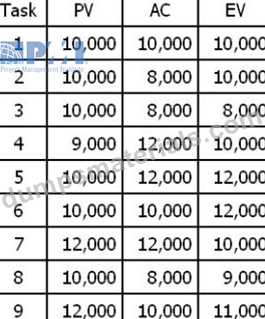
Based on the chart, what is the schedule performance index (5PI) for Task 4?
- A. 1.11
- B. 1.33
- C. 0.83
- D. 0.9
Answer: A
NEW QUESTION # 348
Which process involves determining, documenting, and managing stakeholders' needs and requirements to meet project objectives?
- A. Define Scope
- B. Collect Requirements
- C. Define Activities
- D. Plan Scope Management
Answer: B
Explanation:
Section: Volume B
Explanation:
Process: 5.2 Collect Requirements
Definition: The process of determining, documenting, and managing stakeholder needs and requirements to meet project objectives.
Key Benefit: The key benefit of this process is that it provides the basis for defining and managing the project scope including product scope.
Inputs
1. Scope management plan
2. Requirements management plan
3. Stakeholder management plan
4. Project charter
5. Stakeholder register
Tools & Techniques
1. Interviews
2. Focus groups
3. Facilitated workshops
4. Group creativity techniques
5. Group decision-making techniques
6. Questionnaires and surveys
7. Observations
8. Prototypes
9. Benchmarking
10.Context diagrams
11.Document analysis
Outputs
1. Requirements documentation
2. Requirements traceability matrix
NEW QUESTION # 349
An organizational structure that standardizes the project-related governance and facilitates the sharing of resources, methodologies, tools, and techniques is referred to as:
- A. Project Management System
- B. Project Management Office
- C. Project Management Knowledge Area
- D. Project Management Information System
Answer: B
Explanation:
Section: Volume E
Explanation/Reference: https://www.projectengineer.net/what-is-a-project-management-office/
NEW QUESTION # 350
A community project with a large number of stakeholders is scheduled for delivery in six months. The project manager asked the business analyst to ensure effective requirements elicitation. What should the business analyst do?
- A. Ask the project coordinator to facilitate some of the workshops.
- B. Invite both internal and external stakeholders to the workshops.
- C. Organize a workshop with the sponsor and major stakeholders.
- D. Engage a consultant that is familiar with the community needs.
Answer: B
NEW QUESTION # 351
The project manager is working in an agile/adaptive environment. The project manager is considering different approaches for applying Project Integration Management in this environment.
How can the project manager ensure that this will work for the project?
- A. Take control of all decisions and product planning
- B. Build a team that can respond to changes within a collaborative, decision-making environment
- C. Delegate project decisions to the product owner and sponsor
- D. Promote a team with a narrow specialization within a hierarchical environment
Answer: B
Explanation:
Explanation/Reference:
Reference: https://www.project-management-prepcast.com/project-integration-management-overview-part-
2
NEW QUESTION # 352
An input of the Plan Procurement Management process is:
- A. Seller proposals.
- B. Procurement documents.
- C. Activity cost estimates.
- D. Make-or-buy decisions.
Answer: C
Explanation:
Explanation/Reference:
Explanation:
7.2.3.1 Activity Cost Estimates
Activity cost estimates are quantitative assessments of the probable costs required to complete project work. Cost estimates can be presented in summary form or in detail. Costs are estimated for all resources that are applied to the activity cost estimate. This includes, but is not limited to, direct labor, materials, equipment, services, facilities, information technology, and special categories such as cost of financing (including interest charges), an inflation allowance, exchange rates, or a cost contingency reserve. Indirect costs, if they are included in the project estimate, can be included at the activity level or at higher levels.
Process: 12.1 Plan Procurement Management
Definition: The process of documenting project procurement decisions, specifying the approach, and identifying potential sellers.
Key Benefit: The key benefit of this process is that it determines whether to acquire outside support, and if so, what to acquire, how to acquire it, how much is needed, and when to acquire it.
Inputs
1. Project management plan
2. Requirements documentation
3. Risk register
4. Activity resource requirements
5. Project schedule
6. Activity cost estimates
7. Stakeholder register
8. Enterprise environmental factors
9. Organizational process assets
Tools & Techniques
1. Make-or-buy analysis
2. Expert judgment
3. Market research
4. Meetings
Outputs
1. Procurement management plan
2. Procurement statement of work
3. Procurement documents
4. Source selection criteria
5. Make-or-buy decisions
6. Change requests
7. Project documents updates
NEW QUESTION # 353
A team receives four different requests from separate stakeholders related to one application Match each requirement with its corresponding type of change request.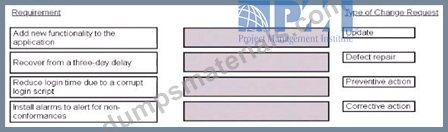
Answer:
Explanation: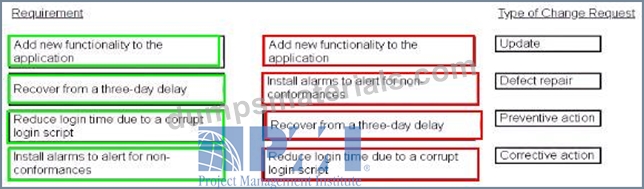
NEW QUESTION # 354
Which type of contract gives both the seller and the buyer flexibility to deviate from performance with financial incentives?
- A. Fixed Price Incentive Fee (FPIF)
- B. Cost Plus Incentive Fee (CPIF)
- C. Cost Pius Award Fee (CPAF)
- D. Time and Material (T&M)
Answer: A
Explanation:
Explanation/Reference:
Explanation:
Fixed Price Incentive Fee Contracts (FPIF). This fixed-price arrangement gives the buyer and seller some flexibility in that it allows for deviation from performance, with financial incentives tied to achieving agreed upon metrics. Typically such financial incentives are related to cost, schedule, or technical performance of the seller. Performance targets are established at the outset, and the final contract price is determined after completion of all work based on the seller's performance. Under FPIF contracts, a price ceiling is set, and all costs above the price ceiling are the responsibility of the seller, who is obligated to complete the work.
NEW QUESTION # 355
......
CAPM are Available for Instant Access: https://www.dumpsmaterials.com/CAPM-real-torrent.html
CAPM Certification – Valid Exam Dumps Questions Study Guide: https://drive.google.com/open?id=1ajL2k_N4IidpodNcZf5iBL4qvrZ0Drdm
