
Cisco 200-301 Questions and Answers Guarantee you Oass the Test Easily
Share Latest 200-301 DUMP with 898 Questions and Answers
Cisco 200-301 is a certification exam that is designed to test the candidate's knowledge of networking concepts, technologies, and best practices. 200-301 exam is conducted by Cisco and is a requirement for obtaining the Cisco Certified Network Associate (CCNA) certification. The CCNA certification is an industry-standard certification that validates the candidate's ability to install, configure, operate, and troubleshoot small to medium-sized networks.
To prepare for the Cisco 200-301 exam, candidates can take advantage of various resources, including Cisco’s official study materials, online courses, and practice exams. Candidates can also participate in study groups and online forums to discuss exam topics with other candidates and industry professionals. Hands-on experience with networking technologies and concepts is also a valuable asset when preparing for the exam.
NEW QUESTION # 259
What is true about Cisco Discovery Protocol?
- A. it is network layer protocol
- B. it is proprietary protocol
- C. it is physical and data link layer protocol
- D. it discovers the routers, switches and gateways.
Answer: B
NEW QUESTION # 260
What parameter can be different on ports within an EtherChannel?
- A. speed
- B. DTP negotiation settings
- C. duplex
- D. trunk encapsulation
Answer: B
NEW QUESTION # 261
Drag and drop the lightweight access point operation modes from the left onto the descriptions on the right
Answer:
Explanation:
Explanation
Table Description automatically generated
NEW QUESTION # 262
Drag and drop the threat-mitigation techniques from the left onto the types of threat or attack they mitigate on the right.
Answer:
Explanation:
Explanation
Double-Tagging attack:In this attack, the attacking computer generates frames with two 802.1Q tags. The first tag matches the native VLAN of the trunk port (VLAN 10 in this case), and the second matches the VLAN of a host it wants to attack (VLAN 20).When the packet from the attacker reaches Switch A, Switch A only sees the first VLAN 10 and it matches with its native VLAN 10 so this VLAN tag is removed. Switch A forwards the frame out all links with the same native VLAN 10. Switch B receives the frame with an tag of VLAN 20 so it removes this tag and forwards out to the Victim computer.Note: This attack only works if the trunk (between two switches) has the same native VLAN as the attacker.To mitigate this type of attack, you can use VLAN access control lists (VACLs, which applies to all traffic within a VLAN. We can use VACL to drop attacker traffic to specific victims/servers) or implement Private VLANs.ARP attack (like ARP poisoning/spoofing) is a type of attack in which a malicious actor sends falsified ARP messages over a local area network as ARP allows a gratuitous reply from a host even if an ARP request was not received. This results in the linking of an attacker's MAC address with the IP address of a legitimate computer or server on the network. This is an attack based on ARP which is at Layer 2.Dynamic ARP inspection (DAI) is a security feature that validates ARP packets in a network which can be used to mitigate this type of attack.
NEW QUESTION # 263
Refer to the exhibit.
If OSPF is running on this network, how does Router 2 handle traffic from Site B to 10.10.13/25 at Site A?
- A. It sends packets out of interface Fa0/1 only.
- B. It cannot send packets to 10.10.13 128/25
- C. It sends packets out of interface Fa0/2 only.
- D. It load-balances traffic out of Fa0/1 and Fa0/2
Answer: B
Explanation:
Router2 does not have an entry for the subnet 10.10.13.128/25. It only has an entry for 10.10.13.0/25, which ranges from 10.10.13.0 to 10.10.13.127.
https://study-ccna.com/administrative-distance-metric/
NEW QUESTION # 264
Refer to exhibit.
Which statement explains the configuration error message that is received?
- A. IT is a network IP address.
- B. The router does not support /28 mask.
- C. It is a broadcast IP address
- D. It belongs to a private IP address range.
Answer: C
NEW QUESTION # 265
Refer to the exhibit.
Which switch becomes the root of the spanning tree for VLAN 110?
- A. Switch 2
- B. Switch 1
- C. Switch 4
- D. Switch 3
Answer: A
NEW QUESTION # 266
Which CRUD operation corresponds to the HTTP GET method?
- A. update
- B. read
- C. delete
- D. create
Answer: B
Explanation:
GET: This method retrieves the information identified by the request URI. In the context of the RESTful web services, this method is used to retrieve resources. This is the method used for read operations (the R in CRUD).
https://hub.packtpub.com/crud-operations-rest/
NEW QUESTION # 267
Drag and drop the Cisco Wireless LAN Controller security settings from the left onto the correct security mechanism categories on the right.
Answer:
Explanation:
NEW QUESTION # 268
Refer to the exhibit.
Based on the LACP neighbor status, in which mode is the SW1 port channel configured?
- A. auto
- B. passive
- C. mode on
- D. active
Answer: B
NEW QUESTION # 269
Refer to Exhibit.
Refer to the exhibit. The router R1 is in the process of being configured. Routers R2 and R3 are configured correctly for the new environment. Which two commands must be configured on R1 for PC1 to communicate to all PCs on the 10.10.10.0/24 network? (Choose two.)
- A. ip route 10.10.10.8 255.255.255.248 g0/1
- B. ip route 10.10.10.0 255.255.255.248 192.168.2.2
- C. ip route 10.10.10.0 255.255.255.0 192.168.2.3
- D. ip route 10.10.10.10 255.255.255.255 192.168.2.2
- E. ip route 10.10.10.10 255.255.255.255 g0/1
Answer: B,C
NEW QUESTION # 270
Drag and drop the characteristics of network architectures from the left onto the type of architecture on the right.
Answer:
Explanation:

NEW QUESTION # 271
Which QoS tool is used to optimize voice traffic on a network that is primarily intended for data traffic?
- A. FIFO
- B. WFQ
- C. WRED
- D. PQ
Answer: D
Explanation:
Many popular QoS techniques that serve data traffic very well, such as WFQ and RED, are ineffective for voice applications.
FIFO (first-in, first-out). FIFO entails no concept of priority or classes of traffic. With FIFO, transmission of packets out the interface occurs in the order the packets arrive.
NEW QUESTION # 272
Which type of address is shared by routers in a HSRP implementation and used by hosts on the subnet as their default gateway address?
- A. loopback IP address
- B. virtual IP address
- C. multicast address
- D. broadcast address
Answer: B
NEW QUESTION # 273
Refer to the exhibit.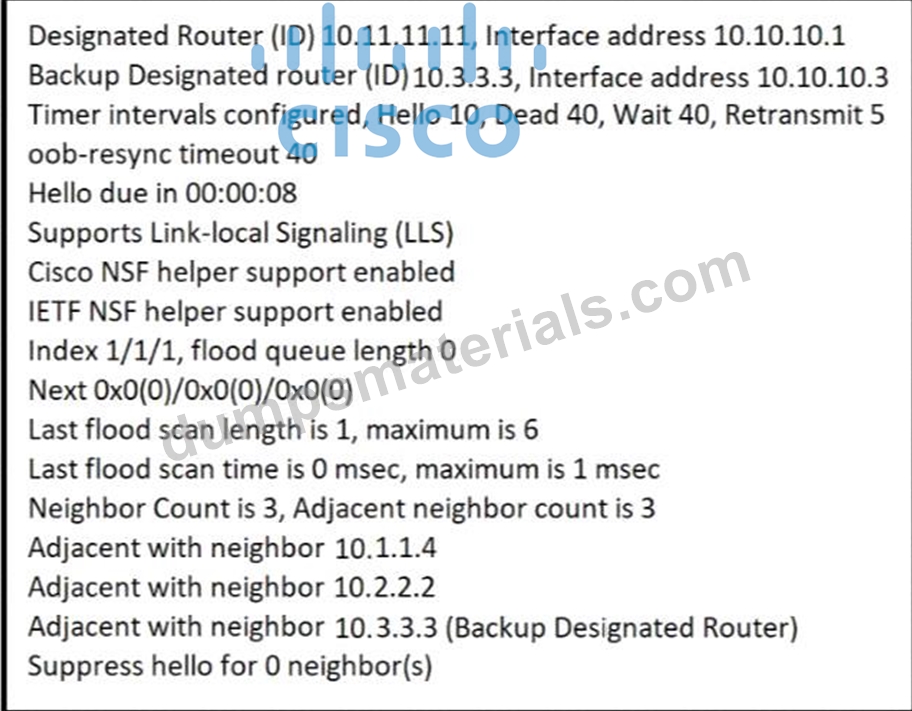
The show ip ospf interface command has been executed on R1 How is OSPF configured?
- A. There are six OSPF neighbors on this interface
- B. A point-to-point network type is configured
- C. The default Hello and Dead timers are in use
- D. The interface is not participating in OSPF
Answer: C
NEW QUESTION # 274
What does a router do when configured with the default DNS lookup settings, and a URL is entered on the CLI?
- A. prompts the user to specify the desired IP address
- B. initiates a ping request to the URL
- C. continuously attempts to resolve the URL until the command is cancelled
- D. sends a broadcast message in an attempt to resolve the URL
Answer: D
NEW QUESTION # 275
Which 802.11 management frame type is sent when a client roams between access points on the same SSID?
- A. Reassociation Request
- B. Authentication Request
- C. Association Request
- D. Probe Request
Answer: A
NEW QUESTION # 276
Which definition describes JWT in regard to REST API security?
- A. an encrypted JSON token that is used for authentication
- B. an encoded JSON token that is used for authentication
- C. an encrypted JSON token that is used for authorization
- D. an encoded JSON token that is used to securely exchange information
Answer: D
NEW QUESTION # 277
Refer to the exhibit.
An engineer configured NAT translations and has verified that the configuration is correct.
Which IP address is the source IP?
- A. 172.23.104.4
- B. 10.4.4.4
- C. 172.23.103.10
- D. 10.4.4.5
Answer: A
NEW QUESTION # 278
After a recent security breach and a RADIUS failure, an engineer must secure the console port of each enterprise router with a local username and password. Which configuration must the engineer apply to accomplish this task?
- A. Option B
- B. Option A
- C. Option C
- D. Option D
Answer: A
NEW QUESTION # 279
A network engineer is configuring an OSPFv2 neighbor adjacency Drag and drop the parameters from the left onto their required categories on the right. Not all parameters are used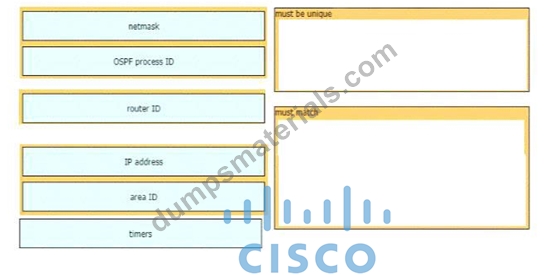
Answer:
Explanation:

NEW QUESTION # 280
......
Dumps for Free 200-301 Practice Exam Questions: https://www.dumpsmaterials.com/200-301-real-torrent.html
PDF Dumps 2023 Exam Questions with Practice Test: https://drive.google.com/open?id=14Kv3n35Tj_gCdvqToLbS4Mn7HxEVboYe
