
Verified Databricks-Certified-Data-Engineer-Associate Exam Dumps Q&As - Provide Databricks-Certified-Data-Engineer-Associate with Correct Answers
Pass Your Databricks-Certified-Data-Engineer-Associate Dumps Free Latest Databricks Practice Tests
The GAQM Databricks-Certified-Data-Engineer-Associate (Databricks Certified Data Engineer Associate) Certification Exam is designed to test an individual's knowledge and skills in using Databricks for data engineering tasks. Databricks Certified Data Engineer Associate Exam certification is highly recognized and respected in the industry and can be used as a benchmark for recruiters and employers to assess the candidate's proficiency in data engineering with Databricks.
GAQM Databricks-Certified-Data-Engineer-Associate is a certification exam designed to test the skills and knowledge of individuals in the field of data engineering. Databricks-Certified-Data-Engineer-Associate exam is created by GAQM, a leading global provider of certification programs for professionals in various industries. Databricks Certified Data Engineer Associate Exam certification is intended for those who work with Databricks and want to demonstrate their expertise in designing, building, and maintaining data pipelines using this technology.
NEW QUESTION # 48
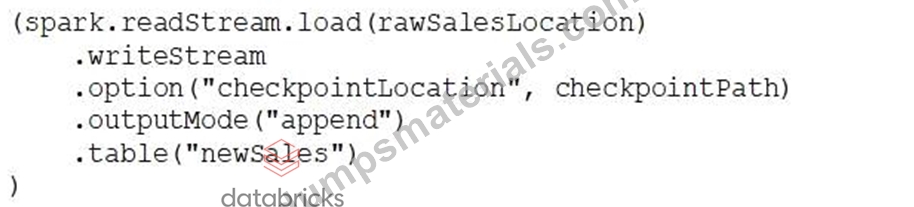
A data engineer has configured a Structured Streaming job to read from a table, manipulate the data, and then perform a streaming write into a new table.
The code block used by the data engineer is below:
If the data engineer only wants the query to process all of the available data in as many batches as required, which of the following lines of code should the data engineer use to fill in the blank?
- A. trigger(continuous="once")
- B. trigger(parallelBatch=True)
- C. trigger(processingTime="once")
- D. trigger(availableNow=True)
- E. processingTime(1)
Answer: D
Explanation:
https://spark.apache.org/docs/latest/api/python/reference/pyspark.ss/api/pyspark.sql.streaming.DataStreamWriter
NEW QUESTION # 49
A data engineer has a single-task Job that runs each morning before they begin working. After identifying an upstream data issue, they need to set up another task to run a new notebook prior to the original task.
Which of the following approaches can the data engineer use to set up the new task?
- A. They can create a new task in the existing Job and then add it as a dependency of the original task.
- B. They can create a new task in the existing Job and then add the original task as a dependency of the new task.
- C. They can create a new job from scratch and add both tasks to run concurrently.
- D. They can clone the existing task in the existing Job and update it to run the new notebook.
- E. They can clone the existing task to a new Job and then edit it to run the new notebook.
Answer: A
Explanation:
Explanation
To set up the new task to run a new notebook prior to the original task in a single-task Job, the data engineer can use the following approach: In the existing Job, create a new task that corresponds to the new notebook that needs to be run. Set up the new task with the appropriate configuration, specifying the notebook to be executed and any necessary parameters or dependencies. Once the new task is created, designate it as a dependency of the original task in the Job configuration. This ensures that the new task is executed before the original task.
NEW QUESTION # 50
A data engineer wants to create a data entity from a couple of tables. The data entity must be used by other data engineers in other sessions. It also must be saved to a physical location.
Which of the following data entities should the data engineer create?
- A. View
- B. Table
- C. Function
- D. Database
- E. Temporary view
Answer: A
NEW QUESTION # 51
A data engineer needs to apply custom logic to string column city in table stores for a specific use case. In order to apply this custom logic at scale, the data engineer wants to create a SQL user-defined function (UDF).
Which of the following code blocks creates this SQL UDF?
- A.

- B.

- C.

- D.

- E.

Answer: D
NEW QUESTION # 52
A data engineer and data analyst are working together on a data pipeline. The data engineer is working on the raw, bronze, and silver layers of the pipeline using Python, and the data analyst is working on the gold layer of the pipeline using SQL. The raw source of the pipeline is a streaming input. They now want to migrate their pipeline to use Delta Live Tables.
Which of the following changes will need to be made to the pipeline when migrating to Delta Live Tables?
- A. The pipeline will need to be written entirely in SQL
- B. The pipeline will need to be written entirely in Python
- C. None of these changes will need to be made
- D. The pipeline will need to stop using the medallion-based multi-hop architecture
- E. The pipeline will need to use a batch source in place of a streaming source
Answer: C
NEW QUESTION # 53
A data engineer needs to create a table in Databricks using data from a CSV file at location /path/to/csv.
They run the following command:
Which of the following lines of code fills in the above blank to successfully complete the task?
- A. FROM "path/to/csv"
- B. USING DELTA
- C. USING CSV
- D. FROM CSV
- E. None of these lines of code are needed to successfully complete the task
Answer: C
NEW QUESTION # 54
A data engineer needs to create a table in Databricks using data from their organization's existing SQLite database.
They run the following command:
Which of the following lines of code fills in the above blank to successfully complete the task?
- A. DELTA
- B. autoloader
- C. org.apache.spark.sql.sqlite
- D. org.apache.spark.sql.jdbc
- E. sqlite
Answer: D
Explanation:
CREATE TABLE new_employees_table
USING JDBC
OPTIONS (
url "<jdbc_url>",
dbtable "<table_name>",
user '<username>',
password '<password>'
) AS
SELECT * FROM employees_table_vw
https://docs.databricks.com/external-data/jdbc.html#language-sql
NEW QUESTION # 55
A data engineer has developed a data pipeline to ingest data from a JSON source using Auto Loader, but the engineer has not provided any type inference or schema hints in their pipeline. Upon reviewing the data, the data engineer has noticed that all of the columns in the target table are of the string type despite some of the fields only including float or boolean values.
Which of the following describes why Auto Loader inferred all of the columns to be of the string type?
- A. Auto Loader only works with string data
- B. All of the fields had at least one null value
- C. JSON data is a text-based format
- D. Auto Loader cannot infer the schema of ingested data
- E. There was a type mismatch between the specific schema and the inferred schema
Answer: C
Explanation:
Explanation
JSON data is a text-based format that uses strings to represent all values. When Auto Loader infers the schema of JSON data, it assumes that all values are strings. This is because Auto Loader cannot determine the type of a value based on its string representation. https://docs.databricks.com/en/ingestion/auto-loader/schema.html Forexample, the following JSON string represents a value that is logically a boolean: JSON "true" Use code with caution. Learn more However, Auto Loader would infer that the type of this value is string. This is because Auto Loader cannot determine that the value is a boolean based on its string representation. In order to get Auto Loader to infer the correct types for columns, the data engineer can provide type inference or schema hints. Type inference hints can be used to specify the types of specific columns. Schema hints can be used to provide the entire schema of the data. Therefore, the correct answer is B. JSON data is a text-based format.
NEW QUESTION # 56
Which of the following Structured Streaming queries is performing a hop from a Silver table to a Gold table?
- A.

- B.

- C.

- D.

- E.
Answer: B
NEW QUESTION # 57
A data engineer has configured a Structured Streaming job to read from a table, manipulate the data, and then perform a streaming write into a new table.
The cade block used by the data engineer is below: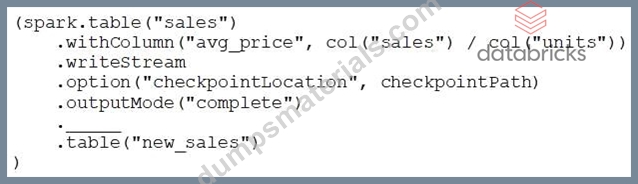
If the data engineer only wants the query to execute a micro-batch to process data every 5 seconds, which of the following lines of code should the data engineer use to fill in the blank?
- A. trigger()
- B. trigger(processingTime="5 seconds")
- C. trigger(once="5 seconds")
- D. trigger("5 seconds")
- E. trigger(continuous="5 seconds")
Answer: B
Explanation:
Explanation
# ProcessingTime trigger with two-seconds micro-batch interval
df.writeStream \
format("console") \
trigger(processingTime='2 seconds') \
start()
https://spark.apache.org/docs/latest/structured-streaming-programming-guide.html#triggers
NEW QUESTION # 58
A data engineer runs a statement every day to copy the previous day's sales into the table transactions. Each day's sales are in their own file in the location "/transactions/raw".
Today, the data engineer runs the following command to complete this task:
After running the command today, the data engineer notices that the number of records in table transactions has not changed.
Which of the following describes why the statement might not have copied any new records into the table?
- A. The PARQUET file format does not support COPY INTO.
- B. The previous day's file has already been copied into the table.
- C. The COPY INTO statement requires the table to be refreshed to view the copied rows.
- D. The names of the files to be copied were not included with the FILES keyword.
- E. The format of the files to be copied were not included with the FORMAT_OPTIONS keyword.
Answer: B
Explanation:
Explanation
https://docs.databricks.com/en/ingestion/copy-into/index.html The COPY INTO SQL command lets you load data from a file location into a Delta table. This is a re-triable and idempotent operation; files in the source location that have already been loaded are skipped. if there are no new records, the only consistent choice is C no new files were loaded because already loaded files were skipped.
NEW QUESTION # 59
In which of the following scenarios should a data engineer use the MERGE INTO command instead of the INSERT INTO command?
- A. When the source table can be deleted
- B. When the target table cannot contain duplicate records
- C. When the source is not a Delta table
- D. When the target table is an external table
- E. When the location of the data needs to be changed
Answer: B
Explanation:
Explanation
With merge , you can avoid inserting the duplicate records. The dataset containing the new logs needs to be deduplicated within itself. By the SQL semantics of merge, it matches and deduplicates the new data with the existing data in the table, but if there is duplicate data within the new dataset, it is inserted.https://docs.databricks.com/en/delta/merge.html#:~:text=With%20merge%20%2C%20you%20can%20a
NEW QUESTION # 60
Which of the following describes the type of workloads that are always compatible with Auto Loader?
- A. Dashboard workloads
- B. Machine learning workloads
- C. Serverless workloads
- D. Streaming workloads
- E. Batch workloads
Answer: D
Explanation:
Auto Loader is a Structured Streaming source that incrementally and efficiently processes new data files as they arrive in cloud storage. It supports both Python and SQL in Delta Live Tables, which are ideal for building streaming data pipelines. Auto Loader can handle near real-time ingestion of millions of files per hour and provide exactly-once guarantees when writing data into Delta Lake. Auto Loader is not designed for dashboard, machine learning, serverless, or batch workloads, which have different requirements and characteristics. Reference: What is Auto Loader?, Delta Live Tables
NEW QUESTION # 61
A data engineer is attempting to drop a Spark SQL table my_table. The data engineer wants to delete all table metadata and data.
They run the following command:
DROP TABLE IF EXISTS my_table
While the object no longer appears when they run SHOW TABLES, the data files still exist.
Which of the following describes why the data files still exist and the metadata files were deleted?
- A. The table was external
- B. The table was managed
- C. The table's data was smaller than 10 GB
- D. The table did not have a location
- E. The table's data was larger than 10 GB
Answer: A
Explanation:
Explanation
The reason why the data files still exist while the metadata files were deleted is because the table was external.
When a table is external in Spark SQL (or in other database systems), it means that the table metadata (such as schema information and table structure) is managed externally, and Spark SQL assumes that the data is managed and maintained outside of the system. Therefore, when you execute a DROP TABLE statement for an external table, it removes only the table metadata from the catalog, leaving the data files intact. On the other hand, for managed tables (option E), Spark SQL manages both the metadata and the data files. When you drop a managed table, it deletes both the metadata and the associated data files, resulting in a complete removal of the table.
NEW QUESTION # 62
A data engineer is attempting to drop a Spark SQL table my_table. The data engineer wants to delete all table metadata and data.
They run the following command:
DROP TABLE IF EXISTS my_table
While the object no longer appears when they run SHOW TABLES, the data files still exist.
Which of the following describes why the data files still exist and the metadata files were deleted?
- A. The table was external
- B. The table was managed
- C. The table's data was smaller than 10 GB
- D. The table did not have a location
- E. The table's data was larger than 10 GB
Answer: A
Explanation:
An external table is a table that is defined in the metastore and points to an existing location in the storage system. When you drop an external table, only the metadata is deleted from the metastore, but the data files are not deleted from the storage system. This is because external tables are meant to be shared by multiple applications and users, and dropping them should not affect the data availability. On the other hand, a managed table is a table that is defined in the metastore and also managed by the metastore. When you drop a managed table, both the metadata and the data files are deleted from the metastore and the storage system, respectively. This is because managed tables are meant to be exclusive to the application or user that created them, and dropping them should free up the storage space. Therefore, the correct answer is C, because the table was external and only the metadata was deleted when the table was dropped. Reference: Databricks Documentation - Managed and External Tables, Databricks Documentation - Drop Table
NEW QUESTION # 63
Which of the following describes the type of workloads that are always compatible with Auto Loader?
- A. Dashboard workloads
- B. Machine learning workloads
- C. Serverless workloads
- D. Streaming workloads
- E. Batch workloads
Answer: D
Explanation:
Auto Loader is a Structured Streaming source that incrementally and efficiently processes new data files as they arrive in cloud storage. It supports both Python and SQL in Delta Live Tables, which are ideal for building streaming data pipelines. Auto Loader can handle near real-time ingestion of millions of files per hour and provide exactly-once guarantees when writing data into Delta Lake. Auto Loader is not designed for dashboard, machine learning, serverless, or batch workloads, which have different requirements and characteristics. References: What is Auto Loader?, Delta Live Tables
NEW QUESTION # 64
A data engineer runs a statement every day to copy the previous day's sales into the table transactions. Each day's sales are in their own file in the location "/transactions/raw".
Today, the data engineer runs the following command to complete this task:
After running the command today, the data engineer notices that the number of records in table transactions has not changed.
Which of the following describes why the statement might not have copied any new records into the table?
- A. The PARQUET file format does not support COPY INTO.
- B. The previous day's file has already been copied into the table.
- C. The COPY INTO statement requires the table to be refreshed to view the copied rows.
- D. The names of the files to be copied were not included with the FILES keyword.
- E. The format of the files to be copied were not included with the FORMAT_OPTIONS keyword.
Answer: B
Explanation:
The COPY INTO statement is an idempotent operation, which means that it will skip any files that have already been loaded into the target table1. This ensures that the data is not duplicated or corrupted by multiple attempts to load the same file. Therefore, if the data engineer runs the same command every day without specifying the names of the files to be copied with the FILES keyword or a glob pattern with the PATTERN keyword, the statement will only copy the first file that matches the source location and ignore the rest. To avoid this problem, the data engineer should either use the FILES or PATTERN keywords to filter the files to be copied based on the date or some other criteria, or delete the files from the source location after they are copied into the table2. Reference: 1: COPY INTO | Databricks on AWS 2: Get started using COPY INTO to load data | Databricks on AWS
NEW QUESTION # 65
Which of the following describes the type of workloads that are always compatible with Auto Loader?
- A. Dashboard workloads
- B. Machine learning workloads
- C. Serverless workloads
- D. Streaming workloads
- E. Batch workloads
Answer: D
Explanation:
Explanation
Auto Loader is a feature of Databricks that simplifies and automates the process of loading streaming data into Delta Lake tables. Auto Loader can detect new and updated files in cloud storage and efficiently load them as micro-batches or as a continuous stream. Auto Loader is always compatible with streaming workloads, as it is designed to handle streaming sources such as Amazon S3, Azure Data Lake Storage Gen2, and Azure Blob Storage. The other types of workloads may or may not be compatible with Auto Loader, depending on the data source and the use case. References: The information can be referenced from Databricks documentation on Auto Loader: Auto Loader.
https://community.databricks.com/t5/data-engineering/practice-exams-for-databricks-certified-data-engineer/td-p
NEW QUESTION # 66
A data engineer is attempting to drop a Spark SQL table my_table. The data engineer wants to delete all table metadata and data.
They run the following command:
DROP TABLE IF EXISTS my_table
While the object no longer appears when they run SHOW TABLES, the data files still exist.
Which of the following describes why the data files still exist and the metadata files were deleted?
- A. The table was external
- B. The table was managed
- C. The table's data was smaller than 10 GB
- D. The table did not have a location
- E. The table's data was larger than 10 GB
Answer: A
Explanation:
An external table is a table that is defined in the metastore and points to an existing location in the storage system. When you drop an external table, only the metadata is deleted from the metastore, but the data files are not deleted from the storage system. This is because external tables are meant to be shared by multiple applications and users, and dropping them should not affect the data availability. On the other hand, a managed table is a table that is defined in the metastore and also managed by the metastore. When you drop a managed table, both the metadata and the data files are deleted from the metastore and the storage system, respectively. This is because managed tables are meant to be exclusive to the application or user that created them, and dropping them should free up the storage space. Therefore, the correct answer is C, because the table was external and only the metadata was deleted when the table was dropped. References: Databricks Documentation - Managed and External Tables, Databricks Documentation - Drop Table
NEW QUESTION # 67
......
Databricks Certified Data Engineer Associate certification exam is a valuable credential for data engineers who work with the Databricks platform. It demonstrates their mastery of data engineering concepts and their practical application using Databricks. Candidates who pass the exam receive a certificate that can help them advance their careers and gain recognition for their expertise.
Get Top-Rated Databricks Databricks-Certified-Data-Engineer-Associate Exam Dumps Now: https://www.dumpsmaterials.com/Databricks-Certified-Data-Engineer-Associate-real-torrent.html
Databricks-Certified-Data-Engineer-Associate Exam Dumps Pass with Updated Tests Dumps: https://drive.google.com/open?id=1byHEF0C1rIkGeV4rRMkd7G1wfEvizzpQ
