
Verified AD0-E117 exam dumps Q&As with Correct 52 Questions and Answers
Adobe AD0-E117 Test Engine PDF - All Free Dumps from DumpsMaterials
Adobe AD0-E117 Exam Syllabus Topics:
| Topic | Details |
|---|---|
| Topic 1 |
|
| Topic 2 |
|
| Topic 3 |
|
| Topic 4 |
|
| Topic 5 |
|
| Topic 6 |
|
| Topic 7 |
|
| Topic 8 |
|
NEW QUESTION 16
A media company wants to use AEM as content hub for multiple customer touch points:
* Brand-specific marketing websites hosted on AEM Sites
* Single Page Applications using headless content
* Native mobile applications
* Content offers in Adobe Target
The company wants to manage its content efficiently with its small editor staff. Text should be entered and reviewed only once, then reused for all touch points.
How should an Architect incorporate these requirements into a solution that leverages AEM Sites features?
A)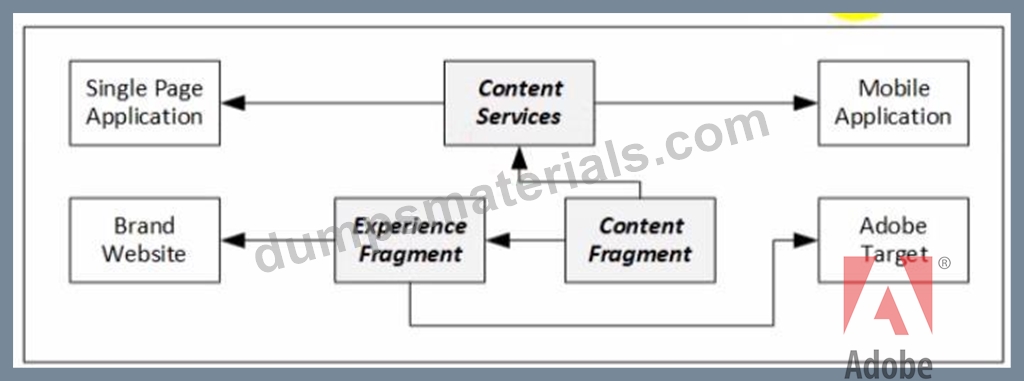
B)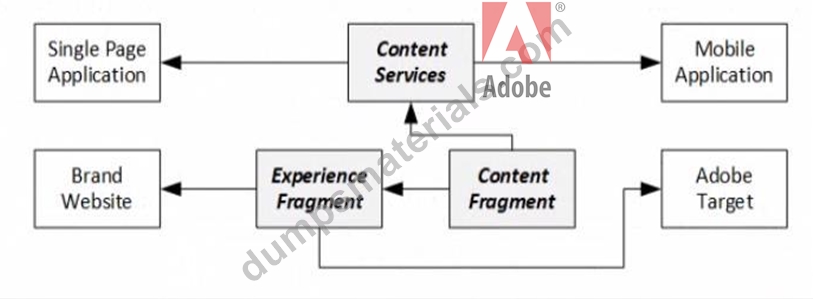
C)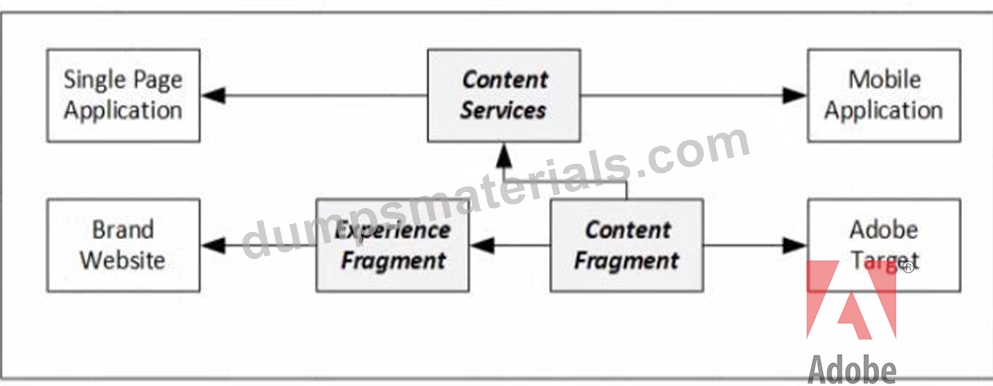
D)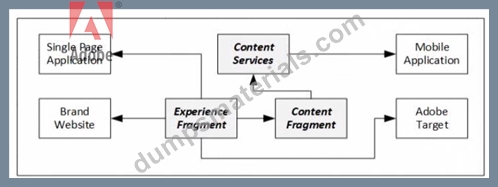
- A. OptionC
- B. OptionA
- C. OptionD
- D. OptionB
Answer: C
NEW QUESTION 17
A client is modernizing some of their AEM sites to go from static to editable templates so they can use the latest features around has the following parameters:
* The client currently has a dozen static templates that they want to move to editable templates.
* The existing pages use the parsys paragraph system for storing components.
* Each page based on one of the static templates has its own custom properties tab that is unique for that template type.
* The client wants template authors to be able to create the editable templates.
Which approach should an Architect use to meet these requirements?
- A. 1. Use the same page components for editable templates
2. Create a new editable template based on each of the existing page components - B. 1. Use a new page component for editable templates based on the core components page component
2. Migrate page properties to respective components dialogues - C. 1. Use the same page components for editable templates
2. Use a new template type for each static template - D. 1. Use a new page component for editable templates based on the core components page component
2. Convert page properties to policies
Answer: A
NEW QUESTION 18
A company is implementing a new e-commerce site that is expected to get seasonal and flash-sale induced traffic peaks from all over the world. It is projected that a minute of downtime could cause excessive lost revenue. The company management wants to keep resource utilization to optimal levels without experiencing degradation to avoid introducing bugs in the system.
The Architect needs to choose between AEM 6.5 and AEM as Cloud Service.
What are the two most critical non-functional requirements the Architect must consider? (Choose two.)
- A. Usability
- B. Availability
- C. Scalability
- D. Reliability
- E. Maintainability
Answer: A,C
NEW QUESTION 19
A company with various departments wants to use tagging to improve search capability. Each department is restricted to use its own tags. How should an Architect organize the tags?
- A. Create a department sub-tag in each tag
- B. Use department ID as a prefix of each tag
- C. Create tags in "departmentName:tagName" format
- D. Create a namespace for each department
Answer: D
NEW QUESTION 20
A financial sector client is using AEM 6.5 on premise. The creative team needs to create the content for the various marketing campaigns that are scheduled. The client wants to use Experience Fragments (XF) to accelerate content creation for marketing purposes.
Which Data flow diagram should an Architect use to communicate requirements to the client network team?
A)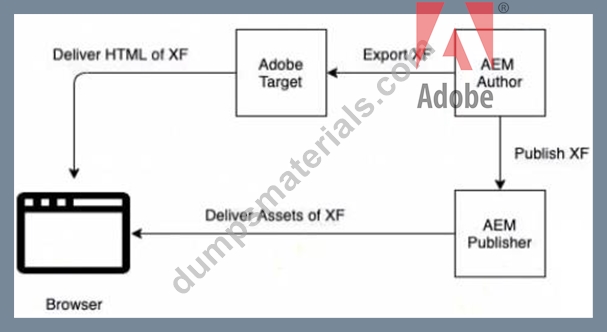
B)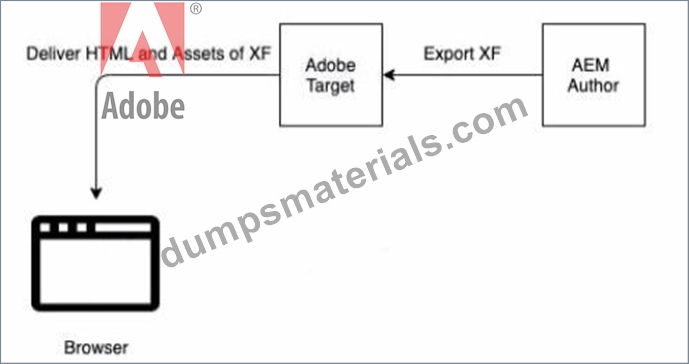
C)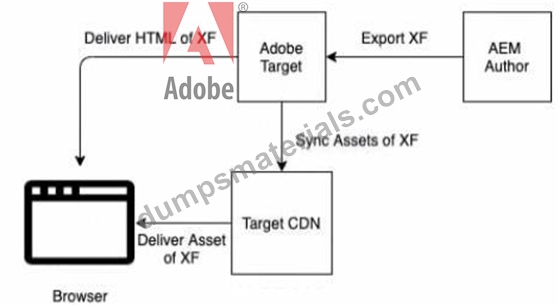
D)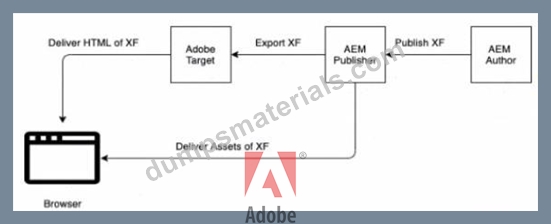
- A. OptionC
- B. OptionD
- C. OptionA
- D. OptionB
Answer: A
NEW QUESTION 21
A customer wants to simplify and automate publishing press pages and defines the following flows: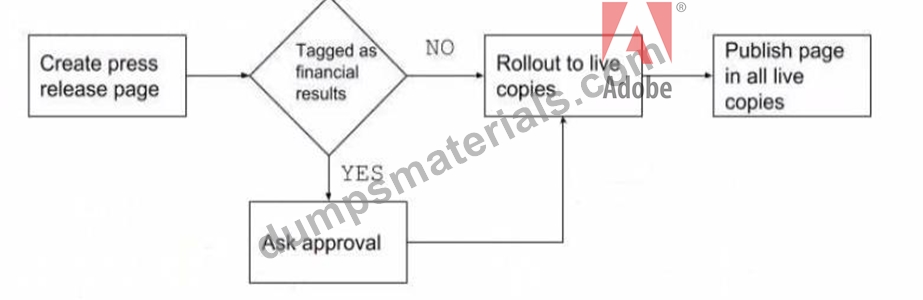
What should the Architect recommend?
- A. Advise the customer to use Launches
- B. Create a custom workflow
- C. Configure MSM with the "Activate on Blueprint activation" option
- D. Implement a Sling event listener that triggers on page creation
Answer: A
NEW QUESTION 22
During the implementation of a public-facing website based on AEM as a Cloud Service, the customer raises an additional requirement to have a commenting functionality for end users implemented on the pages.
What should the Architect do to make the design a future proof solution?
- A. Integrate a third-party solution to store comments externally
- B. Save comments in JCR and leverage reverse replication to synchronize comments via author
- C. Use MongoDB as provided with AEM as a Cloud Service to store the comments
- D. Save comments in JCR and leverage Sling Distribution to synchronize comments between publishers
Answer: C
NEW QUESTION 23
A customer has an international presence and a strong brand image. The customer considers the exceptional quality images used for both print and on the website to be essential for its business, The customer uses AEM
6.5 managed services with a configuration of 2 dispatchers, 2 publishers, and 1 author.
The original images can weigh up to 500Mb with videos weighing even more. Renditions are generated after files are uploaded to AEM DAM by the Design team so the Authoring team can use them on the website.
The teams report issues with platform stability and slowness. Visitors report that images look pixelated on some screens and pages are very slow to load.
Which two actions should the Architect take to resolve these issues? (Choose two.)
- A. Train the design team to upload smaller assets and save the originals elsewhere
- B. Split AEM Assets and Sites in two different stacks and use Connected Assets
- C. Add more dispatchers and publishers to the AEM configuration
- D. Allocate more memory to ImageMagick and FFmpeg
- E. Optimize renditions for the different viewports used by the visitors
Answer: A,B
NEW QUESTION 24
A customer's photo gallery site uses query parameters to filter photo search results. The site experiences high AEM Publish server load when users filter photos on the site. The customer would like to identify the cause of this issue.
What should the Architect investigate first?
- A. ignoreUrlParams configuration in dispatcher.any
- B. Dispatcher load balancing configuration
- C. Cache-Control Headers in dispatcher.any
- D. Volume of assets being loaded at a time
Answer: C
NEW QUESTION 25
A client's site does not show the latest page content for some site visitors. The client has two data centers with each configured with a Dispatcher connected to two Publish machines. The site load issue only occurs intermittently for visitors from one of the data centers.
Which step should the Architect take to resolve the issue?
- A. Check the Publish instance(s) attached to the Dispatcher associated to the impacted data center
- B. Review the log files on the Author instances to determine if there are any template errors
- C. Disable caching on all impacted data centers Dispatchers to force the Publish machines to serve the page content
- D. Check the SSL certificate on the impacted data center's load balance.
Answer: D
NEW QUESTION 26
A client using AEM 6.5 on-premise is experiencing an unsustainable repository growth of 100Gb a day. After investigation, an Architect finds out that the DAM is causing this issue. Each image uploaded to the DAM triggers the creation of approximately 100 renditions, necessary by business to consume in different channels and systems. The client also complains about stale content reported by site visitors happening randomly in pages where article-related components are present.
How should the Architect address these issues?
- A. Split WCM and DAM in separate instances, set up Connected Assets, and implement a workflow to purge all pages affected by an article change in Dispatcher
- B. Split WCM and DAM in separate instances, set up Connected Assets, and re-implement article-related components to use AJAX to load the content
- C. Leverage AEM Adaptive Image Servlet cache image variations in Dispatcher, and implement a cache TTL in Dispatcher
- D. Leverage AEM Adaptive Image Servlet, cache image variations in Dispatcher, and reimplement article-related components to use AJAX to load the content
Answer: B
NEW QUESTION 27
A client wants to change how they publish their content. Refer to the following client business requirements:
* The client has a seasonal business that has significant content changes across their site that need to be rolled out at once based on the season change over date.
* The content authors need to be able to work one season in advance of publish dates to ensure that all changes can be completed on time.
* The content authors need a way to indicate that all the seasonal changes are ready. If the content changes are not completed, then the pages should not get published.
* The content authors need the ability to modify the current live pages without rolling back changes for a future content rollout.
What approach should the Architect recommend?
- A. Use Launches inside of AEM for each new season and use the production ready flag to show changes are completed.
- B. Use the Versioning feature when editing a page to toggle and publish changes when ready.
- C. Use the Manage Publication with scheduling value set to the season change over date when changes are completed.
- D. Create a Project inside of AEM for each new season and create a task for notifying that changes are completed.
Answer: C
NEW QUESTION 28
Refer to the exhibit.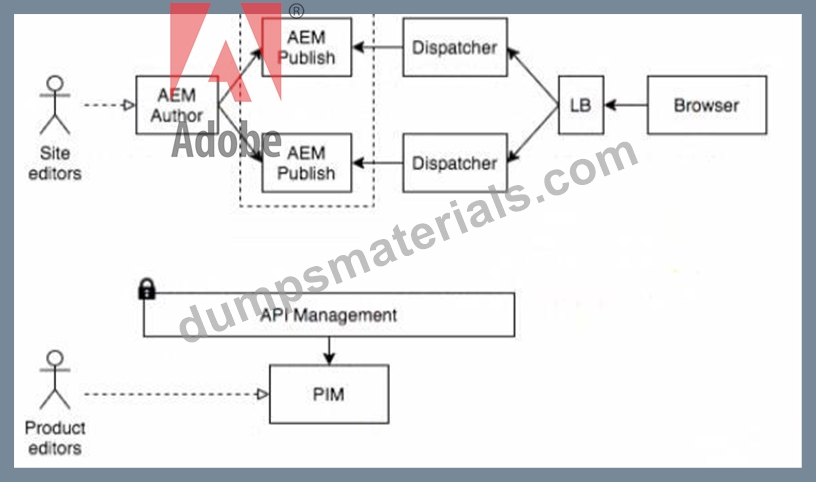
A customer with an existing AEM implementation wants to enrich product pages with technical data coming from their PIM system. The PIM system sits behind an API Management solution that publicly exposes the PIM API's as RESTful web services with basic authentication as the security mechanism. Data consistency with the PIM and secure access to the APIs are key elements of the integration.
How should the Architect set up the integration between AEM and the PIM?
- A. Convert the technical data to Content Fragments and expose using Content Services
- B. Use a client-side integration with AJAX from the browser to the API Management
- C. Integrate the AEM Publishers directly with the API Management solution
- D. Import the technical data into the AEM Author and replicate to Publishers
Answer: C
NEW QUESTION 29
A news agency editor wants to publish news articles to an intermediate Publish (preview) instance for internal review before publishing the article to production Publish instance.
Which two steps should the Architect recommend? (Choose two.)
- A. Create a closed user group (CUG) for editors
- B. Create a separate live copy to preview content
- C. Set up a new replication agent for preview server
- D. Create a reverse replication agent on preview server
- E. Create a custom publish workflow
Answer: B,D
NEW QUESTION 30
A client designs a new experience for one of their brand sites with the following parameters:
* The new experience should behave like a desktop application
* There is a lot of dynamic content in the app
* SEO and initial page load are a top concern for the client
* The client's marketing team needs to be able to author the content with a WYSIWYG editor Which approach should the Architect use to meet these requirements?
- A. Use the traditional server side components on the website
- B. Create a set of API-driven components
- C. Use AEM as a headless CMS
- D. Use the SPA Editor SDK with Server Side Rendering
Answer: B
NEW QUESTION 31
A retail customer with an international presence and both in-store and online sales needs a new assets platform. The customer decides to use AEM assets. The customer's sites will continue to run on their proprietary CMS for websites.
The customer wants to be able to scale the platform for spikes in user traffic such as on local sales or online marketing campaigns. Under some circumstances, the customer also has a higher load of editors for a certain period of time.
Which architecture should an Architect use for this business case?
- A. An AEM as a Cloud Service Sites with Dynamic Media
- B. An AEM Publish instance on Adobe Managed Services with auto scaling
- C. An AEM Assets setup on Adobe Managed Services with Cloud Manager
- D. An AEM as a Cloud Service Assets setup using the combined CDN for delivery
Answer: C
NEW QUESTION 32
A large retail customer is building their ecommerce platform on AEM. Several third-party vendors sell products through their site. Those vendors need to review and verify the content close to production before the content goes live and the customer wants to provide them a restricted environment.
Which approach should the Architect recommend?
- A. Give third-party vendors access to the Author Server
- B. Export content as PDF and share with the vendors
- C. Add a Publish (preview) Server and provide access
- D. Use the Preview Capabilities of AEM Author Server
Answer: C
NEW QUESTION 33
A client's marketing pages are generally slow to load which is causing a significant drop in sales. All other AEM pages load within expected performance guidelines regardless of whether the visitor is being served the desktop or mobile experiences.
The marketing pages typically get slower when multiple external campaigns such as Facebook and AdWords drive traffic to those pages. The page performance tends to dip during high traffic periods. Internal campaign clicks such as those from hero images use similar campaign codes as external campaign traffic.
What should the Architect do to resolve this issue?
- A. Add a new dispatcher farm to assist with the client's marketing pages
- B. Convert the marketing pages to a responsive design instead of an adaptive design
- C. Set AEM to use GZIP compression instead of the web server's compression
- D. Modify the dispatcher.any file's section to ignore campaign-based URL parameters
Answer: B
NEW QUESTION 34
A customer is migrating from their On-Premises AEM 6.4 instances to AEM as a Cloud Service. Next to the required code refactoring, a content migration of approximately 100,000 pages needs to be performed. The customer wants the content freeze period to be limited so that editors can continue to do content actions as long as possible.
Which two recommendations should the Architect make for the migration of the content pages? (Choose two.)
- A. Migrate the content using the Content Transfer Tool
- B. Ensure sufficient storage space on the On-Premise AEM instance
- C. Migrate the content using Lazy Content Migration approach
- D. Upscale the memory of the On-Premise AEM instance
- E. Migrate content deltas using a query-based packaging tool
Answer: B,D
NEW QUESTION 35
A client has an existing AEM site using components that proxy AEM WCM Core Components. The site uses simple page authoring without referenced content, The client wants to create a new experience on another marketing channel. The plan is to use as much of the existing page content as possible to avoid refactoring the current content and to maintain consistency across channels.
Which AEM capability should an Architect use to meet these requirements?
- A. Experience Fragments
- B. Sling Model Exporter
- C. Assets API
- D. Content Fragments
Answer: D
NEW QUESTION 36
......
100% Passing Guarantee - Brilliant AD0-E117 Exam Questions PDF: https://www.dumpsmaterials.com/AD0-E117-real-torrent.html
Get New AD0-E117 Certification – Valid Exam Dumps Questions: https://drive.google.com/open?id=174t2kgePw9yDigmkh6-ifc30RMd8mKla
