
Unique Top-selling 1z0-1035-22 Exams - New 2023 Oracle Pratice Exam
Intelligent Advisor Dumps 1z0-1035-22 Exam for Full Questions - Exam Study Guide
NEW QUESTION # 38
Your policy model has two entities: the applicant (Global) and the applicant's income.
What type of relationship does the text "the applicant's primary income" describe?
- A. one-to-one
- B. many-to-many
- C. one-to-many
- D. self-referential one-to-one
- E. many-to-one
Answer: A
NEW QUESTION # 39
You are working on a project where you need to develop a rule to calculate the currency attribute "the person's total monthly school cost". This attribute is calculated as follows: (1) Add "the annual cost of the tuition" and "the annual cost of lodging". (2) Subtract "the total annual scholarship amount" from the attributes previously summed. (3) Divide the result by 12.
How should you achieve this?
- A. the person's total monthly school cost = Sum(( the annual cost of the tuition, the annual cost of lodging) - the total annual scholarship amount))Div12
- B. the person's total monthly school cost = Sum(( the annual cost of the tuition + the annual cost of lodging), Subtract(the total annual scholarship amount)) /12
- C. the person's total monthly school cost = Sum((the annual cost of the tuition + the annual cost of lodging), Subtract(the total annual scholarship amount) /12
- D. the person's total monthly school cost = Sum(( the annual cost of the tuition, the annual cost of lodging) - the total annual scholarship amount)) /12
- E. the person's total monthly school cost = (( the annual cost of the tuition + the annual cost of lodging) - the total annual scholarship amount) /12
Answer: C
NEW QUESTION # 40
You are modeling policy material that states, "When the employee is late for work or intoxicated at work, the employee will be issued a formal warning and be required to provide a written explanation of their misconduct." Which two attributes should you create as the two conditions?
- A. when the employee is intoxicated at work
- B. the employee will be issued a formal warning and be required to provide a written explanation of their misconduct
- C. the employee was late for work
- D. the employee will be issued a formal warning
- E. when the employee is late for work
- F. the employee is required to provide a written explanation of the employee's misconduct
- G. the employee was intoxicated at work
- H. the employee was late for work or intoxicated at work
Answer: B,H
NEW QUESTION # 41
Refer to the exhibit.
You have created a policy model which adjust employee shift start and end times, to align with an existing payroll system.
If an employee clocked in at 09:22, what will the value of the adjusted employee's clock in time be?
- A. Uncertain
- B. 09:15
- C. 09:00
- D. 09:25
- E. 10:00
- F. 09:30
- G. 09:20
Answer: F
NEW QUESTION # 42
You are working on a new project with other policy modelers to build an interview where data will be saved to a connected application. Each policy modeler, including yourself, is working from their own machine. Place these development steps in order from first to last step undertaken. If a step is undertaken multiple times, note only the first time the step is taken. Some development steps have been omitted.
1: Deploy the project.
2: Add the project to a repository.
3: Download policy modeling.
4: Review the work of other policy modelers.
5: View interview usage statistics.
6: Map data to the data source.
7: Add connections.
8: Download changes.
9: Log in to the Hub.
- A. 2 > 7 > 6 > 3 > 9 > 8 > 4 > 1> 5
- B. 9 > 7 > 3 > 2 > 8 > 4 > 6 > 1 > 5
- C. 9 > 3 > 7 > 6 > 1 > 5 > 8 > 4> 2
- D. 9 > 2 > 7 > 6 > 3 > 8 > 4 > 1 > 5
- E. 9 > 7 > 3 > 8 > 4 > 6 > 5 > 1> 2
Answer: D
NEW QUESTION # 43
Refer to the exhibit.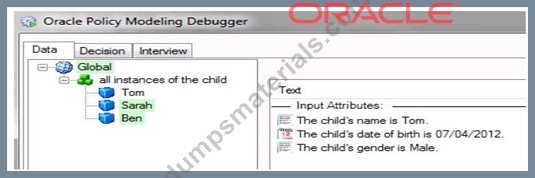
Assuming each child has a unique date of birth, which set of Policy Modeling functions should you use to determine the same of the youngest female child?
- A. InstanceMinimumIf, InstanceValueIf
- B. InstanceValueIf, InstanceMinimum
- C. Exists, InstanceMinimumIf
- D. Minimum, InstanceValue
- E. ForAll, InstanceValueIf
Answer: A
NEW QUESTION # 44
Which two statements about connectors and grouping operators are correct?
- A. AND and OR connectors must always be on separate lines to the attributes they are connecting.
- B. The grouping operator sits at the same level as the conditions it is grouping.
- C. Grouping operators reduce ambiguity in rules.
- D. The ALL grouping operator sits at the same level as the conditions it is grouping.
- E. A rule may contain AND and OR connectors.
Answer: A,E
NEW QUESTION # 45
You need to implement rules for a mapping table to determine "the region of the applicant" and "the applicant is from an English-speaking country" based on "the country of the applicant". You decide to implement it as a rule table in Excel. You defined three Legend Keys on your Declarations tab, one called Region, one called Country and one called English Speaking. You want to use the legend test in your rule table.
What text should you enter in the top-left cell of your rule table that is in OPM - Condition Heading style?
- A. Region
- B. the applicant is from an English-speaking country
- C. the country of the applicant = Country
- D. Country
- E. English Speaking
- F. the country of the applicant
- G. the region of the applicant = Region
- H. the country of the applicant is English speaking
- I. Condition
Answer: I
NEW QUESTION # 46
The source material for your policy model says:
To be eligible for the program, there must be at least one child in the family under 18 years of age. The payment amount for the family is based on the total income of all family members. If a family member has multiple jobs, include income from all jobs.
Which two steps should you perform?
- A. Create an interred entity for "the job" to allow for family members with multiple jobs.
- B. Create two entities: the family member, the family member's age.
- C. Create two entities: the family member, the family member's job.
- D. Use an entity function to calculate a family member's total income from all their jobs.
- E. Create three attributes (the first job, the second job, the third job) to allow for family members with multiple jobs.
- F. Create three entities: the family member, the family member's age, the family member's job.
Answer: B,E
NEW QUESTION # 47
You have a number attribute "the child's age in years". In an interview, you want to ensure that the user is only able to enter ages between 0 and 15.
What are the three methods to achieve this?
- A. Write a warning event rule.
- B. Create a number value list with the allowed ages, then associate the list with the child's age attribute.
- C. Use a regular expression within the Edit Attribute dialog box.
- D. Specify the maximum and minimum values within the Edit Attribute dialog box.
- E. Write an error event rule.
Answer: B,D,E
NEW QUESTION # 48
Which three actions will help avoid or identify a multiply proven attribute error?
- A. Use the "Go To" option in Word to see if the attribute is proven in another rule.
- B. Right-click the attribute on the Data tab to see if the attribute is proven in another rule.
- C. Double-click the attribute on the Interview tab to see if the attribute is used on multiple screens.
- D. Right-click the attribute on the Project tab to see if the attribute is used in multiple forms.
- E. Check the error list on the Rules tab for multiply proven attribute errors.
Answer: B,D,E
NEW QUESTION # 49
You have removed an entity instance in the Debugger using the Delete instance option shown. You also want to delete the single entity instance belonging to the relationship "the brands" using the same method.
Why can't you do this?
- A. The entity instance is inferred, and can only be deleted using the Decision tab in the Debugger.
- B. The entity instance can only be removed using the Interview tab in the Debugger.
- C. The entity instance is inferred, and can only be deleted by modifying the rules or attribute values which caused it to be created.
- D. At least one entity instance of the relationship "the brands" must be retained.
Answer: C
NEW QUESTION # 50
A student admissions system must capture multiple study preferences for a prospective student. Each preference includes a preferred campus. If the student is electing to study at the Sydney campus, then the student should be asked accommodation questions.
Which condition should you use to conclude that "the student should be asked the accommodation questions"?
- A. InstanceCount (the preferences, the preference's campus) = "Sydney"
- B. Exists (the preferences, the preference's campus = "Sydney")
- C. Exists (the preferences, the preference's campus) = "Sydney"
- D. InstanceEquals (the preferences, the preference's campus) = "Sydney"
- E. ValueAt (the preferences, the preference's campus = "Sydney")
Answer: A
NEW QUESTION # 51
You created an entity called "the person". You have written the following rule:
You test your rules in the Debugger with three entity instances of the person:
- Jane is not homeless; Jane's score is 3.
- Bill is homeless; Bill's score is 1.
- Angela is not homeless; Angela's score is 2.
What is the total score of all the persons who are eligible?
- A. Five
- B. Four
- C. Zero
- D. Six
- E. Three
- F. Two
- G. One
Answer: B
NEW QUESTION # 52
Which three options will result in an error due to incorrect use of grouping operators?
- A. Option F
- B. Option C
- C. Option A
- D. Option D
- E. Option B
- F. Option E
Answer: A,B,C
NEW QUESTION # 53
You have a source material for your policy model that reads as follows:
"Only families who meet the minimum work and education requirement are eligible for the competitiveness credit. A family meets the work and education requirement if all of its members are either gainfully employed or enrolled in a full-time study program. Families in which a member does not meet the requirement but is actively searching for a job can apply for a waiver".
Which statement describes the entity structure that your policy model should have?
- A. Create an entity for "the family member" and use the global entity.
- B. Create an entity for "the family member" and an entity for "the family".
- C. Create an entity for "the family member" an entity for "the family", and an entity for "the minimum work and education requirement".
- D. The rules will infer the necessary entities by using automatic data types.
Answer: C
NEW QUESTION # 54
Which two options require custom development with the OPA Mobile SDK?
- A. synchronizing data collected in OPA Mobile with a custom back-end system
- B. incorporating OPA Mobile interviews into composite mobile applications
- C. running OPA Mobile interviews while offline
- D. running OPA Mobile on Android devices
- E. adding an upload control to a OPA Mobile interview screen
Answer: A,B
NEW QUESTION # 55
Which two statements comply with the principles for writing Boolean attributes in Policy Modeling?
- A. the product manufacture date
- B. the applicant has provided proof of their identity and signed the declaration
- C. the customer order does not qualify for free shipping
- D. the employee is eligible for retirement
- E. nobody attended the team meeting
Answer: B,C
NEW QUESTION # 56
You have an entity called "the child". You have three attributes called "the child's score," "the lowest score of all the children," and "the number of children scoring more than ten." You want to write two rules to infer the lowest score of all the children and the number of children scoring more than ten without creating any additional attributes in the child entity.
Which two entity functions do you need to use?
- A. InstanceSum
- B. InstanceMinimumIf
- C. InstanceMaximumIf
- D. InstanceMaximum
- E. InstanceCount
- F. InstanceSumIf
- G. InstanceMinimum
- H. InstanceCountIf
Answer: A,D
NEW QUESTION # 57
Refer to the exhibit.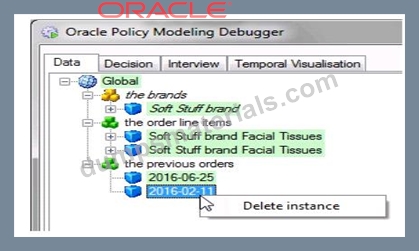
You have removed an entity instance in the Debugger using the Delete instance option shown. You also want to delete the single entity instance belonging to the relationship "the brands" using the same method.
Why can't you do this?
- A. The entity instance is inferred, and can only be deleted using the Decision tab in the Debugger.
- B. The entity instance can only be removed using the Interview tab in the Debugger.
- C. The entity instance is inferred, and can only be deleted by modifying the rules or attribute values which caused it to be created.
- D. At least one entity instance of the relationship "the brands" must be retained.
Answer: C
NEW QUESTION # 58
In the line covered by the red block, which two grouping operators would allow the rule to compile without error?
- A. "any" in style OPM - level 3
- B. "both" in style OPM - level 4
- C. "all" in style OPM - level 3
- D. "both" in style OPM - level 3
- E. "ForAll" in style OPM - level 3
- F. "ForAll" in style OPM - level 4
- G. "all" in style OPM - level 4
- H. "any" in style OPM - level 4
Answer: A,C
NEW QUESTION # 59
......
Best way to practice test for Oracle 1z0-1035-22: https://www.dumpsmaterials.com/1z0-1035-22-real-torrent.html
