
Get 100% Passing Success With True XK0-005 Exam! [Mar-2025]
CompTIA XK0-005 PDF Questions - Exceptional Practice To CompTIA Linux+ Certification Exam
The Linux+ certification exam is designed by CompTIA, a leading provider of IT certifications. CompTIA has been providing IT certifications for over 30 years and is recognized worldwide for its high-quality certification programs. The Linux+ certification is one of CompTIA's most popular certifications and has been recognized by industry experts for its comprehensive coverage of Linux concepts.
NEW QUESTION # 46
A Linux administrator cloned an existing Linux server and built a new server from that clone. The administrator encountered the following error after booting the cloned server:
The administrator performed the commands listed below to further troubleshoot and mount the missing filesystem: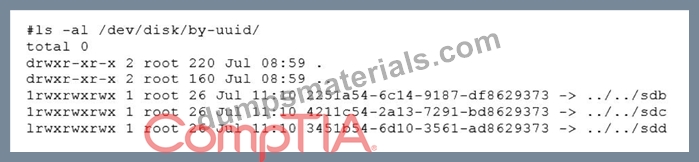
Which of the following should administrator use to resolve the device mismatch issue and mount the disk?
- A. mount disk by-label
- B. mount disk by-blkid
- C. mount disk by device-id
- D. fsck -A
Answer: C
Explanation:
The administrator should use the command mount disk by device-id to resolve the device mismatch issue and mount the disk. The issue is caused by the cloned server having a different device name for the disk than the original server. The output of blkid shows that the disk has the device name /dev/sdb1 on the cloned server, but the output of cat /etc/fstab shows that the disk is expected to have the device name /dev/sda1. The command mount disk by device-id will mount the disk by using its unique identifier (UUID) instead of its device name. The UUID can be obtained from the output of blkid or lsblk -f. The command will mount the disk to the specified mount point (/data) and resolve the issue. The other options are incorrect because they either do not mount the disk (fsck -A), do not use the correct identifier (mount disk by-label or mount disk by- blkid), or do not exist (mount disk by-blkid). References: CompTIA Linux+ (XK0-005) Certification Study Guide, Chapter 10: Managing Storage, pages 318-319.
NEW QUESTION # 47
A systems administrator needs to clone the partition /dev/sdc1 to /dev/sdd1.
Which of the following commands will accomplish this task?
- A. rsync /dev/sdc1 /dev/sdd1
- B. scp /dev/sdc1 /dev/sdd1
- C. dd if=/dev/sdc1 of=/dev/sdd1
- D. tar -cvzf /dev/sdd1 /dev/sdc1
Answer: C
Explanation:
The command dd if=/dev/sdc1 of=/dev/sdd1 copies the data from the input file (if) /dev/sdc1 to the output file (of) /dev/sdd1, byte by byte. This is the correct way to clone a partition. The other options are incorrect because they either compress the data (tar -cvzf), synchronize the files (rsync), or copy the files over a network (scp), which are not the same as cloning a partition.
NEW QUESTION # 48
A systems administrator wants to delete app.conf from a Git repository. Which of the following commands will delete the file?
- A. git rm app.conf
- B. git tag app.conf
- C. git commit app.conf
- D. git checkout app.conf
Answer: A
Explanation:
To delete a file from a Git repository, the administrator can use the command git rm app.conf (D).
This will remove the file "app.conf" from the working directory and stage it for deletion from the repository. The administrator can then commit the change with git commit -m "Delete app.conf" to finalize the deletion. The other commands will not delete the file, but either tag, commit, or checkout the file.
NEW QUESTION # 49
A newly created container has been unable to start properly, and a Linux administrator is analyzing the cause of the failure. Which of the following will allow the administrator to determine the FIRST command that is executed inside the container right after it starts?
- A. docker info <container_id>
- B. docker inspect <container_id>
- C. docker export <container_id>
- D. docker start <container_id>
Answer: B
Explanation:
The command that will allow the administrator to determine the first command that is executed inside the container right after it starts is docker inspect <container_id>. This command will display detailed information about the container, including its configuration, state, network settings, mounts, and logs. One of the configuration fields is "Entrypoint", which shows the command that is executed when the container is run. The entrypoint can be specified in the Dockerfile or overridden at runtime using the --entrypoint option.
The other options are not correct commands for determining the first command that is executed inside the container. The docker export <container_id> command will export the contents of the container's filesystem as a tar archive to STDOUT. This will not show the entrypoint of the container, but only its files. The docker info <container_id> command is invalid because docker info does not take any arguments. It shows system-wide information about Docker, such as the number of containers, images, volumes, networks, and storage drivers. The docker start <container_id> command will start a stopped container and attach its STDOUT and STDERR to the terminal. This will not show the entrypoint of the container, but only its output. Reference: docker inspect | Docker Docs; docker export | Docker Docs; docker info | Docker Docs; docker start | Docker Docs
NEW QUESTION # 50
Which of the following technologies can be used as a central repository of Linux users and groups?
- A. PAM
- B. MFA
- C. SSO
- D. LDAP
Answer: D
Explanation:
LDAP stands for Lightweight Directory Access Protocol, which is a protocol for accessing and managing a central directory of users and groups. LDAP can be used as a central repository of Linux users and groups, allowing for centralized authentication and authorization across multiple Linux systems. MFA, SSO, and PAM are not technologies that can be used as a central repository of Linux users and groups. MFA stands for Multi-Factor Authentication, which is a method of verifying a user's identity using more than one factor, such as a password, a token, or a biometric. SSO stands for Single Sign-On, which is a feature that allows a user to log in once and access multiple applications or systems without having to re-enter credentials. PAM stands for Pluggable Authentication Modules, which is a framework that allows Linux to use different authentication methods, such as passwords, tokens, or biometrics.
NEW QUESTION # 51
An administrator reviews the following configuration file provided by a DevOps engineer: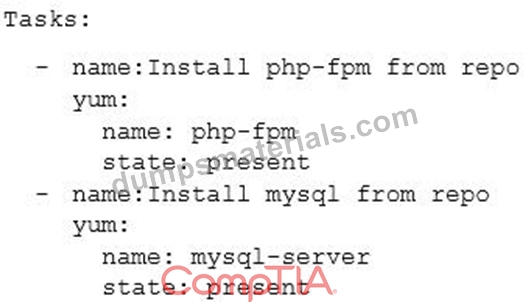
Which of the following would the application parsing this file MOST likely have to support?
- A. JSON
- B. SOAP
- C. AJAX
- D. YAML
Answer: D
Explanation:
This is YAML file just by looking at Syntax
https://docs.ansible.com/ansible/latest/reference_appendices/YAMLSyntax.html And here is JSON syntax
https://www.tutorialspoint.com/json/json_syntax.htm
NEW QUESTION # 52
A junior administrator is setting up a new Linux server that is intended to be used as a router at a remote site. Which of the following parameters will accomplish this goal?
- A.

- B.

- C.

- D.

Answer: D
Explanation:
The parameter net.ipv4.ip_forward=1 will accomplish the goal of setting up a new Linux server as a router. This parameter enables the IP forwarding feature, which allows the server to forward packets between different network interfaces. This is necessary for a router to route traffic between different networks. The parameter can be set in the /etc/sysctl.conf file or by using the sysctl command. This is the correct parameter to use to accomplish the goal. The other options are incorrect because they either do not exist (net.ipv4.ip_forwarding or net.ipv4.ip_route) or do not enable IP forwarding (net.ipv4.ip_forward=0). Reference: CompTIA Linux+ (XK0-005) Certification Study Guide, Chapter 12: Managing Network Connections, page 382.
NEW QUESTION # 53
An administrator needs to create a file named hello in the home directory that contains the following text:
it's me!
Which of the following commands would accomplish this goal?
- A. touch ~/hello
echo "it's me!" > ~/hello - B. mkdir ~/hello
touch ~/"it's me!" - C. mv ~/hello
cp "it's me!" > ~/hello - D. type ~/hello
print "it's me!"
Answer: A
Explanation:
task 1: Create a file named hello in the home directory.
# touch ~/hello
Task 2: the hello file must contain the text "it's me!".
# echo "it's me!" > ~/hello
NEW QUESTION # 54
A server is experiencing intermittent connection issues. Some connections to the Internet work as intended, but some fail as if there is no connectivity. The systems administrator inspects the server configuration: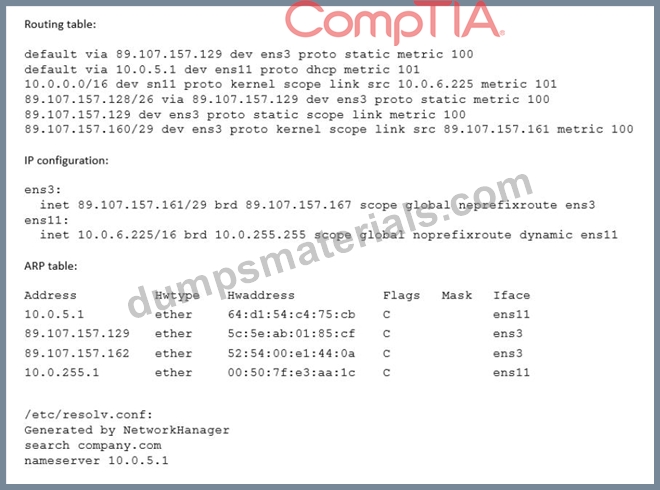
Which of the following is MOST likely the cause of the issue?
- A. Two default routes are configured.
- B. The ARP table contains incorrect entries.
- C. The IP netmask is wrong for ens3.
- D. An internal-only DNS server is configured.
Answer: A
Explanation:
The most likely cause of the issue is that two default routes are configured on the server. The default route is the route that is used when no other route matches the destination of a packet.
The default route is usually the gateway that connects the local network to the Internet. The server configuration shows that there are two default routes in the routing table, one with the gateway 192.168.1.1 and the other with the gateway 10.0.0.1. This can cause a conflict and confusion for the server when deciding which gateway to use for the outgoing packets. Some packets may be sent to the wrong gateway and fail to reach the Internet, while some packets may be sent to the correct gateway and work as intended. This can result in intermittent connection issues and inconsistent behavior. The administrator should remove one of the default routes and keep only the correct one for the network. This can be done by using the ip route del command or by editing the network configuration files. This will resolve the issue and restore the connectivity.
The other options are incorrect because they are not supported by the outputs. The DNS server, the IP netmask, and the ARP table are not the causes of the issue.
NEW QUESTION # 55
A Linux administrator is trying to remove the ACL from the file /home/user/dat a. txt but receives the following error message:
Given the following analysis: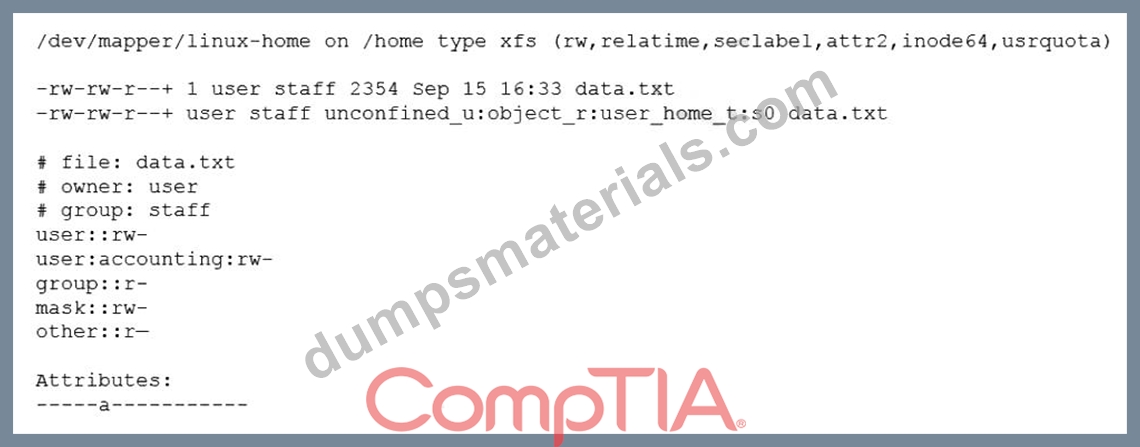
Which of the following is causing the error message?
- A. SELinux file context is denying the ACL changes.
- B. The administrator is not using a highly privileged account.
- C. File attributes are preventing file modification.
- D. The filesystem is mounted with the wrong options.
Answer: C
NEW QUESTION # 56
A Linux administrator is trying to remove the ACL from the file /home/user/data. txt but receives the following error message:
Given the following analysis: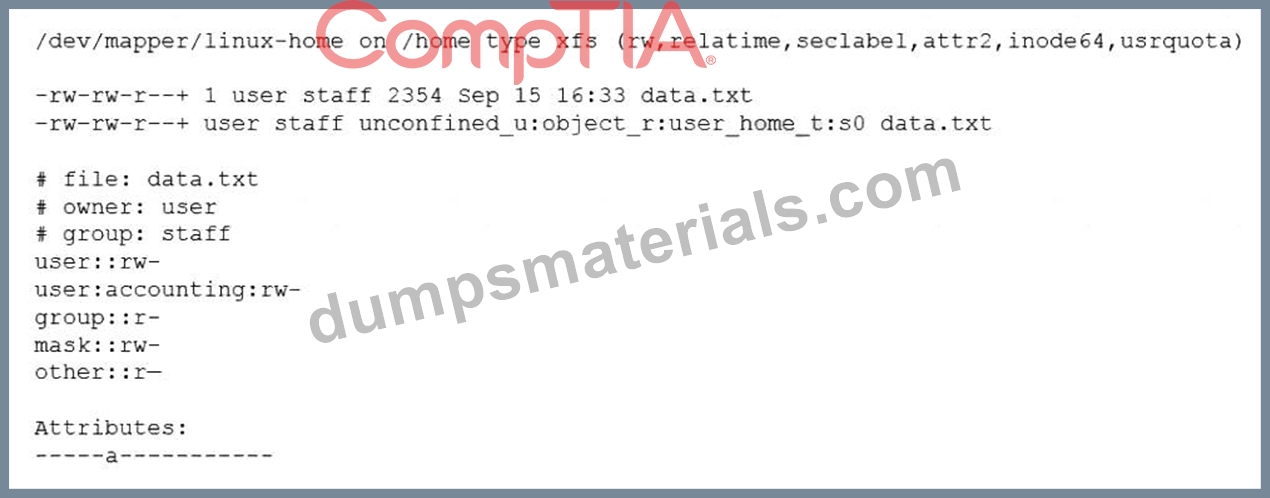
Which of the following is causing the error message?
- A. SELinux file context is denying the ACL changes.
- B. The administrator is not using a highly privileged account.
- C. File attributes are preventing file modification.
- D. The filesystem is mounted with the wrong options.
Answer: C
Explanation:
Explanation
File attributes are preventing file modification, which is causing the error message. The output of lsattr
/home/user/data.txt shows that the file has the immutable attribute (i) set, which means that the file cannot be changed, deleted, or renamed. The command setfacl -b /home/user/data.txt tries to remove the ACL from the file, but fails because of the immutable attribute. The administrator needs to remove the immutable attribute first by using the command chattr -i /home/user/data.txt and then try to remove the ACL again. The other options are incorrect because they are not supported by the outputs. The administrator is using a highly privileged account, as shown by the # prompt. The filesystem is mounted with the correct options, as shown by the output of mount | grep /home. SELinux file context is not denying the ACL changes, as shown by the output of ls -Z /home/user/data.txt. References: CompTIA Linux+ (XK0-005) Certification Study Guide, Chapter 11: Managing Files and Directories, pages 357-358.
NEW QUESTION # 57
A new drive was recently added to a Linux system. Using the environment and tokens provided, complete the following tasks:
* Create an appropriate device label.
* Format and create an ext4 file system on the new partition.
The current working directory is /.
Answer:
Explanation: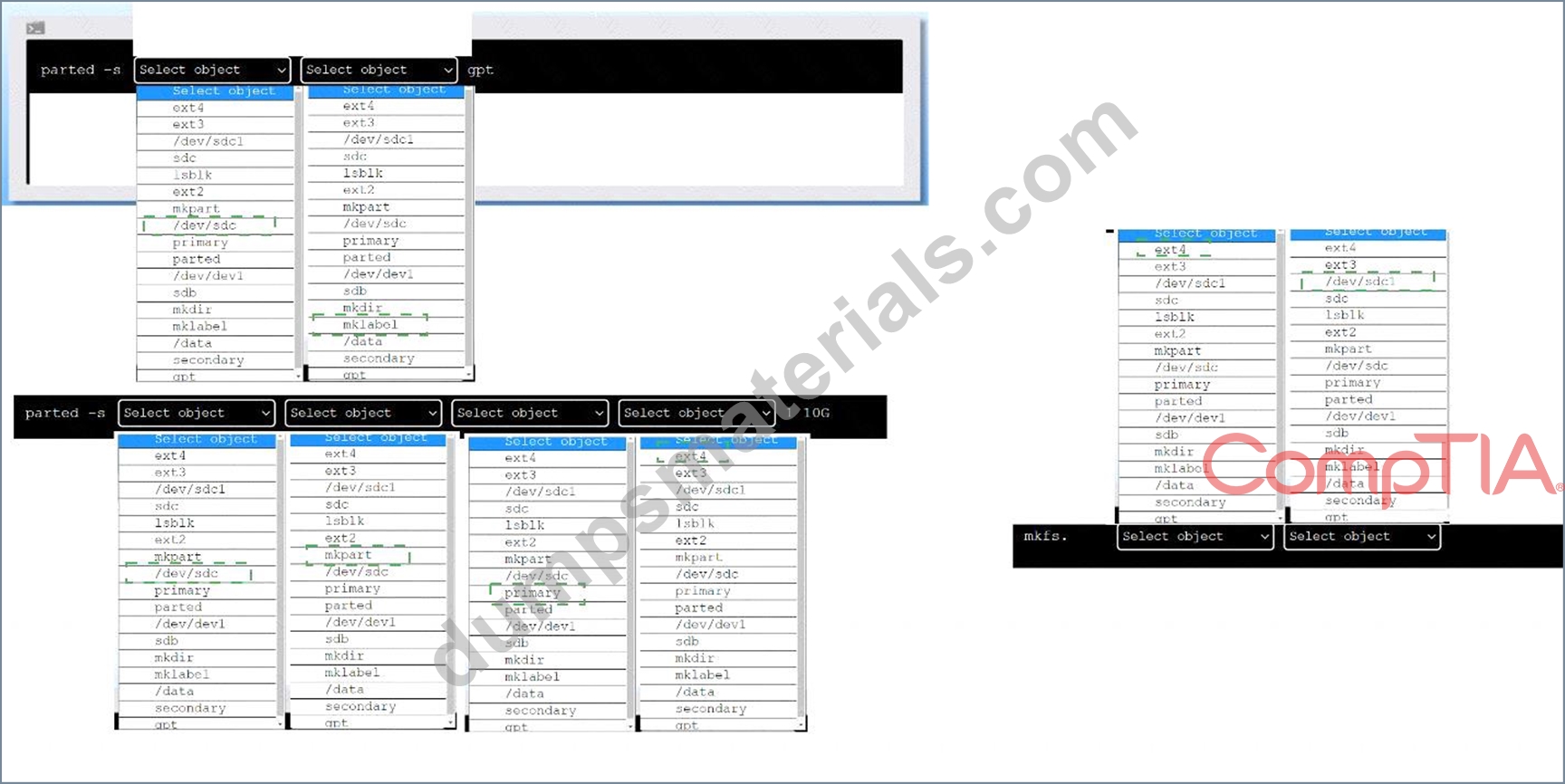
Explanation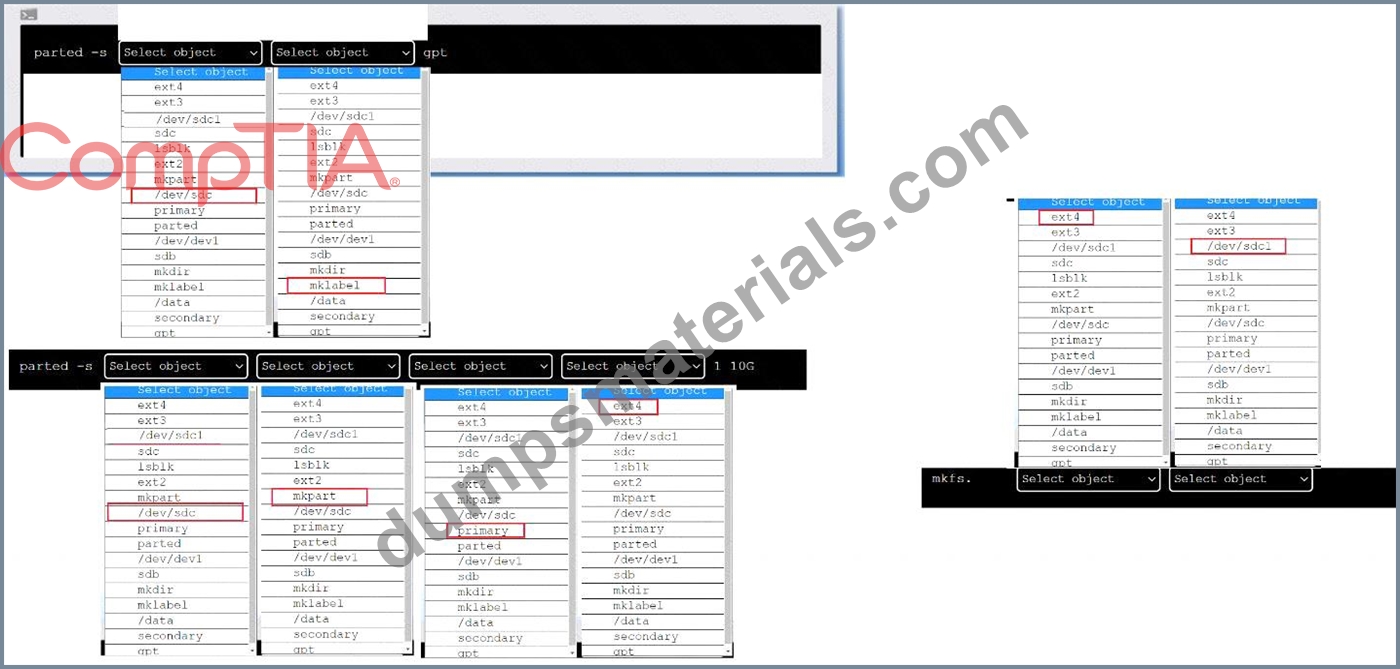
To create an appropriate device label, format and create an ext4 file system on the new partition, you can use the following commands:
To create a GPT (GUID Partition Table) label on the new drive /dev/sdc, you can use the parted command with the -s option (for script mode), the device name (/dev/sdc), the mklabel command, and the label type (gpt). The command is:
parted -s /dev/sdc mklabel gpt
To create a primary partition of 10 GB on the new drive /dev/sdc, you can use the parted command with the -s option, the device name (/dev/sdc), the mkpart command, the partition type (primary), the file system type (ext4), and the start and end points of the partition (1 and 10G). The command is:
parted -s /dev/sdc mkpart primary ext4 1 10G
To format and create an ext4 file system on the new partition /dev/sdc1, you can use the mkfs command with the file system type (ext4) and the device name (/dev/sdc1). The command is:
mkfs.ext4 /dev/sdc1
You can verify that the new partition and file system have been created by using the lsblk command, which will list all block devices and their properties.
NEW QUESTION # 58
A systems administrator wants to upgrade /bin/ someapp to a new version, but the administrator does not know the package name. Which of the following will show the RPM package name that provides that binary file?
- A. rpm -qf /bin/ someapp
- B. rpm - P / bin/ some app
- C. rpm -Vv / bin/ someapp
- D. rpm -i / bin/ someapp
Answer: A
Explanation:
Explanation
The rpm command is used to manage RPM packages on Linux systems. The -qf option queries the package name that provides a given file. Therefore, the command rpm -qf /bin/someapp will show the RPM package name that provides the binary file /bin/someapp. The statements B, C, and D are incorrect because they do not query the package name, but rather verify, remove, or install a package. References: [How to Use RPM Command in Linux with Examples]
NEW QUESTION # 59
A Linux administrator needs to resolve a service that has failed to start. The administrator runs the following command:
The following output is returned
Which of the following is MOST likely the issue?
- A. The service startupfile should not be owned by the root group.
- B. The service startupfile cannot be owned by root.
- C. The service does not have permissions to read write the startupfile.
- D. The service startupfile size cannot be 81k.
Answer: C
Explanation:
Explanation
The most likely issue is that the service does not have permissions to read or write the startupfile. The output of systemct1 status startup.service shows that the service has failed to start and the error message is
"Permission denied". The output of ls -l /etc/startupfile shows that the file has the permissions -rw-r--r--, which means that only the owner (root) can read and write the file, while the group (root) and others can only read the file. The service may not run as root and may need write access to the file. The administrator should change the permissions of the file by using the chmod command and grant write access to the group or others, or change the owner or group of the file by using the chown command and assign it to the user or group that runs the service. The other options are incorrect because they are not supported by the outputs. The file size, owner, and group are not the causes of the issue. References: CompTIA Linux+ (XK0-005) Certification Study Guide, Chapter 11: Managing Files and Directories, pages 345-346.
NEW QUESTION # 60
A Linux administrator has installed a web server, a database server, and a web application on a server. The web application should be active in order to render the web pages. After the administrator restarts the server, the website displays the following message in the browser: Error establishing a database connection. The Linux administrator reviews the following relevant output from the systemd init files: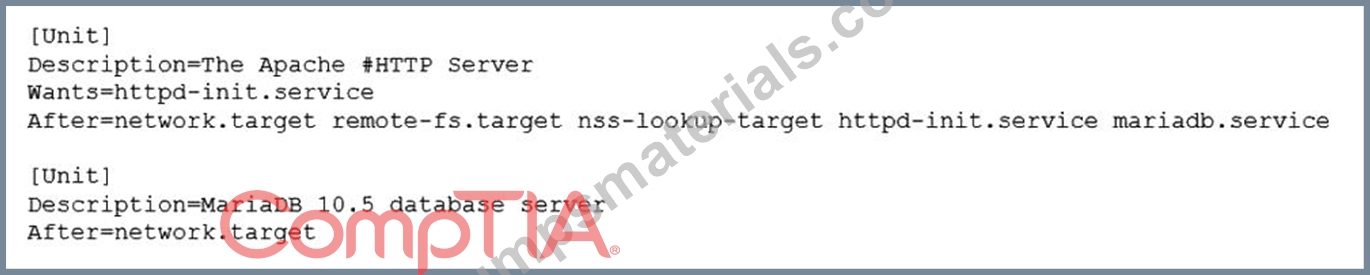
The administrator needs to ensure that the database is available before the web application is started. Which of the following should the administrator add to the HTTP server .service file to accomplish this task?
- A. TRIGGERS=mariadb.service
- B. ONFAILURE=mariadb.service
- C. REQUIRES=mariadb.service
- D. WANTEDBY=mariadb.service
Answer: C
NEW QUESTION # 61
A junior systems administrator needs to make a packet capture file that will only capture HTTP protocol data to a file called test.pcap.
Which of the following commands would allow the administrator to accomplish this task?
- A. tcpdump -i eth0 port 80 -w test.pcap
- B. netcat -p 80 -w test.pcap
- C. tshark -r test.pcap -o http
- D. tcpdump -i eth0 port 80 -r test.pcap
Answer: A
Explanation:
https://www.wireshark.org/docs/man-pages/tshark.html
NEW QUESTION # 62
......
XK0-005 dumps - DumpsMaterials - 100% Passing Guarantee: https://www.dumpsmaterials.com/XK0-005-real-torrent.html
Fast, Hands-On XK0-005 exam: https://drive.google.com/open?id=15e6E12u8U5E2FIDXxS9eWhzSr45NRE34
