
The Most Efficient Integration-Architect Pdf Dumps For Assured Success [2024]
We offers you the latest free online Integration-Architect dumps to practice
NEW QUESTION # 44
A customer's enterprise architect has identified requirements around caching, queuing, error handling, alerts, retries, event handling, etc. The company has asked the Salesforce integration architect to help fulfill such aspects with their Salesforce program.
Which three recommendations should the Salesforce integration architect make?
Choose 3 answers
- A. Message transformation and protocol translation should be done within Salesforce.Recommend leveraging Salesforce native protocol conversion capabilities as middleware tools are NOT suited for such tasks
- B. Provide true message queueing for integration scenarios (including orchestration, process choreography, quality of service, etc.) given that a middleware solution is required.
- C. Event handling processes such as writing to a log, sending an error or recovery process, or sending an extra message, can be assumed to be handled by middleware.
- D. Transform a fire-and-forget mechanism to request-reply should be handled by middleware tools (like ETL/ESB) to improve performance.
- E. Event handling in a publish/subscribe scenario, the middleware can be used to route requests or messages to active data-event subscribers from active data-event publishers.
Answer: B,C,E
Explanation:
Explanation
The recommendations that the Salesforce integration architect should make to fulfill the requirements around caching, queuing, error handling, alerts, retries, event handling, etc. are based on the best practices and capabilities of the middleware tools. The recommendation B is valid because middleware tools can provide true message queueing for integration scenarios that require asynchronous processing, guaranteed delivery, load balancing, etc. The recommendation D is valid because middleware tools can handle various events that may occur during the integration process, such as logging errors, sending notifications, triggering recovery actions, etc. The recommendation E is valid because middleware tools can support the publish/subscribe pattern for event-driven integration, where the middleware can route messages from publishers to subscribers based on topics or filters. The recommendation A is not valid because transforming a fire-and-forget mechanism to request-reply does not improve performance, but rather increases the latency and complexity of the integration. The recommendation C is not valid because message transformation and protocol translation are tasks that are better suited for middleware tools than Salesforce, as they can handle different formats and protocols more efficiently and flexibly23
1: Integration Architecture Designer Resource Guide 2: Integration Patterns and Practices 3: Salesforce Integration Architecture Designer Certification Exam Guide
NEW QUESTION # 45
Universal Containers (UC) is currently managing a custom monolithic web service that runs on an on-premise server.
This monolithic web service is responsible for Point-to-Point (P2P) integrations between:
1. Salesforce and a legacy billing application
2. Salesforce and a cloud-based Enterprise Resource Planning application
3. Salesforce and a data lake.
UC has found that the tight interdependencies between systems is causing integrations to fail.
What should an architect recommend to decouple the systems and improve performance of the integrations?
- A. Use the Salesforce Bulk API when integrating back into Salesforce.
- B. Leverage modular design by breaking up the web service into smaller pieces for a microservice architecture.
- C. Re-write and optimize the current web service to be more efficient.
- D. Move the custom monolithic web service from on-premise to a cloud provider.
Answer: B
NEW QUESTION # 46
Universal Containers (UC) currently owns a middleware tool and they have developed an API-led integration architecture with three API tiers. The first tier interfaces directly with the systems of engagement, the second tier implements business logic and aggregates data, while the third tier interfaces directly with systems of record. Some of the systems of engagement will be a mobile application, a web application, and Salesforce.
UC has a business requirement to return data to the systems of engagement in different formats while also enforcing different security protocols.
What should an Integration Architect recommend to meet these requirements?
- A. Enforce separate security protocols and return formats at the second tier of the API-led architecture.
- B. Implement an API gateway that all systems of engagement must interface with first.
- C. Enforce separate security protocols and return formats at the first tier of the API-led architecture.
- D. Leverage an Identity Provider solution that communicates with the API tiers via SAML
Answer: B
NEW QUESTION # 47
Which two system constraint questions should be considered when designing an integration to send orders from Salesforce to a fulfillment system?
Choose 2 answers
- A. Which system will validate order shipping addresses?
- B. Can the fulfillment system implement a contract-first Outbound Messaging interface?
- C. What latency is acceptable for orders to reach the fulfillment system?
- D. Can the fulfillment system participate in idempotent design to avoid duplicate orders?
Answer: B,D
NEW QUESTION # 48
A large enterprise customer operating in a high regulated industry is planning to implement Salesforce for customer facing associates in both Sales and Service, and back-office staff. The business processes that Salesforce supports are critical to the business.
Salesforce will be integrated to multiple back-office systems to provide a single interface for associates.
Reliability and monitoring of these integrations are required as associates support customers.
Which integration solution should the architect consider when planning the implementation?
- A. Build a custom integration gateway to support back-office system integrations and ensure reliability and monitoring capabilities.
- B. Decouple back-office system callouts into separate distinct services that have inbuilt error logging and monitoring frameworks.
- C. Leverage Middleware for all back-office system integrations ensuring real time alerting, monitoring and reporting capabilities.
- D. Architect Services in back-office systems to support callouts from Salesforce and build reliability, monitoring and reporting capabilities.
Answer: C
Explanation:
Explanation
Leveraging Middleware for all back-office system integrations ensuring real time alerting, monitoring and reporting capabilities is the best integration solution for this scenario. Middleware is a software layer that acts as an intermediary between Salesforce and other systems, providing a common platform for data transformation, routing, orchestration, security, error handling, logging, and monitoring. Middleware can help to ensure reliability and performance of the integrations, as well as provide visibility and control over the integration processes. Middleware can also support various integration patterns and protocols, such as SOAP, REST, JMS, etc. Reference: Salesforce Integration Architecture Designer Resource Guide, page 14
NEW QUESTION # 49
An Architect is required to integrate with an External Data Source via a Named Credential with an Apex callout due to technical constraints.
How is authentication achieved?
- A. Connect via Communities.
- B. Handle authentication in the code.
- C. Handle authentication with login flows.
- D. Connect via Salesforce Connect.
Answer: C
Explanation:
https://help.salesforce.com/articleView?id=named_credentials_define.htm&type=5
NEW QUESTION # 50
A conglomerate is designing a Lightning Web Component (LWC) to display transactions aggregated from different sources. Their current system landscape is as follows:
1. Transactions are created at any time through their various on-premise and cloud-based systems.
2. All necessary transactions are replicated to a custom Transaction object in Salesforce. It is updated periodically so it only has a subset of the necessary transactions between updates.
3. Middleware supports publish-subscribe interactions and provides RESTful Enterprise APIs that can retrieve transactions from on-premise and cloud-based systems.
The company wants to address a usability concern regarding incomplete data displayed on the LWC component. What should the Integration Architect specify so the LWC will be able to display all the required transactions?
- A. Call the Enterprise APIs directly from the LWC's JavaScript code and redisplay the LWC on receipt of the API response.
- B. Let the Lightning Data Service with an wire adapter display new values when the custom object records change.
- C. Use the Continuation class to call the Enterprise APIs and then process the response in a callback method.
- D. Publish a Platform Event, have the middleware subscribe and update the custom object on receipt of Platform Event.
Answer: A
NEW QUESTION # 51
A company wants to standardize exception tracking, handling, and analytics. Given the following actions:
1. Build a company wide logging service hosted on a middleware platform
2. Create case object records for exceptions based thresholds
3. Change all their Apex Loggers to publish Application Exceptions as custom Platform Events.
Which two specifications should the integration architect include in the logging service architecture?
Choose 2 answers
- A. Create Salesforce Cases conditionally using automatic Case creation rules.
- B. Subscribe to the Application Exceptions using the Salesforce Streaming API.
- C. Create Salesforce Cases using the Salesforce REST, SOAP or Bulk API.
- D. Receive Application Events through Change Data Capture (CDC).
Answer: A,C
NEW QUESTION # 52
Northern Trail Outfitters needs to make synchronous callouts "available to promise" services to query product availability and reserve inventory during customer checkout process.
Which two considerations should an integration architect make when building a scalable integration solution?
Choose 2 answers
- A. The number batch jobs that can run concurrently.
- B. The maximum query cursors open per user on the service.
- C. The typical and worst-case historical response times.
- D. How many concurrent service calls are being placed.
Answer: A,B
NEW QUESTION # 53
A company in a heavily regulated industry requires data in legacy systems to be displayed in Salesforce user interfaces (UIs). They are proficient in their cloud-based ETL (extract, transform, load) tools. They expose APIs built on their on-premise middleware to cloud and on-premise applications.
Which two findings about their current state will allow copies of legacy data in Salesforce?
Choose 2 answers
- A. Only on-premise systems are allowed access to legacy systems.
- B. On-premise middleware provides APIs to legacy systems data.
- C. Cloud-based ETL can access Salesforce and supports queues.
- D. Legacy systems can use queues for on-premise integration.
Answer: B,C
Explanation:
Explanation
Option B is a correct finding, because it means that the company can use their cloud-based ETL tools to extract data from the legacy systems via the APIs exposed by the on-premise middleware, transform the data as needed, and load the data into Salesforce using queues. Queues are a way of managing asynchronous operations, such as bulk data loading, by placing them in a queue and executing them when resources are available1.
Option C is also a correct finding, because it means that the company can expose their legacy data to the cloud via their on-premise middleware APIs. APIs are a way of enabling communication and data exchange between different systems using standard protocols and formats2. By providing APIs to access their legacy data, the company can use any cloud-based tool or application that can consume those APIs to retrieve and manipulate the data.
Option A is not a correct finding, because it means that the company cannot access their legacy data from the cloud, which prevents them from using their cloud-based ETL tools or any other cloud-based integration solution. If only on-premise systems are allowed to access the legacy systems, then the company would need to use an on-premise integration tool or application to copy the data to Salesforce.
Option D is not a correct finding, because it does not affect the ability to copy legacy data in Salesforce.
Queues are useful for on-premise integration, but they are not necessary for copying data to Salesforce. The company can use other methods, such as direct API calls or batch processes, to load data into Salesforce without using queues.
References: 1: Queueable Apex | Apex Developer Guide | Salesforce Developers 2: API Basics | SOAP API Developer Guide | Salesforce Developers
NEW QUESTION # 54
Northern Trail Outfitters is in the final stages of merging two Salesforce orgs but needs to keep the retiring org available for a short period of time for lead management as it is connected to multiple public web site forms.
The sales department has requested that new leads are available in the new Salesforce instance within 30 minutes.
Which two approaches will require the least amount of development effort?
Choose 2 answers
- A. Call the Salesforce REST API to insert the lead into the target system.
- B. Configure named credentials in the source org.
- C. Use the tooling API with Process Builder to insert leads in real time.
- D. Use the Composite REST API to aggregate multiple leads in a single call.
Answer: B,D
Explanation:
The two approaches that will require the least amount of development effort are configuring named credentials in the source org and using the Composite REST API to aggregate multiple leads in a single call.
Named credentials are a type of metadata that store authentication information for accessing external services, such as the target Salesforce org. By using named credentials, you can simplify the code for making callouts and avoid hardcoding credentials or tokens.
The Composite REST API is a resource that allows you to execute multiple REST API requests in a single call.
You can use the Composite REST API to create, update, or delete up to 25 records in one request.
This can reduce the number of API calls and improve performance.
References: [Named Credentials], [Composite Resources]
NEW QUESTION # 55
A company is planning on sending orders from Salesforce to a fulfillment system. The integration architect has been asked to plan for the integration.
Which two questions should the integration architect consider?
Choose 2 answers
- A. Can the fulfillment system implement a contract-first Outbound Messaging interface?
- B. Can the fulfillment system create new addresses within the Order Create service?
- C. Can the fulfillment system make a callback into Salesforce?
- D. Is the product catalog data identical at all times in both systems?
Answer: A,C
Explanation:
https://www.youtube.com/watch?v=zQncznMLrt4 Contract first interface is important as it can impact integration design in terms of efficiency and collaboration.
NEW QUESTION # 56
A company's cloud-based single page application consolidates data local to the application with data from on premise and 3rd party systems. The diagram below typifies the application's combined use of synchronous and asynchronous calls.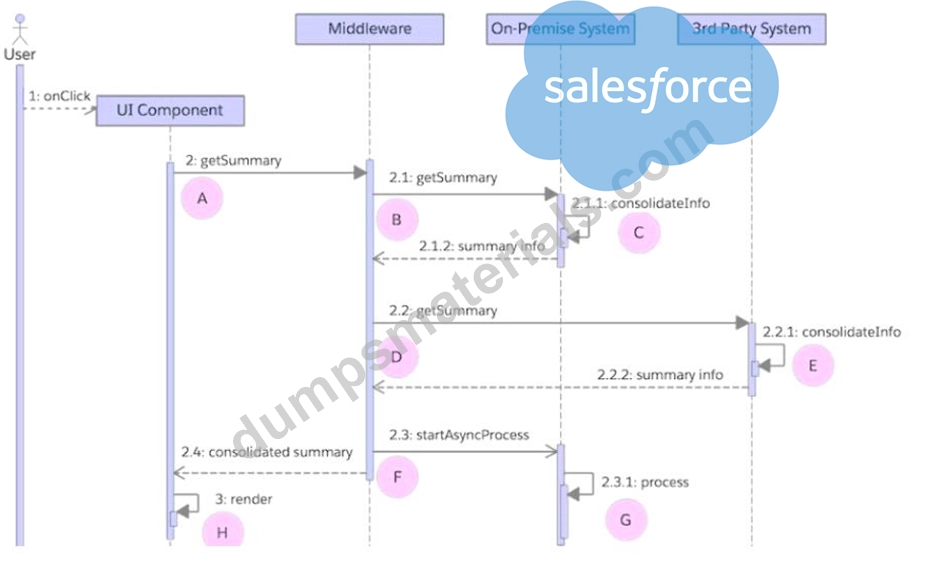
The company wants to use the average response time of its application's user interface as a basis for certain alerts. For this purpose, the following occurs:
1. Log every call's start and finish date and time to a central analytics data store.
2. Compute response time uniformly as the difference between the start and finish date and time - A to H in the diagram.
Which computation represents the end-to-end response time from the user's perspective?
- A. Sum of A, G, and H
- B. Sum of A to H
- C. Sum of A and H
- D. Sum of A to F
Answer: C
NEW QUESTION # 57
Northern Trail Outfitters' ERP is integrated with Salesforce and syncs several million contacts per day. To prevent specific data from syncing, the integration uses a SOQL query filtered by sharing hierarchy.
Which two things should an architect do to improve the performance of the integration?
Choose 2 answers
- A. Remove the sharing restrictions.
- B. Remove the query filters.
- C. Include non-selective criteria in query filters.
- D. Include selective criteria in query filters.
Answer: A,D
Explanation:
https://help.salesforce.com/articleView?id=000325247&type=1&mode=1
NEW QUESTION # 58
An organization needs to integrate Salesforce with an external system and is considering authentication options. The organization already has implemented SAML, using a third-party Identity Provider for integrations between other systems.
Which use case can leverage the existing SAML integration to connect Salesforce with other internal systems?
- A. Make an API inbound integration from an external Java client more secure.
- B. Make Apex SOAP outbound integrations to external web services more secure.
- C. Make formula fields with HYPERLINK() to external web servers more secure.
- D. A Make Apex REST outbound integrations to external web services more secure.
Answer: C
NEW QUESTION # 59
Given the diagram below, a Salesforce org, middleware, and Historical data store (with
20million records and growing) exists with connectivity between them
Historical records are archived from Salesforce and moved to Historical Data store (which houses 20M records and growing; fine-tuned to be performant with search queries).
Call center agents use Salesforce, when reviewing occasional special cases, have requested access to view the related historical case items that relate to submit cases.
Which mechanism and patterns are recommended to maximize declarative configuration?
- A. Use an ESB tool with Request-Reply pattern and then make a real-time Apex callout to the ESB endpoint to fetch and display component related to Case object
- B. Use an ETL tool with a Batch Data Synchronization pattern to migrate historical data into Salesforce and into a custom object (historical data) related to Case object.
- C. C Use an ESB tool with a fire and forget pattern and then publish a platform event for the requested historical data.
- D. Use ESB tool with Data Virtualization pattern, expose OData endpoint, and then use Salesforce Connect to consume and display the External Object alongside with the Case object.
Answer: D
Explanation:
Explanation
The Data Virtualization pattern allows Salesforce to access external data sources without storing the data in Salesforce. This reduces the data storage and synchronization costs and enables real-time access to the historical data. Salesforce Connect can be used to consume OData endpoints exposed by the ESB tool and display the external objects as related lists or custom components on the Case object
NEW QUESTION # 60
Northern Trail Outfitters (NTO) has recently changed their Corporate Security Guidelines. The guidelines require that all cloud applications pass through a secure firewall before accessing on-premise resources. NTO is evaluating middleware solutions to integrate cloud applications with on-premise resources and services.
What are two considerations an Integration Architect should evaluate before choosing a middleware solution?
Choose 2 answers
- A. The middleware solution is capable of establishing a secure API gateway between cloud applications and on-premise resources.
- B. The middleware solution enforces the OAuth security protocol.
- C. The middleware solution is able to interface directly with databases via an ODBC connection string.
- D. An API gateway component is deployable behind a Demilitarized Zone (DMZ) or perimeter network.
Answer: A,D
Explanation:
Explanation
An API gateway is a component that acts as a single point of entry for all cloud applications to access on-premise resources and services. It can provide security, routing, transformation, and other features to facilitate integration. An API gateway component should be deployable behind a DMZ or perimeter network, which is a subnetwork that separates the internal network from the external network and provides an additional layer of security. The middleware solution should also be capable of establishing a secure API gateway between cloud applications and on-premise resources, which may involve using protocols such as HTTPS, SSL/TLS, or VPN. The OAuth security protocol is not a requirement for choosing a middleware solution, as it is a standard for authorizing access to resources on behalf of a user. The middleware solution's ability to interface directly with databases via an ODBC connection string is also not a requirement, as it is a specific feature that may or may not be needed depending on the integration scenario. Reference: Salesforce Integration Architecture Designer Resource Guide, page 14-15
NEW QUESTION # 61
A customer of Salesforce has used Platform Events to integrate their Salesforce instance with an external third party Artificial Intelligence (AI) system. The AI system provides a prediction score for each lead that is received by Salesforce. Once the prediction score is received, the lead information is saved to Platform events for other processes. The trigger on the Platform Events is failing once this was rolled out to Production.
What type of monitoring should the Integration Consultant have considered to monitor this integration?
- A. Set up debug logs for Platform Event triggers to monitor performance .
- B. Monitor the volume of leads that are created in Salesforce.
- C. Monitor Platform Events created per hour limits across the Salesforce instance.
- D. Validate the Platform Event definition matches leads definition.
Answer: A
NEW QUESTION # 62
......
Integration-Architect PDF 100% Cover Real Exam Questions: https://www.dumpsmaterials.com/Integration-Architect-real-torrent.html
Salesforce Integration-Architect Real Exam Questions Guaranteed Updated Dump: https://drive.google.com/open?id=1eeDGah6s3jjIG-3rzIsxBJ1mJrLiF2-Z
