
Pass L4M5 Exam in First Attempt Guaranteed 100% Cover Real Exam Questions [Mar-2026]
Valid L4M5 test answers & CIPS L4M5 exam pdf
CIPS L4M5: Commercial Negotiation exam is designed to prepare candidates for effective negotiation practices in the purchasing industry. L4M5 exam assesses a candidate's ability to identify key factors in a negotiation process, interpret and apply negotiation theories, and employ negotiation strategies. Candidates will be required to showcase their understanding of informed decision-making, developing and maintaining relationships, and the management of the negotiation process.
CIPS L4M5 exam covers a range of topics related to commercial negotiation, including the principles of negotiation, negotiation styles and tactics, and the legal and ethical considerations involved in negotiation. L4M5 exam is designed to test candidates' abilities to effectively negotiate contracts, manage stakeholder relationships, and achieve mutually beneficial outcomes in commercial transactions.
CIPS L4M5: Commercial Negotiation is an essential exam for procurement professionals who want to master the art of negotiation. L4M5 exam is part of the Chartered Institute of Procurement and Supply (CIPS) Level 4 Diploma in Procurement and Supply. L4M5 exam is designed to test candidates' ability to negotiate effectively in a commercial environment. Successful completion of L4M5 exam will demonstrate that candidates have the skills and knowledge required to negotiate complex commercial contracts.
NEW QUESTION # 165
Champion Toys (CT) is negotiating a large order with Top Teds. CT has identified lead times, order quantities, and delivery locations as tradeables. At which negotiation stage should CT introduce these tradeables?
- A. Proposing
- B. Bargaining
- C. Closure
- D. Opening
Answer: B
Explanation:
Tradeables-variables such as price, delivery, quality, and payment terms-are introduced in the bargaining stage of negotiations. This is the phase where both parties test positions, make concessions, and trade issues to create acceptable packages. Proposing and opening are earlier stages focused on setting out agendas and clarifying needs, while closure comes after tradeables are resolved. Introducing tradeables too early can weaken leverage, and leaving them too late risks deadlock. Bargaining ensures the structured exchange of concessions while protecting the overall bargaining mix.
Reference: CIPS L4M5 (2nd ed.), LO 1.1 - Negotiation stages, bargaining as the point for tradeables.
NEW QUESTION # 166
Which of the following are most likely to be sources of conflict that can emerge from the content of commercial negotiations? Select TWO that apply.
- A. Cultural differences
- B. Contract governing law
- C. Framework arrangement
- D. Requisition
- E. Payment terms
Answer: B,E
Explanation:
There are multiple sources of divergent positions that can arise in situations where money is exchange for goods and services. There are 2 different types of sources. Those that arise from the content or subject matter of the negotiation (what is being negotiated) and those that arise from the process of negotiation (how it is being negotiated).
Sources of divergent position - the content of negotiation:
Table Description automatically generated
Cultural differences are the source of conflict in the process of negotiation.
Requisition is an internal document raised by user or store to communicate to procurement the need to buy the product or service specified. This is merely a internal document.
Framework arrangement is a rather loose set-up, without any legal standing. It usually occurs when an organisation has decided for itself to limit the number of suppliers it is willing to work with and, through a purely internal process, sets up an approved list of such suppliers.
LO 1, AC 1.1
NEW QUESTION # 167
A garden furniture supplier currently in negotiations for a high-value contract has offered the procurement manager a visit to their site. The supplier suggests that during this visit, they can undertake the contract negotiation. What would be an appropriate response from the procurement manager?
- A. Decline the offer as it would take too much time to go and visit the supplier
- B. Decline the offer as negotiating while on a site visit will provide the supplier with an unfair advantage because they will be in a familiar environment
- C. Accept the offer as this would be an ideal opportunity to see what the supplier can offer and will provide the supplier with familiarity while negotiating
- D. Accept the offer as this would save time. A supplier visit and negotiation could be done at the same time
Answer: B
Explanation:
Negotiating in the supplier's environment (their site) can unintentionally shift the power dynamic. The supplier may gain apsychological edgedue to the comfort and control of their surroundings. Best practice recommends holding negotiations in aneutral settingto ensure balance and reduce any influence based on physical context. While site visits are beneficial for supplier evaluation, they should beseparate from the negotiationto maintain objectivity.
Reference: L4M5 Commercial Negotiation 2nd edition (CORE), Section 3.4 - Controlling the Environment of Negotiation
NEW QUESTION # 168
When considering a new supply source for a product, a procurement professional reviews supplier quotations before negotiation. Which of the following is a direct cost in the supplier's quotation?
- A. Insurance for production machinery
- B. Wages for the supplier's sales department
- C. Metal used in the product
- D. Rent for the supplier's premises
Answer: C
Explanation:
Direct costs are those directly attributable to the production of a unit - such as raw materials, components, and direct labour. Here, the metal used is a clear direct cost, as it varies with production output. Rent, insurance, and sales wages are indirect (overhead) costs, which must be allocated across products.
Understanding this distinction is vital in negotiations, since direct costs are easier to challenge for efficiency gains, while indirect allocations may be arbitrary. Buyers with clear knowledge of cost breakdowns can negotiate more effectively, avoiding inflated pricing.
Reference: CIPS L4M5 (2nd ed.), LO 2.2 - Cost analysis: direct vs indirect costs in supplier quotations.
NEW QUESTION # 169
Which of the following is considered a strength of a 'logical' style negotiator?
- A. Assertive
- B. Methodical
- C. Friendly and accessible
- D. Interrelate issues easily and make quick decisions
Answer: B
Explanation:
A useful and simple shorthand for preferrednegotiation styles is summarised by four simple descriptor: 'warm',
'tough', 'logical' and 'dealer', which can be applied to describe individuals' dominant preferred style in most circumstances.
Warm - a people person
Tough - a hard-nosed negotiator
Logic- a numbers person
Dealer - a trader who loves bargaining
Strengths, weaknesses of logical style are described below:
Table Description automatically generated
NEW QUESTION # 170
A negotiation meeting commences with the supplier asking the buyer 'How do you feel about the service you receive from us currently?' The supplier then asks 'What do you think about our latest products?' followed by
'How do we compare with other suppliers you use?' The supplier is using which type of questions?
- A. Closed questions
- B. Probing questions
- C. Hypothetical questions
- D. Open questions
Answer: D
NEW QUESTION # 171
Which of the following types of question are likely to be the most effective to check facts in negotiations?
- A. Open
- B. Closed
- C. Leading
- D. Hypothetical
Answer: B
NEW QUESTION # 172
Which of the following are typical characteristics of activity-based costing (ABC) method? Select TWO that apply.
- A. Limited understanding of true costs incurred
- B. ABC provides the information required to take action and realise improvements
- C. Variable and all related overhead expenses are specifically assigned to a business activity
- D. ABC has tended to over cost products on long runs and under cost those on short runs
- E. Costs are allocated based on volume
Answer: B,C
Explanation:
Activity-based costing is an alternative approach to traditional absorption costing. The characteristics of these two methods are illustrated in the graph below:
Graphical user interface, text, chat or text message, website Description automatically generated
NEW QUESTION # 173
Procurement gets involved in negotiating purchase requisitions only when there is a value analysis to ensure that only value-adding aspects are included. Is this statement true?
- A. Yes, the role of purchasing is to add value to the purchase, and therefore every purchase requisition must go through a team value analysis
- B. Yes, value analysis is the single most important responsibility of procurement in the processing of repeat requisitions
- C. No, value analysis is a very technical process that requires the expertise of engineering and financial analysts
- D. No, purchasing can negotiate other details of the purchase requisition even where value analysis is absent
Answer: D
Explanation:
Procurement can negotiate various aspects of a purchase requisition even without a formal value analysis.
While value analysis can enhance cost-effectiveness, procurement professionals often negotiate on pricing, terms, and conditions to add value independently of value analysis, as per CIPS's guidelines on procurement flexibility in negotiations.
NEW QUESTION # 174
Where there are high levels of commitment to relationships between both the buyer and supplier, this is seen as collaborative and beneficial to negotiations. Is this statement correct?
- A. No, this can be classified as adversarial
- B. Yes, characteristics include arm's length transactions and minimal communication
- C. No, collaboration does not require commitments from either side
- D. Yes, characteristics include risk management and strategic planning
Answer: D
Explanation:
A collaborative relationship is characterized by mutual commitment, which enhances risk management and strategic planning between buyer and supplier. High levels of trust and commitment enable both parties to work closely to achieve shared objectives, creating a beneficial negotiation environment. This approach aligns with CIPS's principles of collaborative procurement relationships.
NEW QUESTION # 175
At the first stage of CIPS Procurement and Supply Cycle (Understand need), which of the following is the most important duty of procurement professional?
- A. Undertaking 'reverse marketing'
- B. Evaluating the interests from suppliers
- C. Deciding whether RFQ or ITT should be used
- D. Demand management
Answer: D
Explanation:
:
At the first stage of CIPS Procurement and Supply Cycle (Understand need and develop a high-level specification), procurement professional mainly negotiate with internal stakeholders. They have a duty to proportionately and constructively challenge specification if there's genuine doubt over the need or how the need is expressed. This is called demand management. Their first duty is to the organisation's treasury, not to functional managers.
Demand management including: negotiation/challenge between procurement and internal stakeholders over the need/requirement/specification. Remember that in any process or product, the greatest opportunity for cost reduction is at the design stage.
NEW QUESTION # 176
A supplier's mark-up on all products is 25%. Supplier's profit margin is...?
- A. 30%
- B. 75%
- C. 20%
- D. 15%
Answer: C
Explanation:
LO 2, AC 2.1
NEW QUESTION # 177
Jane is planning for a forthcoming negotiation with a key supplier. She has learned what are important to the supplier and what are important to her company from previous contracts between them. In order to avoid negotiation deadlocks, she has set up several concession plans. But Jane has little experience in dealing with suppliers and doesn't know when to trade these concessions. When is the best time in a negotiation to trade concessions?
- A. In the proposing phase
- B. At bargaining stage
- C. At opening stage
- D. In the testing phase
Answer: B
Explanation:
The question asks about the point in time when Jane should make concessions with the supplier. These concessions should be traded after preliminary stages such as opening, testing and proposing are over and proposals move from being tentative and general to being more definite and specific. This stage is called bargaining phase. The bargaining phase is the 'meat' of the negotiation meeting.
LO 3, AC 3.1
NEW QUESTION # 178
Which of the following are most likely to be sources of conflict that can emerge from the process of commercial negotiations? Select TWO that apply.
- A. Types of purchase
- B. Differences in culture
- C. Standard terms and conditions
- D. Line of the best fits
- E. Differences in conflict management style
Answer: B,E
Explanation:
There are multiple sources of divergent positions that can arise in situations where money is exchange for goods and services. There are 2 different types of sources. Those that arise from the content or subject matter of the negotiation (what is being negotiated) and those that arise from the process of negotiation (how it is being negotiated).
Sources of divergent positions - the process of negotiation:
Table Description automatically generated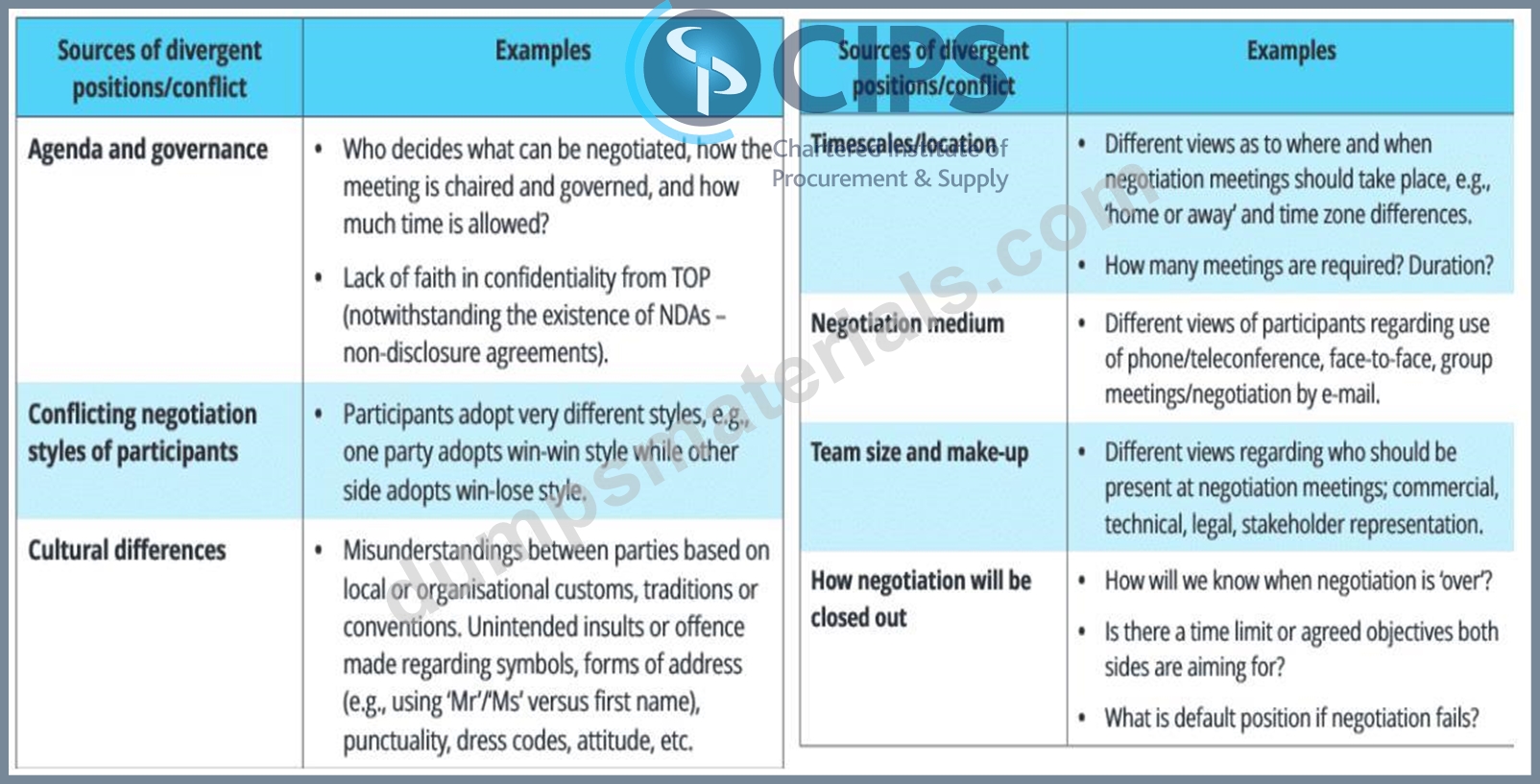
Line of best fits is the line that goes approximately through the middle of the data points with an equal number of data points above and below it. Line of best fits is a method of calculating medium value in statistics.
Standard terms and conditions are basic terms and conditions of business governing transactions that do not have a definitive contract, usually designed to be included in form documents such as orders. While there may be conflicts regarding standard terms and conditions, they are about the content of negotiation, not the process.
Type of purchase: when buying organisation makes an decision to purchase an item, a buyer is faced with three possible scenarios. The item to be bought could be a straight re-buy, a modified re-buy or a new purchase. Decision on type of purchase is purely an internal decision.
NEW QUESTION # 179
One of the most important steps in preparing for negotiations is to appraise the relative power of the parties.
The buying organisation must assess its bargaining power against that of the supplier it intends to negotiate with. This information is necessary in facilitating the preparation, the negotiation team and the negotiation strategy.
In what situation is the bargaining power of buyers likely to be high relative to suppliers?
- A. The buyer's requirement is urgent and cannot be postponed
- B. There are few suppliers relative to buyers
- C. There are fewer buyers relative to suppliers
- D. The supplier's product is critical to the buyer's business
Answer: C
Explanation:
Whenmany supplierscompete forfew buyers, buyers gain leverage. This competition can drive prices down and increase the buyer's ability to negotiate favorable terms. Conversely, if the buyer is dependent on a supplier (as in A), the buyer's power diminishes.
"Buyer power increases when there are many suppliers and few buyers. The buyer has multiple options and can negotiate from a position of strength." (L4M5 Commercial Negotiation, 2nd edition, Section 2.3 - Relative Bargaining Power and Market Dynamics)
NEW QUESTION # 180
Different types of relationships impact negotiations. Which source of leverage would most support the buyer?
- A. Powerful colleagues
- B. Personality power
- C. Friends power
- D. Legitimate power
Answer: D
Explanation:
Legitimate power comes from formal authority and organisational backing, making it a credible and sustainable leverage source in negotiations. Personality power or reliance on colleagues and friends lacks long- term weight and may not influence suppliers strategically. Buyers who use legitimate power, backed by governance and authority, negotiate from a position of credibility and professionalism, reinforcing stronger outcomes.
Reference: CIPS L4M5 (2nd ed.), LO 3.1 - Sources of power: legitimate, coercive, expert, referent.
NEW QUESTION # 181
Community Meal Partners (CMP) is a not-for-profit company that delivers cooked meals to older residents in their homes. CMP uses a fleet of bespoke vans with onboard ovens. In planning the future procurement of the fleet, CMP has conducted a review of the microeconomics of the van supply market and found that the vans are supplied by a monopoly supplier due to patented technology. Which of the following strategies could CMP utilise to optimise its bargaining position with the van supplier?
- A. Procure shorter-term lease contracts
- B. Renegotiate van lease prices with the supplier
- C. Publicly seek alternative service solutions
- D. Conduct regular and frequent tendering
Answer: C
Explanation:
When facing a monopoly supplier, buyers must find creative ways to introduce leverage. Publicly exploring alternative solutions can create the perception of competition or a fallback plan, thus shifting bargaining power slightly toward the buyer.
Reference: L4M5 Commercial Negotiation 2nd edition (CORE), Section 2.3 - Market Conditions and Negotiation Strategy
NEW QUESTION # 182
Which of the following will help to indicate personality preferences in four dimensions?
- A. Mill's RESPECT mnemonic
- B. Myers-Briggs Type Indicator
- C. Intelligence quotient
- D. Thomas-Kilmann Conflict Resolution model
Answer: B
Explanation:
The Myers-Briggs Type Indicator (MBTI) is an introspective self-report questionnaire indicating differing psychological preferences in how people perceive the world and make decisions. MBTI indicates personality preferences in four dimensions.
The Thomas-Kilmann Conflict Mode Instrument (TKI) is a conflict style inventory, which is a tool developed to measure an individual's response to conflict situations.
Mill's RESPECT mnemonic is set out by Harry A. Mills which describes seven steps to agreements An intelligence quotient (IQ) is a total score derived from a set of standardized tests designed to assess human intelligence.
NEW QUESTION # 183
John and a supplier agree on a long-term relationship based on trust, respect, and shared risk/reward. What type of relationship is this?
- A. Partnership
- B. Arm's length
- C. Outsourcing
- D. Transactional
Answer: A
Explanation:
A partnership is characterised by trust, mutual respect, and joint sharing of risks and rewards. Both sides collaborate on innovation and improvement. In contrast, transactional or arm's-length relationships are short- term and price-driven, while outsourcing simply transfers responsibility without guaranteeing collaboration.
CIPS emphasises partnerships as enablers of integrative negotiations, where joint value and long-term benefits can be achieved.
Reference: CIPS L4M5 (2nd ed.), LO 1.1 - Relationship spectrum: partnership vs transactional.
NEW QUESTION # 184
......
L4M5 Exam Questions – Valid L4M5 Dumps Pdf: https://www.dumpsmaterials.com/L4M5-real-torrent.html
Verified L4M5 dumps Q&As - Pass Guarantee: https://drive.google.com/open?id=1dow6JaJaMbqBs0tyLv-uzxKD1-91ihwL
