
Full CKAD Practice Test and 33 unique questions with explanations waiting just for you!
Kubernetes Application Developer Dumps CKAD Exam for Full Questions - Exam Study Guide
How to Pass CNCF Certified Kubernetes Application Developer Exam
With this certification, you will be able to earn your commission faster. It is a common career path for many IT professionals. You can easily demonstrate that you are qualified for the job by obtaining this certification. Online study guides are available for this certification. This course covers all concepts that will help students pass the CNCF Certified Kubernetes Application Developer exam. Docs are available for students wanting to learn more about the product. A guarantee is offered to students in case they are not satisfied with the product. A discount is available for students who are currently enrolled in an educational program.
CNCF Certified Kubernetes Application Developer is one of the best certifications for students and professionals alike. Real exam questions are available for students and can be used to prepare for the exam. Question types include multiple choice and true/false. Regarded as one of the most important certifications for IT professionals, this certification will put you on your way to a successful career. We offer 24/7 customer support to all students. A free demo is available for students wanting to learn more about the product. Passes are not guaranteed for students who are using free products. Continually updated practice exam questions are available for use.
CNCF CKAD Dumps covers all concepts necessary to pass the CNCF Certified Kubernetes Application Developer exam. This material is created by an expert and can be used to pass the exam. Sample questions are provided with the product. Providing a guarantee to students, the CNCF Certified Kubernetes Application Developer exam product includes a money back guarantee. Github repo is available for students wanting to learn more information. Enable your students to study for this exam whenever and wherever they want.
NEW QUESTION 13 
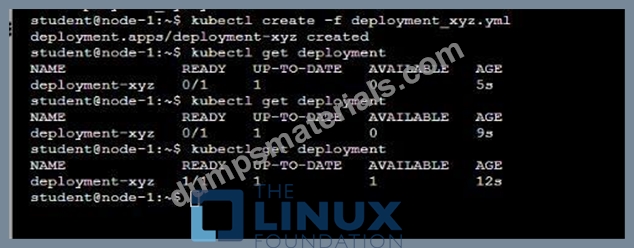
Given a container that writes a log file in format A and a container that converts log files from format A to format B, create a deployment that runs both containers such that the log files from the first container are converted by the second container, emitting logs in format B.
Task:
* Create a deployment named deployment-xyz in the default namespace, that:
*Includes a primary
lfccncf/busybox:1 container, named logger-dev
*includes a sidecar Ifccncf/fluentd:v0.12 container, named adapter-zen
*Mounts a shared volume /tmp/log on both containers, which does not persist when the pod is deleted
*Instructs the logger-dev
container to run the command
which should output logs to /tmp/log/input.log in plain text format, with example values:
* The adapter-zen sidecar container should read /tmp/log/input.log and output the data to /tmp/log/output.* in Fluentd JSON format. Note that no knowledge of Fluentd is required to complete this task: all you will need to achieve this is to create the ConfigMap from the spec file provided at /opt/KDMC00102/fluentd-configma p.yaml , and mount that ConfigMap to /fluentd/etc in the adapter-zen sidecar container See the solution below.
Answer:
Explanation:
Explanation
Solution:


NEW QUESTION 14
Refer to Exhibit.
Context
You are tasked to create a secret and consume the secret in a pod using environment variables as follow:
Task
* Create a secret named another-secret with a key/value pair; key1/value4
* Start an nginx pod named nginx-secret using container image nginx, and add an environment variable exposing the value of the secret key key 1, using COOL_VARIABLE as the name for the environment variable inside the pod
Answer:
Explanation:
Solution:


NEW QUESTION 15
Context
Task:
1- Update the Propertunel scaling configuration of the Deployment web1 in the ckad00015 namespace setting maxSurge to 2 and maxUnavailable to 59
2- Update the web1 Deployment to use version tag 1.13.7 for the Ifconf/nginx container image.
3- Perform a rollback of the web1 Deployment to its previous version
Answer:
Explanation:
Solution:


NEW QUESTION 16
Context
Task
Create a new deployment for running.nginx with the following parameters;
* Run the deployment in the kdpd00201 namespace. The namespace has already been created
* Name the deployment frontend and configure with 4 replicas
* Configure the pod with a container image of lfccncf/nginx:1.13.7
* Set an environment variable of NGINX__PORT=8080 and also expose that port for the container above
Answer:
Explanation:
Solution:


NEW QUESTION 17
Context
Task:
Modify the existing Deployment named broker-deployment running in namespace quetzal so that its containers.
1) Run with user ID 30000 and
2) Privilege escalation is forbidden
The broker-deployment is manifest file can be found at:
Answer:
Explanation:
Solution:


NEW QUESTION 18
Exhibit:
Context
You are tasked to create a secret and consume the secret in a pod using environment variables as follow:
Task
* Create a secret named another-secret with a key/value pair; key1/value4
* Start an nginx pod named nginx-secret using container image nginx, and add an environment variable exposing the value of the secret key key 1, using COOL_VARIABLE as the name for the environment variable inside the pod
- A. Solution:


- B. Solution:

Answer: B
NEW QUESTION 19
Exhibit:
Context
A user has reported an aopticauon is unteachable due to a failing livenessProbe .
Task
Perform the following tasks:
* Find the broken pod and store its name and namespace to /opt/KDOB00401/broken.txt in the format:
The output file has already been created
* Store the associated error events to a file /opt/KDOB00401/error.txt, The output file has already been created. You will need to use the -o wide output specifier with your command
* Fix the issue.
- A. Solution:
Create the Pod:
kubectl create -f http://k8s.io/docs/tasks/configure-pod-container/exec-liveness.yaml
Within 30 seconds, view the Pod events:
kubectl describe pod liveness-exec
The output indicates that no liveness probes have failed yet:
FirstSeen LastSeen Count From SubobjectPath Type Reason Message
--------- -------- ----- ---- ------------- -------- ------ -------
24s 24s 1 {default-scheduler } Normal Scheduled Successfully assigned liveness-exec to worker0
23s 23s 1 {kubelet worker0} spec.containers{liveness} Normal Pulling pulling image "gcr.io/google_containers/busybox"
23s 23s 1 {kubelet worker0} spec.containers{liveness} Normal Pulled Successfully pulled image "gcr.io/google_containers/busybox"
23s 23s 1 {kubelet worker0} spec.containers{liveness} Normal Created Created container with docker id 86849c15382e; Security:[seccomp=unconfined]
23s 23s 1 {kubelet worker0} spec.containers{liveness} Normal Started Started container with docker id 86849c15382e
After 35 seconds, view the Pod events again:
kubectl describe pod liveness-exec
At the bottom of the output, there are messages indicating that the liveness probes have failed, and the containers have been killed and recreated.
FirstSeen LastSeen Count From SubobjectPath Type Reason Message
--------- -------- ----- ---- ------------- -------- ------ -------
37s 37s 1 {default-scheduler } Normal Scheduled Successfully assigned liveness-exec to worker0
36s 36s 1 {kubelet worker0} spec.containers{liveness} Normal Pulling pulling image "gcr.io/google_containers/busybox"
36s 36s 1 {kubelet worker0} spec.containers{liveness} Normal Pulled Successfully pulled image "gcr.io/google_containers/busybox"
36s 36s 1 {kubelet worker0} spec.containers{liveness} Normal Created Created container with docker id 86849c15382e; Security:[seccomp=unconfined]
36s 36s 1 {kubelet worker0} spec.containers{liveness} Normal Started Started container with docker id 86849c15382e
2s 2s 1 {kubelet worker0} spec.containers{liveness} Warning Unhealthy Liveness probe failed: cat: can't open '/tmp/healthy': No such file or directory
Wait another 30 seconds, and verify that the Container has been restarted:
kubectl get pod liveness-exec
The output shows that RESTARTS has been incremented:
NAME READY STATUS RESTARTS AGE
liveness-exec 1/1 Running 1 m - B. Solution:
Create the Pod:
kubectl create -f http://k8s.io/docs/tasks/configure-pod-container/exec-liveness.yaml
Within 30 seconds, view the Pod events:
kubectl describe pod liveness-exec
The output indicates that no liveness probes have failed yet:
FirstSeen LastSeen Count From SubobjectPath Type Reason Message
--------- -------- ----- ---- ------------- -------- ------ -------
24s 24s 1 {default-scheduler } Normal Scheduled Successfully assigned liveness-exec to worker0
23s 23s 1 {kubelet worker0} spec.containers{liveness} Normal Pulling pulling image "gcr.io/google_containers/busybox"
kubectl describe pod liveness-exec
At the bottom of the output, there are messages indicating that the liveness probes have failed, and the containers have been killed and recreated.
FirstSeen LastSeen Count From SubobjectPath Type Reason Message
--------- -------- ----- ---- ------------- -------- ------ -------
37s 37s 1 {default-scheduler } Normal Scheduled Successfully assigned liveness-exec to worker0
36s 36s 1 {kubelet worker0} spec.containers{liveness} Normal Pulling pulling image "gcr.io/google_containers/busybox"
36s 36s 1 {kubelet worker0} spec.containers{liveness} Normal Pulled Successfully pulled image "gcr.io/google_containers/busybox"
36s 36s 1 {kubelet worker0} spec.containers{liveness} Normal Created Created container with docker id 86849c15382e; Security:[seccomp=unconfined]
36s 36s 1 {kubelet worker0} spec.containers{liveness} Normal Started Started container with docker id 86849c15382e
2s 2s 1 {kubelet worker0} spec.containers{liveness} Warning Unhealthy Liveness probe failed: cat: can't open '/tmp/healthy': No such file or directory
Wait another 30 seconds, and verify that the Container has been restarted:
kubectl get pod liveness-exec
The output shows that RESTARTS has been incremented:
NAME READY STATUS RESTARTS AGE
liveness-exec 1/1 Running 1 m
Answer: A
NEW QUESTION 20
Exhibit:
Given a container that writes a log file in format A and a container that converts log files from format A to format B, create a deployment that runs both containers such that the log files from the first container are converted by the second container, emitting logs in format B.
Task:
* Create a deployment named deployment-xyz in the default namespace, that:
* Includes a primary
lfccncf/busybox:1 container, named logger-dev
* includes a sidecar Ifccncf/fluentd:v0.12 container, named adapter-zen
* Mounts a shared volume /tmp/log on both containers, which does not persist when the pod is deleted
* Instructs the logger-dev
container to run the command
which should output logs to /tmp/log/input.log in plain text format, with example values:
* The adapter-zen sidecar container should read /tmp/log/input.log and output the data to /tmp/log/output.* in Fluentd JSON format. Note that no knowledge of Fluentd is required to complete this task: all you will need to achieve this is to create the ConfigMap from the spec file provided at /opt/KDMC00102/fluentd-configma p.yaml , and mount that ConfigMap to /fluentd/etc in the adapter-zen sidecar container
- A. Solution:


- B. Solution:
Answer: A
NEW QUESTION 21
Context
Anytime a team needs to run a container on Kubernetes they will need to define a pod within which to run the container.
Task
Please complete the following:
* Create a YAML formatted pod manifest
/opt/KDPD00101/podl.yml to create a pod named app1 that runs a container named app1cont using image Ifccncf/arg-output with these command line arguments: -lines 56 -F
* Create the pod with the kubect1 command using the YAML file created in the previous step
* When the pod is running display summary data about the pod in JSON format using the kubect1 command and redirect the output to a file named /opt/KDPD00101/out1.json
* All of the files you need to work with have been created, empty, for your convenience
Answer:
Explanation:
See the solution below.
Explanation
Solution:


NEW QUESTION 22
Context
Context
It is always useful to look at the resources your applications are consuming in a cluster.
Task
* From the pods running in namespace cpu-stress , write the name only of the pod that is consuming the most CPU to file /opt/KDOBG030l/pod.txt, which has already been created.
Answer:
Explanation:
Solution:
NEW QUESTION 23
Context
Task
You are required to create a pod that requests a certain amount of CPU and memory, so it gets scheduled to-a node that has those resources available.
* Create a pod named nginx-resources in the pod-resources namespace that requests a minimum of 200m CPU and 1Gi memory for its container
* The pod should use the nginx image
* The pod-resources namespace has already been created
Answer:
Explanation:
Solution:


NEW QUESTION 24 
Context
Your application's namespace requires a specific service account to be used.
Task
Update the app-a deployment in the production namespace to run as the restrictedservice service account. The service account has already been created.
Answer:
Explanation:
See the solution below.
Explanation
Solution:
NEW QUESTION 25
Refer to Exhibit.
Set Configuration Context:
[student@node-1] $ | kubectl
Config use-context k8s
Task
You have rolled out a new pod to your infrastructure and now you need to allow it to communicate with the web and storage pods but nothing else. Given the running pod kdsn00201 -newpod edit it to use a network policy that will allow it to send and receive traffic only to and from the web and storage pods.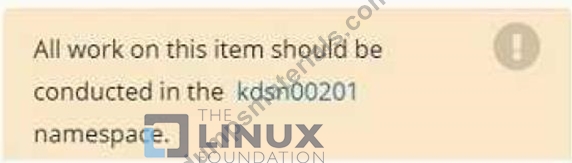

Answer:
Explanation:
To allow a pod to send and receive traffic only to and from specific pods, you can use network policies in Kubernetes.
First, you will need to create a network policy that defines the allowed traffic. You can create a network policy yaml file with the following rules:
apiVersion: networking.k8s.io/v1
kind: NetworkPolicy
metadata:
name: newpod-network-policy
namespace: default
spec:
podSelector:
matchLabels:
app: kdsn00201-newpod
ingress:
- from:
- podSelector:
matchLabels:
app: web
- podSelector:
matchLabels:
app: storage
This policy will only allow incoming traffic to the pod with the label app=kdsn00201-newpod from pods with the label app=web or app=storage. If you have different labels on your web and storage pods please update the matchLabels accordingly.
Once you have created the network policy, you can apply it to the cluster by running the following command:
kubectl apply -f <network-policy-file>.yaml
This will apply the network policy to the cluster, and the newpod will only be able to send and receive traffic to and from the web and storage pods.
Please note that, NetworkPolicy resource is not available by default, you need to enable the NetworkPolicy feature on your Kubernetes cluster. This feature is enabled by default on some clusters and must be explicitly enabled on others. You can check if NetworkPolicy is available by running the command kubectl api-versions | grep networking Also, you need to ensure that the pods that you want to allow traffic to and from are running on the same namespace.
NEW QUESTION 26 
Task:
The pod for the Deployment named nosql in the craytisn namespace fails to start because its container runs out of resources.
Update the nosol Deployment so that the Pod:
1) Request 160M of memory for its Container
2) Limits the memory to half the maximum memory constraint set for the crayfah name space.
Answer:
Explanation:
See the solution below.
Explanation
Solution:


NEW QUESTION 27
Exhibit:
Task
You are required to create a pod that requests a certain amount of CPU and memory, so it gets scheduled to-a node that has those resources available.
* Create a pod named nginx-resources in the pod-resources namespace that requests a minimum of 200m CPU and 1Gi memory for its container
* The pod should use the nginx image
* The pod-resources namespace has already been created
- A. Solution:
- B. Solution:
Answer: A
NEW QUESTION 28
Refer to Exhibit.
Set Configuration Context:
[student@node-1] $ | kubectl
Config use-context k8s
Context
A user has reported an aopticauon is unteachable due to a failing livenessProbe .
Task
Perform the following tasks:
* Find the broken pod and store its name and namespace to /opt/KDOB00401/broken.txt in the format:
<namespace>/<pod>
The output file has already been created
* Store the associated error events to a file /opt/KDOB00401/error.txt, The output file has already been created. You will need to use the -o wide output specifier with your command
* Fix the issue.
Answer:
Explanation:
To find the broken pod and store its name and namespace to /opt/KDOB00401/broken.txt, you can use the kubectl get pods command and filter the output by the status of the pod.
kubectl get pods --field-selector=status.phase=Failed -o jsonpath='{.items[*].metadata.namespace}/{.items[*].metadata.name}' > /opt/KDOB00401/broken.txt This command will list all pods with a status of Failed and output their names and namespaces in the format <namespace>/<pod>. The output is then written to the /opt/KDOB00401/broken.txt file.
To store the associated error events to a file /opt/KDOB00401/error.txt, you can use the kubectl describe command to retrieve detailed information about the pod, and the grep command to filter the output for error events.
kubectl describe pods <pod-name> --namespace <pod-namespace> | grep -i error -B5 -A5 > /opt/KDOB00401/error.txt Replace <pod-name> and <pod-namespace> with the name and namespace of the broken pod you found in the previous step.
This command will output detailed information about the pod, including error events. The grep command filters the output for lines containing "error" and also prints 5 lines before and after the match.
To fix the issue, you need to analyze the error events and find the root cause of the issue.
It could be that the application inside the pod is not running, the container image is not available, the pod has not enough resources, or the liveness probe configuration is incorrect.
Once you have identified the cause, you can take appropriate action, such as restarting the application, updating the container image, increasing the resources, or modifying the liveness probe configuration.
After fixing the issue, you can use the kubectl get pods command to check the status of the pod and ensure
NEW QUESTION 29
Task:
Create a Deployment named expose in the existing ckad00014 namespace running 6 replicas of a Pod. Specify a single container using the ifccncf/nginx: 1.13.7 image Add an environment variable named NGINX_PORT with the value 8001 to the container then expose port
8001
Answer:
Explanation:
See the solution below.
Explanation
Solution:
Text Description automatically generated
Text Description automatically generated
NEW QUESTION 30
Refer to Exhibit.
Task:
Update the Pod ckad00018-newpod in the ckad00018 namespace to use a NetworkPolicy allowing the Pod to send and receive traffic only to and from the pods web and db
Answer:
Explanation:
Solution:

NEW QUESTION 31
Exhibit:
Task
Create a new deployment for running.nginx with the following parameters;
* Run the deployment in the kdpd00201 namespace. The namespace has already been created
* Name the deployment frontend and configure with 4 replicas
* Configure the pod with a container image of lfccncf/nginx:1.13.7
* Set an environment variable of NGINX__PORT=8080 and also expose that port for the container above
- A. Solution:

- B. Solution:
Answer: B
NEW QUESTION 32
Context
Task:
A pod within the Deployment named buffale-deployment and in namespace gorilla is logging errors.
1) Look at the logs identify errors messages.
Find errors, including User "system:serviceaccount:gorilla:default" cannot list resource "deployment" [...] in the namespace "gorilla"
2) Update the Deployment buffalo-deployment to resolve the errors in the logs of the Pod.
The buffalo-deployment 'S manifest can be found at -/prompt/escargot/buffalo-deployment.yaml
Answer:
Explanation:
Solution:
NEW QUESTION 33
......
Difficulty in Attempting CNCF Certified Kubernetes Application Developer Exam
The difficulty of the CNCF Certified Kubernetes Application Developer exam is a commonly debated topic among many test takers. Many people worry that this exam is much harder than other certification exams from vendor-neutral organizations. However, the difficulty of this exam is similar to many other vendor-neutral certifications. If you are confident you will pass this exam, do not worry about the difficulty. Just focus on preparing for it. CNCF CKAD Dumps is a very good option to prepare for this exam, and it will give you a lot of study materials.
The most likely path to passing the CNCF Certified Kubernetes Application Developer is by taking and passing a vendor-neutral course. Created by highly skilled IT professionals, these courses will provide the necessary knowledge and skills to pass this exam. If you are willing to take a vendor-neutral course, then the CNCF Certified Kubernetes Application Developer cert will be one of your greatest career accomplishments. Mobile app developers need to know the concepts of cloud computing. So they should prepare for the CNCF Certified Kubernetes Application Developer exam with a course created specifically to help them with their career. Environment engineers need to work with many different types of virtual machines. The CNCF Certified Kubernetes Application Developer course will prepare them for this.
Authentic Best resources for CKAD Online Practice Exam: https://www.dumpsmaterials.com/CKAD-real-torrent.html
Get the superior quality CKAD Dumps Questions from DumpsMaterials: https://drive.google.com/open?id=1En3va3B4C6z2QQ6hF-SnAkYIjWFwPlo6
