
Pass Oracle 1Z1-082 Exam Quickly With DumpsMaterials
Prepare 1Z1-082 Question Answers - 1Z1-082 Exam Dumps
Oracle 1Z1-082 exam is an essential certification for all professionals who work in Oracle Database Administration I. This is a popular exam taken by professionals who are responsible for database administration and management. If you're looking to demonstrate your understanding of database administration and gain recognition in the industry, then passing the Oracle 1Z1-082 exam is the way to go.
To prepare for the Oracle 1Z0-082 exam, candidates can take advantage of a variety of resources, including Oracle's official study materials, online training courses, and practice exams. Additionally, candidates can gain practical experience by working with Oracle databases and practicing database administration tasks.
NEW QUESTION # 10
Which three statements are true about external tables in Oracle 18c and later releases? (Choose three.)
- A. External table files can be used for other external tables in a different database
- B. The ORACLE_DATAPUMP access driver can be used to load data into a database from an external table
- C. They support UPDATEs but not INSERTs and DELETEs
- D. The ORACLE_LOADER access driver can be used to unload data from a database into an external table
- E. They cannot be partitioned
- F. The ORACLE_DATAPUMP access driver can be used to unload data from a database into an external table
Answer: A,D,F
Explanation:
https://docs.oracle.com/en/database/oracle/oracle-database/18/admin/managing-tables.html#GUID-F6948F0E-0557-4C42-9145-1897DE974CC3
NEW QUESTION # 11
You currently have an active transaction in your session and have been granted select access to vstransaction.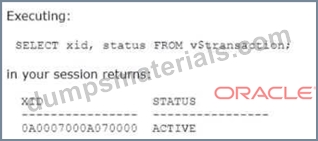
In which three situations will re-executing this query still return a row but with a different XID, indicating a new transaction has started?
- A. after successfully executing a commit or rollback followed by a DML statement
- B. after successfully executing a commit or rollback followed by a select statement
- C. after successfully executing a truncate statement followed by a DML statement
- D. after successfully executing a DML statement following a failed DML statement
- E. after successfully executing a create table statement followed by a create index statement
- F. after successfully executing a create table as select statement followed by a select for update statement
Answer: A,C,F
NEW QUESTION # 12
You execute this command: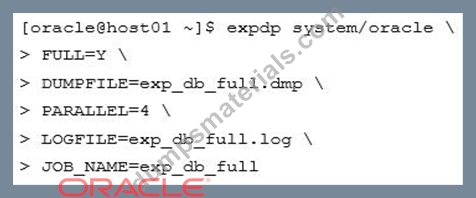
During the export operation, you detach from the job by using CTRL+C and then execute this command:
Export> STOP_JOB=immediate
Are you sure you wish to stop the job ([yes]/no): yes
Which two statements are true about the job? (Choose two.)
- A. It continues to run in the background
- B. It is paused and can be resumed
- C. You can reattach to it and monitor it
- D. You can no longer monitor it
- E. It terminates
Answer: D,E
Explanation:
https://blog.oracle48.nl/killing-and-resuming-datapump-expdp-and-impdp-jobs/
NEW QUESTION # 13
Which three statements are true about inner and outer joins? (Choose three.)
- A. A left or right outer join returns only unmatched rows
- B. Outer joins can be used when there are multiple join conditions on two tables
- C. A full outer join must use Oracle syntax
- D. An inner join returns matched rows
- E. A full outer join returns matched and unmatched rows
- F. Outer joins can only be used between two tables per query
Answer: A,D,E
Explanation:
https://www.studytonight.com/dbms/joining-in-sql.php
NEW QUESTION # 14
Examine the description of the PROMOTIONS table: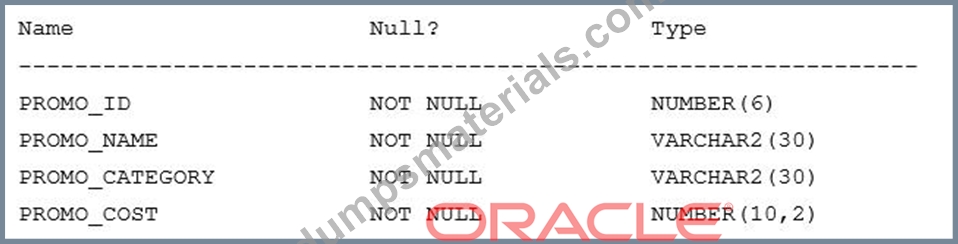
You want to display the unique promotion costs in each promotion category.
Which two queries can be used? (Choose two.)
- A. SELECT promo_category, DISTINCT promo_cost FROM promotions ORDER BY 2;
- B. SELECT DISTINCT promo_category || ` has ` || promo_cost AS COSTS FROM promotions ORDER BY 1;
- C. SELECT DISTINCT promo_category, promo_cost FROM promotions ORDER BY 1;
- D. SELECT DISTINCT promo_cost || ' in ` || DISTINCT promo_category FROM promotions ORDER BY 1;
- E. SELECT promo_cost, promo_category FROM promotions ORDER BY by 1;
Answer: A,C
NEW QUESTION # 15
Which two statements are true about the Automatic Diagnostic Repository (ADR)? (Choose two.)
- A. The ADR base defaults to $ORACLE_HOME/rdbms/admin ifneither DIAGNOSTIC_DEST nor ORACLE_BASE is set
- B. It supports diagnostics for Automatic Storage Management (ASM)
- C. The ADR base defaults to $ORACLE_HOME/dbs if the DIAGNOSTIC_DEST parameter and the ORACLE_BASE environment variable are not set
- D. It supports diagnostics for Oracle Clusterware
- E. It is held inside an Oracle database schema
Answer: B,D
Explanation:
The database, Oracle Automatic Storage Management (Oracle ASM), the listener, Oracle Clusterware, and other Oracle products or components store all diagnostic data in the ADR. https://docs.oracle.com/database/121/ADMIN/diag.htm#ADMIN11260
NEW QUESTION # 16
Examine this command: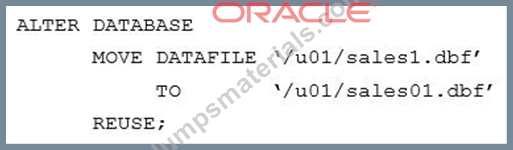
Which two statements are true? (Choose two.)
- A. The tablespace containing SALES1.DBF must be altered READ ONLY before executing the command.
- B. The file is renamed and stored in the same location
- C. If Oracle Managed Files (OMF) is used, then the file is renamed but moved to DB_CREATE_FILE_DEST.
- D. The tablespace containing SALES1.DBF must be altered OFFLINE before executing the command.
- E. DML may be performed on tables with one or more extents in this data file during the execution of this command.
Answer: A,E
NEW QUESTION # 17
Which three activities are recorded in the database alert log? (Choose three.)
- A. non-default database parameters
- B. session logins and logouts
- C. deadlock errors
- D. block corruption errors
- E. Data Definition Language (DDL) statements
Answer: A,C,D
Explanation:
Reference:
https://docs.oracle.com/cd/B28359_01/server.111/b28310/monitoring001.htm#ADMIN11247
NEW QUESTION # 18
View the Exhibits and examine the structure of the COSTS and PROMOTIONS tables.
You want to display PROD_IDS whose promotion cost is less than the highest cost PROD_ID in a promotion time interval.
Examine this SQL statement: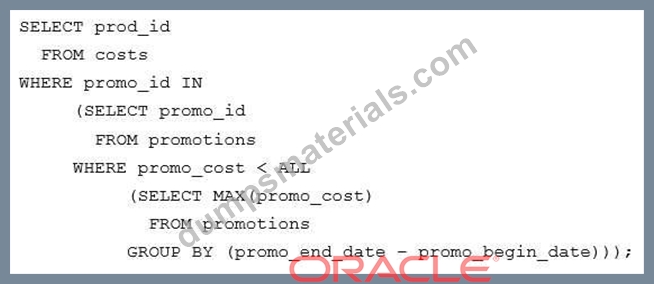
Exhibit 1.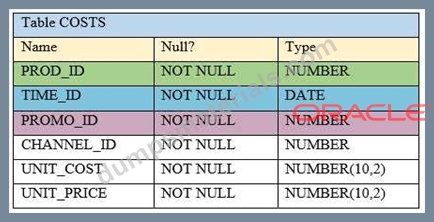
Exhibit 2.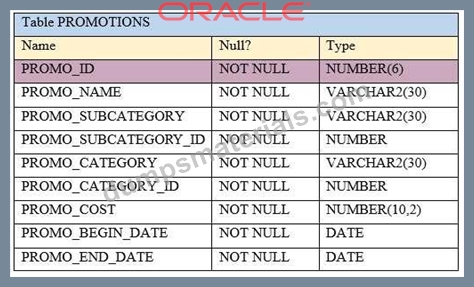
What will be the result?
- A. It executes successfully but does not give the required result
- B. It gives an error because the ALL keyword is not valid
- C. It gives an error because the GROUP BY clause is not valid
- D. It executes successfully and gives the required result
Answer: D
NEW QUESTION # 19
Table ORDER_ITEMS contains columns ORDER_ID, UNIT_PRICE and QUANTITY, of data type NUMBER.
Examine these SQL statements:
Statement 1:
SELECT MAX(unit_price * quantity) "Maximum Order"
FROM order_items;
Statement 2:
SELECT MAX(unit_price * quantity) "Maximum Order"
FROM order_items
GROUP BY order_id;
Which two statements are true?
- A. Statement 2 returns only one row of output.
- B. Both the statements give the same output.
- C. Statement 2 may return multiple rows of output.
- D. Statement 1 returns only one row of output.
- E. Both statements will return NULL if either UNIT_PRICE or QUANTITY contains NULL.
Answer: C,D
Explanation:
https://docs.oracle.com/javadb/10.8.3.0/ref/rrefsqlj27781.html
The Expression can contain multiple column references or expressions, but it cannot contain another aggregate or subquery. It must evaluate to a built-in data type. You can therefore call methods that evaluate to built-in data types. (For example, a method that returns a java.lang.Integer or int evaluates to an INTEGER.) If an expression evaluates to NULL, the aggregate skips that value.
NEW QUESTION # 20
Which three Oracle database space management features will work with both Dictionary and Locally managed tablespaces? (Choose three.)
- A. Online index segment shrink
- B. Oracle Managed Files (OMF)
- C. Capacity planning growth reports based on historical data in the Automatic Workload Repository (AWR)
- D. Online table segment shrink
- E. Automatic data file extension (AUTOEXTEND)
Answer: B,C,E
NEW QUESTION # 21
Which two are true about shrinking a segment online? (Choose two.)
- A. To shrink a table it must have a PRIMARY KEY constraint
- B. To shrink a table it must have row movement enabled
- C. To shrink a table it must have a UNIQUE KEY constraint
- D. It is not possible to shrink either indexes or Index Organized Tables (IOTs)
- E. It always eliminates all migrated rows if any exist in the table
- F. It must be in a tablespace that uses Automatic Segment Space Management (ASSM)
Answer: B,F
Explanation:
Reference:
https://docs.oracle.com/cd/B19306_01/server.102/b14200/statements_3001.htm
NEW QUESTION # 22
Which three statements are true about a self-join? (Choose three.)
- A. It can be an outer join
- B. The ON clause can be used
- C. The ON clause must be used
- D. It must be an equi join
- E. It must be an inner join
- F. The query must use two different aliases for the table
Answer: B,E,F
NEW QUESTION # 23
Which three statements are true about the DESCRIBE command? (Choose three.)
- A. It can be used only from SQL *Plus
- B. It displays the PRIMARY KEY constraint for any column or columns that have that constraint
- C. It can be used to display the structure of an existing view
- D. It displays the NOT NULL constraint for any columns that have that constraint
- E. It displays all constraints that are defined for each column
- F. It can be used from SQL Developer
Answer: A,C,D
NEW QUESTION # 24
Which two statements are true about single row functions? (Choose two.)
- A. CONCAT : can be used to combine any number of values
- B. MOD : returns the quotient of a division operation
- C. TRUNC : can be used to combine any number of values
- D. CEIL : can be used for positive and negative numbers
- E. FLOOR : returns the smallest integer greater than or equal to a specified number
Answer: B,C
NEW QUESTION # 25
Which two statements are true about the results of using the INTERSECT operator in compound queries?
(Choose two.)
- A. The number of columns in each SELECT in the compound query can be different
- B. INTERSECT ignores NULLs
- C. INTERSECT returns rows common to both sides of the compound query
- D. Reversing the order of the intersected tables can sometimes affect the output
- E. Column names in each SELECT in the compound query can be different
Answer: B,E
NEW QUESTION # 26
Which three are types of segments in an Oracle Database? (Choose three.)
- A. index
- B. sequences
- C. clusters
- D. stored procedures
- E. tables
- F. undo
Answer: C,E,F
NEW QUESTION # 27
In one of your databases, the user HR has the password HRMGR. You want to connect to a database instance whose listener listens on port 1531 by using this statement:
CONNECT HR/HRMGR@orcl
No name server is used.
Which statement is true about ORCL?
- A. It must resolve to a valid connect descriptor in the client's tnsnames.ora file
- B. It must be the name of the server running the database to whose instance HR wishes to connect
- C. It must resolve to a valid connect descriptor in the server's tnsnames.ora file
- D. It must be the value of the SERVICE_NAMES parameter on the client side
- E. It must be the name of the database to whose instance HR wishes to connect
Answer: B
NEW QUESTION # 28
Which three statements are true regarding indexes? (Choose three.)
- A. A UNIQUE index can be altered to be non-unique
- B. A SELECT statement can access one or more indices without accessing any tables
- C. When a table is dropped and is moved to the RECYCLE BIN, all indexes built on that table are permanently dropped
- D. An update to a table can result in no updates to any of the table's indexes
- E. An update to a table can result in updates to any or all of the table's indexes
- F. A table belonging to one user can have an index that belongs to a different user
Answer: A,C,F
Explanation:
https://docs.oracle.com/cd/A87860_01/doc/server.817/a76956/indexes.htm
https://docs.oracle.com/cd/B10501_01/server.920/a96521/indexes.htm
NEW QUESTION # 29
In one of your databases, the user HR has the password HRMGR.
You want to connect to a database instance whose listener listens on port 1531 by using this statement:
CONNECT HR/HRMGR@orcl
No name server is used.
Which statement is true about ORCL?
- A. It must resolve to a valid connect descriptor in the client's tnsnames.ora file
- B. It must be the name of the server running the database to whose instance HR wishes to connect
- C. It must resolve to a valid connect descriptor in the server's tnsnames.ora file
- D. It must be the value of the SERVICE_NAMES parameter on the client side
- E. It must be the name of the database to whose instance HR wishes to connect
Answer: B
NEW QUESTION # 30
Which three statements are true about advanced connection options supported by Oracle Net for connection to Oracle Database instances? (Choose three.)
- A. Source Routing enables the use of Connection Manager (CMAN) which enables network traffic to be routed through a firewall
- B. Load Balancing requires the use of a name server
- C. Connect Time Failover requires the connect string to have two or more listener addresses configured
- D. Connect Time Failover requires the use of Transparent Application Failover (TAF)
- E. Load Balancing can balance the number of connections to dispatchers when using a Shared Server configuration
- F. Source Routing requires the use of a name server
Answer: A,C,F
Explanation:
https://docs.oracle.com/cd/E11882_01/network.112/e41945/advcfg.htm#NETAG013
NEW QUESTION # 31
......
By passing the Oracle 1Z1-082 exam, professionals can demonstrate their proficiency in Oracle Database Administration and enhance their career prospects. Oracle Database Administration I certification also provides a strong foundation for further Oracle certifications in Database Administration, including the Oracle Certified Professional (OCP) and Oracle Certified Master (OCM) certifications.
Real Oracle 1Z1-082 Exam Questions [Updated 2026]: https://www.dumpsmaterials.com/1Z1-082-real-torrent.html
Free 1Z1-082 Exam Dumps to Pass Exam Easily: https://drive.google.com/open?id=1Oh8xUHeuKOaZlL8DYFJlualkjN8C0cci
