
Adobe AD0-E716 Exam Dumps - PDF Questions and Testing Engine
Latest AD0-E716 Exam Dumps for Pass Guaranteed
NEW QUESTION # 10
A new customer registered on the Integration environment of an Adobe Commerce Cloud project but did not receive a welcome email What would be blocking the email from being sent?
- A. On all Integration environments, email is always disabled.
- B. SendGrid has not been configured for this environment.
- C. The Outgoing Emails setting is disabled into Environment Settings in the Project Web Interface.
Answer: A
Explanation:
In Adobe Commerce Cloud, outgoing emails are disabled by default on Integration environments to prevent test or development emails from being sent to real customers.
* Email Configuration on Integration Environments:
* Emails are disabled on Integration environments by default to prevent accidental communications during development. This behavior is a standard setting and cannot be overridden in Integration.
* Why Option B is Correct:
* This is a standard practice in Adobe Commerce Cloud, as email functionality is disabled to prevent disruptions. Options A and C are not applicable since Integration environments do not support outgoing emails regardless of additional settings.
* References:
* Adobe Commerce Cloud documentation on Email Configuration
NEW QUESTION # 11
How would a developer enable the magnification of CSS files on an Adobe Commerce Cloud Staging environment?
- A. Locally from the command line
bin/magento config:set --lock-config dev/css/minify_files 1
Commit the app/etc/config.php file and redeploy. - B. SSH to the Adobe Commerce Staging environment. From the command line

- C. Update the stores > setting > configuration > Advanced > Developer > css configuration in the Admin Panel.
Answer: B
Explanation:
For Adobe Commerce Cloud environments, modifying configuration settings often involves using the ece- tools command-line interface. To enable CSS minification on a staging environment, SSH into the environment and use ece-tools to set the configuration.
* Using ece-tools for Cloud Environments:
* The ece-tools command sets environment configurations, which is preferable in Cloud environments as changes are made outside of the database, allowing for consistent configuration across deployments.
* Why Option C is Correct:
* SSH access to the environment and using ece-tools ensures that settings are deployed properly.
Option A involves committing app/etc/config.php, which is not directly related to Adobe Commerce Cloud's best practices. Option B involves the Admin panel, which is less practical for deployment consistency.
* Steps:
* After setting the configuration, run bin/magento setup:static-content:deploy to apply the changes.
* References:
* Adobe Commerce Cloud documentation on Using ece-tools
NEW QUESTION # 12
There is an integration developed using a cron service that runs twice a day, sending the Order ID to the integrated ERP system if there are orders that are able to create an invoice. The order is already loaded with the following code:
$order = $this->orderRepository->get($orderId);
In order to verify if the store has invoices to be created, what implementation would the Adobe Commerce developer use?
- A.

- B.

- C.

Answer: B
Explanation:
The developer can use the canInvoice method of the order object to check if the order can be invoiced or not.
This method returns true if the order has a state of new, processing, or payment review and has not been fully invoiced yet. The developer can use this method in a conditional statement to send the order ID to the ERP system only if the order can be invoiced. Verified References: [Magento 2.4 DevDocs] [Magento Stack Exchange]
NEW QUESTION # 13
ECE-Tools provides a set of tools that can be used to manage and maintain your Adobe Commerce Cloud environment. What are some of the features provided by ECE-Tools?
- A. Builds application, Applies custom patches, and Shows the list of S3 backup tar.gz files.
- B. Builds application, Applies custom patches and Dump configuration for static content deployment.
- C. Fastly configuration, Applies custom patches and Dump configuration for static content deployment.
Answer: B
Explanation:
Some of the features provided by ECE-Tools are building application, applying custom patches, and dumping configuration for static content deployment. ECE-Tools is a set of scripts and tools designed to manage and deploy Adobe Commerce Cloud projects. It provides commands for building application code, applying patches for Magento core issues or custom modules, and dumping configuration settings for static content deployment optimization. Verified Reference: [Magento 2.4 DevDocs] 2
NEW QUESTION # 14
An Adobe Commerce Cloud developer wants to be sure that, even after transferring database from Production to Staging, the payment configurations are still valid on the Staging environment.
What does the developer need to add to be sure that the configurations are always properly set?
- A. Lines in the dedicated core_conf ig_data_stg table.
- B. Environment level environment variables.
- C. Project level environment variables.
Answer: B
Explanation:
The developer needs to add environment level environment variables to be sure that the payment configurations are always properly set on the Staging environment. Environment variables are configuration settings that affect the behavior of the Adobe Commerce Cloud application and services. Environment variables can be set at the project level or the environment level. Project level variables apply to all environments, while environment level variables override the project level variables for a specific environment. The developer can use environment level variables to customize the payment configurations for the Staging environment without affecting other environments. Verified References: [Magento 2.4 DevDocs]
NEW QUESTION # 15
An Adobe Commerce Cloud merchant has been experiencing significant downtime during production deployment. They have already checked that the application is in ideal state.
In addition to the configuration of the SCD.MATRIX variable to reduce amount of unnecessary theme files, what would be the next steps to reduce the downtime?
- A. 1. Check SCD is configured under the build phase.
2. Check if Adobe Commerce Cloud automatically adjusts SCD.THREADS. - B. 1. Check SCD is configured under the build phase.
2. Increase the SCD.THREADS to speed up the build process. - C. 1. Check SCD is configured under deploy phase.
2. Decrease the SCD.THREADS to speed up the build process
Answer: B
Explanation:
The next steps to reduce the downtime are to check that the SCD is configured under the build phase and to increase the SCD.THREADS to speed up the build process. The SCD stands for static content deployment, which is the process of generating and deploying static files such as CSS, JS, images, etc. By configuring the SCD under the build phase, the static files are generated before the code is deployed to the production environment, which reduces the downtime during deployment. The SCD.THREADS is a variable that determines how many threads are used for parallel processing during the SCD. By increasing the SCD.THREADS, the developer can improve the performance and efficiency of the SCD process. Verified Reference: [Magento 2.4 DevDocs] 12
NEW QUESTION # 16
How would a developer enable the magnification of CSS files on an Adobe Commerce Cloud Staging environment?
- A. SSH to the Adobe Commerce Staging environment. From the command line

- B. Update the stores > setting > configuration > Advanced > Developer > css configuration in the Admin Panel.
- C. Locally from the command line
bin/magento config:set --lock-config dev/css/minify_files 1
Commit the app/etc/config.php file and redeploy.
Answer: C
Explanation:
The developer can enable the magnification of CSS files on an Adobe Commerce Cloud Staging environment by locally running the command bin/magento config:set --lock-config dev/css/minify_files 1 from the command line. This will set the configuration value in the app/etc/config.php file and lock it from being changed in the Admin Panel. The developer then needs to commit the app/etc/config.php file and redeploy the environment. Verified References: [Magento 2.4 DevDocs] 2
NEW QUESTION # 17
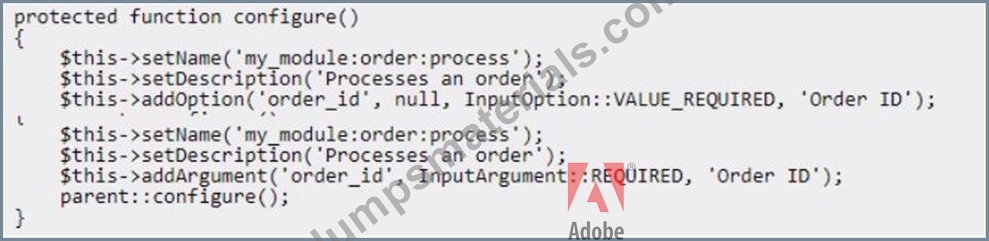
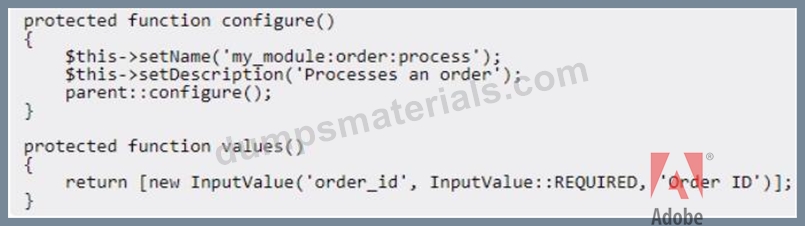
An Adobe Commerce developer has created a process that exports a given order to some external accounting system. Launching this process using the Magento CLI with the command php bin/magento my_module:order: process --order_id=<order_id> is required.
Example: php bin/magento my_module:order:process --order_id=1245.
What is the correct way to configure the command?
- A.
- B.
- C.

- D.

Answer: A
Explanation:
According to the How to use the Magento command-line interface (CLI) guide, to configure and run the Magento CLI, the developer needs to make the bin/magento file executable and then use it to run commands. To create a custom command, the developer needs to create a class that implements \Symfony\Component\Console\Command\Command and define its name, description, arguments, options, and logic. The developer also needs to register the command in the di.xml file of their module using the Magento\Framework\Console\CommandList argument. Therefore, option C is the correct answer, as it shows the correct class and di.xml code to configure the custom command. Verified Reference: https://www.a2hosting.com/kb/installable-applications/optimization-and-configuration/magento1/using-the-magento-command-line-interface-cli/
NEW QUESTION # 18
An Adobe Commerce developer creates a new website using a data patch. Each website will have unique pricing by website. The developer does not have visibility into the production and staging environments so they do not know what the configuration currently is.
How would they ensure the configuration is deployed and consistent across all environments?
- A.

- B.

- C.

Answer: C
Explanation:
To ensure that the configuration is deployed and consistent across all environments, the developer can use the following steps:
* Create a data patch that contains the configuration for the new website.
* Deploy the data patch to all environments.
* Use the magento deploy:status command to verify that the configuration has been deployed to all environments.
NEW QUESTION # 19
An Adobe Commerce developer is about to deploy a critical feature to their Adobe Commerce Cloud (Pro Plan) production. They want to create a snapshot in order to be able to rollback if there is an issue with the feature.
How would they create the snapshot?
- A. Use the Cloud CLI for Commerce dedicated command.
- B. Use the dedicated button on Project Web Interface.
- C. Create a ticket to Adobe Commerce Cloud support.
Answer: B
Explanation:
The developer can create a snapshot before deploying a critical feature to their Adobe Commerce Cloud (Pro Plan) production by using the dedicated button on Project Web Interface. A snapshot is a backup of an entire environment, including code, data, media files, and configuration settings. A snapshot can be used to restore an environment to a previous state in case of any issues or errors during deployment or testing. The developer can create a snapshot by accessing the Project Web Interface, choosing an environment, and clicking Create Snapshot. Verified Reference: [Magento 2.4 DevDocs]
NEW QUESTION # 20
Which hashing algorithm will Adobe Commerce choose to hash customer passwords?
- A. If the Sodium extension is installed, SHA256 will be chosen, otherwise MD5 will be used as the Magento default hashing algorithm.
- B. It does not matter if the Sodium extension is installed or not, the Magento hashing default algorithm will be SHA256.
- C. If the Sodium extension is installed, Argon 2ID13 will be chosen, otherwise SHA256 will be used as the Magento default hashing algorithm.
Answer: C
Explanation:
If the Sodium extension is installed, Argon 2ID13 will be chosen as the Magento default hashing algorithm.
Otherwise, SHA256 will be used.
The Sodium extension is a PHP extension that provides cryptographic functions. Argon 2ID13 is a password hashing algorithm that is considered to be more secure than SHA256.
If the Sodium extension is installed, Magento will use Argon 2ID13 as the default hashing algorithm for customer passwords. If the Sodium extension is not installed, Magento will use SHA256 as the default hashing algorithm.
NEW QUESTION # 21
ECE-Tools provides a set of tools that can be used to manage and maintain your Adobe Commerce Cloud environment. What are some of the features provided by ECE-Tools?
- A. Builds application, Applies custom patches, and Shows the list of S3 backup tar.gz files.
- B. Builds application, Applies custom patches and Dump configuration for static content deployment.
- C. Fastly configuration, Applies custom patches and Dump configuration for static content deployment.
Answer: B
Explanation:
Some of the features provided by ECE-Tools are building application, applying custom patches, and dumping configuration for static content deployment. ECE-Tools is a set of scripts and tools designed to manage and deploy Adobe Commerce Cloud projects. It provides commands for building application code, applying patches for Magento core issues or custom modules, and dumping configuration settings for static content deployment optimization. Verified References: [Magento 2.4 DevDocs] 2
NEW QUESTION # 22
The developer is required to convert a modules database scripts from old install/upgrade setup files to a data patches format and does not want to apply database changes that were already done by install/upgrade scripts.
The current module version is 1.5.4.
What would be the recommended solution to skip changes that were already applied via old format (install/upgrade scripts)?
- A. This is not possible. A module cannot implement both data patch and install scripts.
- B. Inside apply() method, check for module version and run the code if version is less than 1.5.4.
- C. Implement Patchversioninterface and return 1.5.4 on the getversion() method.
Answer: C
Explanation:
According to the Develop data and schema patches guide for Magento 2 developers, data patches are classes that contain data modification instructions. They are defined in a
<Vendor>/<Module_Name>/Setup/Patch/Data/<Patch_Name>.php file and implement MagentoFrameworkSetupPatchDataPatchInterface. Data patches can also implement Patchversioninterface to specify the module version that the patch is associated with. The getVersion() method returns the module version as a string. To skip changes that were already applied via old format (install/upgrade scripts), the developer should implement Patchversioninterface and return 1.5.4 on the getVersion() method. This way, the data patch will only be applied if the module version is greater than or equal to 1.5.4. Verified References:
https://devdocs.magento.com/guides/v2.3/extension-dev-guide/declarative-schema/data-patches.html
NEW QUESTION # 23
What are two features with Adobe Commerce Cloud that come out of the box? (Choose Two.)
- A. A built in connector with all major blog platforms
- B. Continuous deployment provided with the platform
- C. Fastly
- D. Support ACL
Answer: B,C
Explanation:
Adobe Commerce Cloud offers several out-of-the-box features, including built-in Fastly integration for CDN and web application firewall services, as well as continuous deployment capabilities through its cloud infrastructure.
* Continuous Deployment:
* Adobe Commerce Cloud supports continuous deployment workflows, allowing code to be automatically built, tested, and deployed through its integration with Git and cloud CI/CD pipelines.
* Fastly Integration:
* Fastly is included as a CDN and caching layer with Adobe Commerce Cloud, offering improved site speed and security through caching and a web application firewall.
* Why Options B and D are Correct:
* Both of these features are inherent to Adobe Commerce Cloud. Option A (Support ACL) is a part of the Magento Admin Panel but is not a cloud-specific feature, and Option C (Blog platform connector) is not provided out-of-the-box.
* References:
* Adobe Commerce Cloud documentation on Fastly CDN
* Adobe Commerce Cloud documentation on Deployment and CI/CD
NEW QUESTION # 24
An Adobe Commerce developer is tasked with adding custom data to orders fetched from the API. While keeping best practices in mind, how would the developer achieve this?
- A. Create an extension attribute on Nagento\sales\Api\E)ata\orderinterface and an after plugin on Magento\Sales\Model\Order: :getExtensionAttributes() to add the custom data.
- B. Create a before plugin on Magento\sales\model\ResourceModel\order\collection: :load and alter the query to fetch the additional data. Data will then be automatically added to the items fetched from the API.
- C. Create an extension attribute On Magento\Sales\Api\Data\OrderInterface and an after plugin On Magento\Sales\Api\OrderRepositoryInterface On geto and getListo to add the custom data.
Answer: C
Explanation:
The developer should create an extension attribute on the Magento\Sales\Api\Data\OrderInterface interface and an after plugin on the Magento\Sales\Api\OrderRepositoryInterface::get() and Magento\Sales\Api\OrderRepositoryInterface::getList() methods.
The extension attribute will store the custom data. The after plugin will be used to add the custom data to the order object when it is fetched from the API.
Here is the code for the extension attribute and after plugin:
PHP
namespace MyVendor\MyModule\Api\Data;
interface OrderExtensionInterface extends \Magento\Sales\Api\Data\OrderInterface
{
/**
* Get custom data.
* * @return string|null
*/
public function getCustomData();
/**
* Set custom data.
* * @param string $customData
* @return $this
*/
public function setCustomData($customData);
}
namespace MyVendor\MyModule\Model;
class OrderRepository extends \Magento\Sales\Api\OrderRepositoryInterface
{
/**
* After get order.
* * @param \Magento\Sales\Api\OrderRepositoryInterface $subject
* @param \Magento\Sales\Api\Data\OrderInterface $order
* @return \Magento\Sales\Api\Data\OrderInterface
*/
public function afterGetOrder($subject, $order)
{
if ($order instanceof OrderExtensionInterface) {
$order->setCustomData('This is custom data');
}
return $order;
}
/**
* After get list.
* * @param \Magento\Sales\Api\OrderRepositoryInterface $subject
* @param \Magento\Sales\Api\Data\OrderInterface[] $orders
* @return \Magento\Sales\Api\Data\OrderInterface[]
*/
public function afterGetList($subject, $orders)
{
foreach ($orders as $order) {
if ($order instanceof OrderExtensionInterface) {
$order->setCustomData('This is custom data');
}
}
return $orders;
}
}
Once the extension attribute and after plugin are created, the custom data will be added to orders fetched from the API.
NEW QUESTION # 25
An Adobe Commerce developer is asked to change the tracking level on a custom module for free downloading of pdf and images.
The module contains following models:
Vendor\FreeDownload\Model\Download
Vendor\FreeDownload\Model\DownloadPdf extends Vendor\FreeDownload\Model\Download Vendor\FreeDownload\Model\DownloadImage extends Vendor\FreeDownload\Model\Download Download class has a parameter for tracking_level.
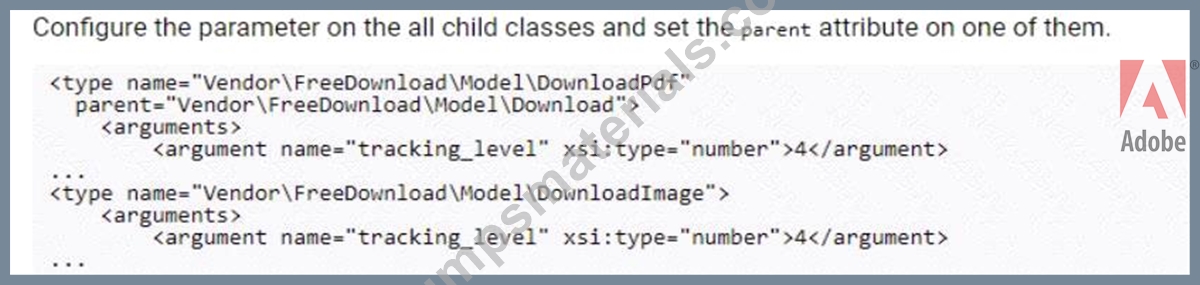
How will the developer configure the tracking_level parameter, in di.xml.to have a value of 4 for Download class and all classes that extend Download?
- A.
- B.

- C.

Answer: A
Explanation:
To configure the tracking_level parameter in di.xml to have a value of 4 for the Download class and all classes that extend Download, the developer would use the following code:
<config>
<global>
<models>
<Vendor\FreeDownload\Model\Download>
<setting name="tracking_level" value="4"/>
</Vendor\FreeDownload\Model\Download>
<Vendor\FreeDownload\Model\DownloadPdf>
<rewrite name="tracking_level" value="4"/>
</Vendor\FreeDownload\Model\DownloadPdf>
<Vendor\FreeDownload\Model\DownloadImage>
<rewrite name="tracking_level" value="4"/>
</Vendor\FreeDownload\Model\DownloadImage>
</models>
</global>
</config>
The setting element is used to set a configuration value for a specific model. The rewrite element is used to override the default configuration value for a specific model. In this case, the tracking_level parameter is set to
4 for all models that extend Download.
NEW QUESTION # 26
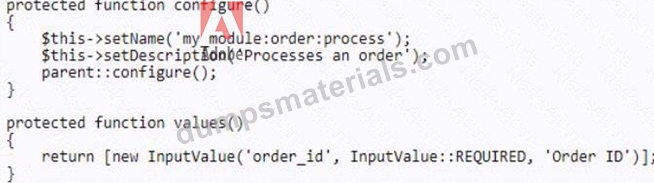
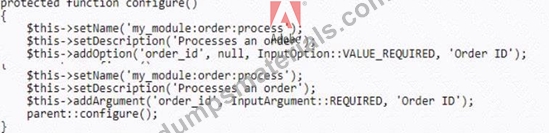
An Adobe Commerce developer has created a process that exports a given order to some external accounting system. Launching this process using the Magento CLI with the command php bin/magento my_module:order:
process --order_id=<order_id> is required.
Example: php bin/magento my_module:order:process --order_id=1245.
What is the correct way to configure the command?
- A.

- B.
- C.
- D.

Answer: C
Explanation:
According to the How to use the Magento command-line interface (CLI) guide, to configure and run the Magento CLI, the developer needs to make the bin/magento file executable and then use it to run commands.
To create a custom command, the developer needs to create a class that implements
\Symfony\Component\Console\Command\Command and define its name, description, arguments, options, and logic. The developer also needs to register the command in the di.xml file of their module using the Magento\Framework\Console\CommandList argument. Therefore, option C is the correct answer, as it shows the correct class and di.xml code to configure the custom command. Verified References:
https://www.a2hosting.com/kb/installable-applications/optimization-and-configuration/magento1/using-the-mage
NEW QUESTION # 27
An Adobe Commerce developer is tasked with adding an new export option for the order grid, they have added the following code for the export button within sales_order_grid.xml: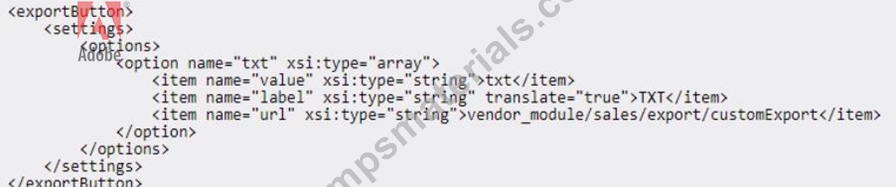
Upon testing, they are getting redirected, what would be a cause for this error?
- A. The option's uri attribute is not valid.
- B. The developer has to add a formkey for the new export option.
- C. The layout cache needs to be refreshed.
Answer: B
Explanation:
The developer has to add a formkey for the new export option because the formkey is required for security reasons. Without the formkey, the request will be rejected and redirected to the dashboard page. Verified Reference: [Magento 2.4 User Guide] [Magento 2.4 DevDocs]
NEW QUESTION # 28
What is the command used to upgrade ECE-Tools on an Adobe Commerce Cloud platform?
- A. composer update magento/ece-tools --with-all-dependencies
- B. php ./vendor/bin/ece-tools upgrade
- C. magento-cloud ece-tools:upgrade
Answer: A
Explanation:
The command used to upgrade ECE-Tools on an Adobe Commerce Cloud platform is composer update magento/ece-tools --with-all-dependencies. This command will update the ECE-Tools package and its dependencies to the latest version available in the composer repository. The developer then needs to commit and push the changes to the composer.json and composer.lock files and redeploy the environment. Verified References: [Magento 2.4 DevDocs]
NEW QUESTION # 29
An Adobe Commerce developer is tasked with creating a custom block that will be displayed on every page in the footer of the site.
After completing and optimizing the development, the developer notices that the block takes too much time to be generated on each page and decides to store it in the system cache after enabling it for all cache groups.
What would be the minimum requirement to achieve this?
- A. Set a value for the cache_Lifetime data property of the block.
- B. Set a value for cache_key data property of the block.
- C. Set values for both cache_lifetime and cache_key data properties of the block.
Answer: C
Explanation:
To store a block in the system cache, the developer needs to set values for both the cache_lifetime and cache_key data properties of the block. The cache_lifetime property specifies how long the block should be cached, and the cache_key property specifies a unique identifier for the block.
The following code shows how to set the cache_lifetime and cache_key data properties of a block:
PHP
$block->setData('cache_lifetime', 600);
$block->setData('cache_key', 'my_custom_block');
Once the cache_lifetime and cache_key data properties have been set, the block will be stored in the system cache and will not be regenerated on each page load.
NEW QUESTION # 30
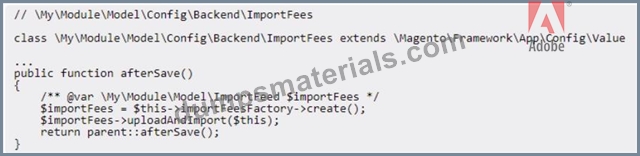
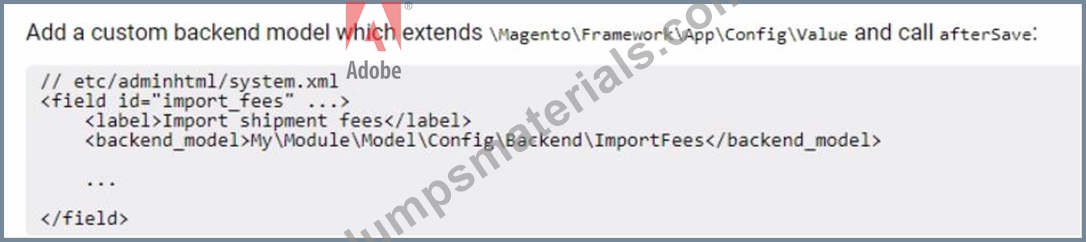
A logistics company with an Adobe Commerce extension sends a list of reviewed shipment fees to all its clients every month in a CSV file. The merchant then uploads this CSV file to a "file upload" field in admin configuration of Adobe Commerce.
What are the two requirements to display the "file upload" field and process the actual CSV import? (Choose two.) A)
- A.

- B.
- C.
- D.

Answer: B,C
Explanation:
To display the "file upload" field and process the actual CSV import, the following two requirements must be met:
The developer must create a new system configuration setting that specifies the path to the CSV file.
The developer must create a new controller action that handles the file upload and import process.
The system.xml file is used to define system configuration settings. The following XML snippet shows how to define a new system configuration setting for the CSV file path:
XML
<config>
<system>
<config>
<shipment_fees_csv_path>/path/to/csv/file</shipment_fees_csv_path>
</config>
</system>
</config>
The Controller\Adminhtml\ShipmentFees controller class is used to handle the file upload and import process. The following code shows how to create a new controller action that handles the file upload and import process:
PHP
public function uploadAction()
{
$file = $this->getRequest()->getFile('shipment_fees_csv_file');
if ($file->isUploaded()) {
$importer = new ShipmentFeesImporter();
$importer->import($file);
}
return $this->redirect('adminhtml/system_config/edit/section/shipment_fees');
}
NEW QUESTION # 31
A developer is working on an Adobe Commerce Cloud project and wants to get connection data for the environment's deployed services. The developer has all of the necessary permissions to do this.
Which two options would the developer take to get the connection credentials? (Choose Two.)
- A. Run the magento-cloud relationships CLI Command.
- B. Get the data from the Project Web Interface dedicated section.
- C. Execute ece-tools env:config:show services Command.
- D. Connect to server via SSH and read $_ENV['services'] variable.
Answer: A,B
Explanation:
In Adobe Commerce Cloud, connection data for deployed services (such as databases, caches, and other services) can be retrieved using different methods depending on the developer's access and the tools available.
* Using magento-cloud relationships Command:
* This CLI command retrieves the connection credentials for the services associated with the environment, such as database and Redis, directly from the command line.
* Project Web Interface:
* The Project Web Interface provides a dedicated section where developers can access service connection details, making it convenient for those who prefer a graphical interface.
* Why Options A and B are Correct:
* Both methods are valid and frequently used for accessing connection information. Option C, ece- tools env:config:show services, does not exist. Option D, reading $_ENV['services'], would require SSH access and does not provide direct connection details in a user-friendly format.
* References:
* Adobe Commerce documentation on Accessing Services
NEW QUESTION # 32
An Adobe Commerce developer is working on a Magento 2 instance which contains a B2C and a B2B website, each of which contains 3 different store views for English, Welsh, and French language users. The developer is tasked with adding a link between the B2C and B2B websites using a generic link template which is used throughout the sites, but wants these links to display in English regardless of the store view.
The developer creates a custom block for use with this template, before rendering sets the translate locale and begins environment emulation using the following code:
They find that the template text is still being translated into each stores language. Why does this occur?
- A. startEnvironmentEmuiation() resets the translation locale to the one of the emulated stores, which overrides the locale the developer has set when the order of setLocate and startEnvironmentEmulation is used as displayed above.
- B. setLocate() does not change translation locale after it has been initially set, the $this->_translate-
>emulate($newLocaiecode) method exists to temporarily modify this by pushing the new locale to the top of the current emuiatedLocales stack. - C. startEnvironmffntEmulation() SetS and locks the locale by Using the setLocale() Optional Second
$lock parameter, i.e. setLocale($newLocaleCode,
true), to override and lock the locale of the emulated store. If this is set and locked initially then the environment emulation will not be able to override this.
Answer: A
Explanation:
The startEnvironmentEmulation() method resets the translation locale to the one of the emulated stores, which overrides the locale the developer has set when the order of setLocale() and startEnvironmentEmulation() is used as displayed above.
The correct way to achieve the desired result is to use the emulate() method to temporarily modify the translation locale. The following code shows how to do this:
PHP
$this->_translate->emulate('en_US');
// Render the template
$this->_translate->revert();
This code will set the translation locale to English before rendering the template, and then revert the locale back to the default value after the template has been rendered.
The startEnvironmentEmulation() method is used to emulate a different store view or website. This can be useful for testing purposes, or for developing features that need to work in different environments.
The emulate() method is used to temporarily modify the translation locale. This can be useful for rendering templates in a specific language, or for testing features that need to work in different languages.
NEW QUESTION # 33
On an Adobe Commerce Cloud platform, at what level is the variable env: composer_auth located in the Project Web Interface?
- A. In the Integration variables.
- B. In the Project variables.
- C. In the Environment-specific variables.
Answer: B
Explanation:
The variable env: composer_auth is located in the Project variables section in the Project Web Interface. This variable is used to store the authentication credentials for Composer repositories that require access keys or tokens. The developer can set this variable at the project level to apply it to all environments, or override it at the environment level if needed. Verified References: [Magento 2.4 DevDocs] 2
NEW QUESTION # 34
......
Reliable Adobe Commerce AD0-E716 Dumps PDF Mar 20, 2025 Recently Updated Questions: https://www.dumpsmaterials.com/AD0-E716-real-torrent.html
Pass Your Adobe AD0-E716 Exam with Correct 71 Questions and Answers: https://drive.google.com/open?id=1NBR_U2fO55ApN3KOttgaDhoYKYntYY5S
