
[2024] Pass PECB ISO-IEC-27001-Lead-Auditor Exam Updated 280 Questions
Get 2024 Updated Free PECB ISO-IEC-27001-Lead-Auditor Exam Questions and Answer
PECB ISO-IEC-27001-Lead-Auditor certification exam is a rigorous exam that requires candidates to demonstrate their knowledge and skills through a written exam and a practical audit. The written exam consists of multiple-choice questions and is designed to test the candidate's knowledge and understanding of the ISO 27001 standard and the auditing process. The practical audit is designed to test the candidate's ability to apply the principles and techniques learned during the training to a real-world scenario.
NEW QUESTION # 131
What type of measure involves the stopping of possible consequences of security incidents?
- A. Corrective
- B. Detective
- C. Repressive
- D. Preventive
Answer: C
Explanation:
A repressive measure is a type of measure that involves the stopping of possible consequences of security incidents. A security incident is an event that compromises the confidentiality, integrity, or availability of information assets3. A repressive measure is a measure that aims to prevent or reduce the harm caused by a security incident after it has occurred. Examples of repressive measures include blocking malicious IP addresses, revoking user access rights, isolating infected systems, or restoring data from backups4. Repressive measures are different from preventive measures, which are measures that aim to avoid or reduce the likelihood of a security incident before it occurs. Examples of preventive measures include installing antivirus software, enforcing password policies, encrypting sensitive data, or conducting security awareness training4. Therefore, the correct answer is C. Reference: ISO/IEC 27000:2022, clause 3.25; Lepide.
NEW QUESTION # 132
Scenario 6: Sinvestment is an insurance company that offers home, commercial, and life insurance. The company was founded in North Carolina, but have recently expanded in other locations, including Europe and Africa.
Sinvestment is committed to complying with laws and regulations applicable to their industry and preventing any information security incident. They have implemented an ISMS based on ISO/IEC 27001 and have applied for ISO/IEC 27001 certification.
Two auditors were assigned by the certification body to conduct the audit. After signing a confidentiality agreement with Sinvestment. they started the audit activities. First, they reviewed the documentation required by the standard, including the declaration of the ISMS scope, information security policies, and internal audits reports. The review process was not easy because, although Sinvestment stated that they had a documentation procedure in place, not all documents had the same format.
Then, the audit team conducted several interviews with Sinvestment's top management to understand their role in the ISMS implementation. All activities of the stage 1 audit were performed remotely, except the review of documented information, which took place on-site, as requested by Sinvestment.
During this stage, the auditors found out that there was no documentation related to information security training and awareness program. When asked, Sinvestment's representatives stated that the company has provided information security training sessions to all employees. Stage 1 audit gave the audit team a general understanding of Sinvestment's operations and ISMS.
The stage 2 audit was conducted three weeks after stage 1 audit. The audit team observed that the marketing department (which was not included in the audit scope) had no procedures in place to control employees' access rights. Since controlling employees' access rights is one of the ISO/IEC 27001 requirements and was included in the information security policy of the company, the issue was included in the audit report. In addition, during stage 2 audit, the audit team observed that Sinvestment did not record logs of user activities.
The procedures of the company stated that "Logs recording user activities should be retained and regularly reviewed," yet the company did not present any evidence of the implementation of such procedure.
During all audit activities, the auditors used observation, interviews, documented information review, analysis, and technical verification to collect information and evidence. All the audit findings during stages 1 and 2 were analyzed and the audit team decided to issue a positive recommendation for certification.
According to ISO/IEC 27001 requirements, does the company need to provide evidence of implementation of the procedure regarding logs recording user activities? Refer to scenario 6.
- A. No, because the implementation of this procedure is not a requirement of the standard
- B. No, the company only recommended implementing this procedure
- C. Yes, event logs recording user activities must be kept and regularly reviewed
Answer: C
Explanation:
Yes, according to ISO/IEC 27001, the company needs to provide evidence of the implementation of procedures regarding the logging of user activities. This requirement is essential to ensure that events are recorded and regularly reviewed, supporting the detection and prevention of security incidents.
References: ISO/IEC 27001:2013, Clause A.12.4 (Logging and monitoring)
NEW QUESTION # 133
You are an experienced audit team leader guiding an auditor in training.
Your team is currently conducting a third-party surveillance audit of an organisation that stores data on behalf of external clients. The auditor in training has been tasked with reviewing the PEOPLE controls listed in the Statement of Applicability (SoA) and mplemented at the site.
Select four controls from the following that would you expect the auditor in training to review.
- A. The organisation's arrangements for information deletion
- B. The operation of the site CCTV and door control systems
- C. How protection against malware is implemented
- D. Confidentiality and nondisclosure agreements
- E. Remote working arrangements
- F. The conducting of verification checks on personnel
- G. The organisation's business continuity arrangements
- H. Information security awareness, education and training
Answer: D,E,F,H
Explanation:
The PEOPLE controls are related to the human aspects of information security, such as roles and responsibilities, awareness and training, screening and contracts, and remote working. The auditor in training should review the following controls:
* Confidentiality and nondisclosure agreements (A): These are contractual obligations that bind the employees and contractors of the organisation to protect the confidentiality of the information they handle, especially the data of external clients. The auditor should check if these agreements are signed, updated, and enforced by the organisation. This control is related to clause A.7.2.1 of ISO/IEC
27001:2022.
* Information security awareness, education and training : These are activities that aim to enhance the knowledge, skills, and behaviour of the employees and contractors regarding information security. The auditor should check if these activities are planned, implemented, evaluated, and improved by the organisation. This control is related to clause A.7.2.2 of ISO/IEC 27001:2022.
* Remote working arrangements (D): These are policies and procedures that govern the information security aspects of working from locations other than the organisation's premises, such as home or public places. The auditor should check if these arrangements are defined, approved, and monitored by the organisation. This control is related to clause A.6.2.1 of ISO/IEC 27001:2022.
* The conducting of verification checks on personnel (E): These are background checks that verify the identity, qualifications, and suitability of the employees and contractors who have access to sensitive information or systems. The auditor should check if these checks are conducted, documented, and reviewed by the organisation. This control is related to clause A.7.1.1 of ISO/IEC 27001:2022.
References:
* ISO/IEC 27001:2022, Information technology - Security techniques - Information security management systems - Requirements
* PECB Candidate Handbook ISO/IEC 27001 Lead Auditor, 1
* ISO 27001:2022 Lead Auditor - IECB, 2
* ISO 27001:2022 certified ISMS lead auditor - Jisc, 3
* ISO/IEC 27001:2022 Lead Auditor Transition Training Course, 4
* ISO 27001 - Information Security Lead Auditor Course - PwC Training Academy, 5
NEW QUESTION # 134
Select the words that best complete the sentence:
Answer:
Explanation:
Explanation:
A third-party audit is an independent assessment of an organisation's management system by an external auditor, who is not affiliated with the organisation or its customers. The auditor verifies that the management system meets the requirements of a specific standard, such as ISO 27001, and evaluates its effectiveness and performance. The auditor also identifies any strengths, weaknesses, opportunities, or risks of the management system, and provides recommendations for improvement. The purpose of a third-party audit is to provide an objective and impartial evaluation of the organisation's management system, and to inform a certification decision by a certification body. A certification body is an organisation that grants a certificate of conformity to the organisation, after reviewing the audit report and evidence, and confirming that the management system meets the certification criteria. A certification decision is the outcome of the certification process, which can be positive (granting, maintaining, renewing, or expanding the scope of certification) or negative (suspending, withdrawing, or reducing the scope of certification). References:
PECB Candidate Handbook ISO 27001 Lead Auditor, pages 19-25
ISO 19011:2018 - Guidelines for auditing management systems
The ISO 27001 audit process | ISMS.online
NEW QUESTION # 135
You receive an E-mail from some unknown person claiming to be representative of your bank and asking for your account number and password so that they can fix your account. Such an attempt of social engineering is called
- A. Phishing
- B. Mountaineering
- C. Spoofing
- D. Shoulder Surfing
Answer: A
NEW QUESTION # 136
You are performing an ISMS audit at a residential nursing home called ABC that provides healthcare services.
You find all nursing home residents wear an electronic wristband for monitoring their location, heartbeat, and blood pressure always. You learned that the electronic wristband automatically uploads all data to the artificial intelligence (AI) cloud server for healthcare monitoring and analysis by healthcare staff.
To verify the scope of ISMS, you interview the management system representative (MSR) who explains that the ISMS scope covers an outsourced data center.
Select three options for the audit evidence you need to find to verify the scope of the ISMS.
- A. The auditee has identified the resident's needs and expectations on how they should protect the resident's personal data
- B. The auditee has identified the resident's needs and expectations on the comfort facility, medical professional's competence, and clean environment
- C. The auditee has identified the resident's needs and expectations on the facility and environmental safety
- D. The auditee has ISO 9001 certification
- E. The auditee is considering the purchase of a healthcare monitoring app from an external software company
- F. The IT service agreement with the data center where the artificial intelligence (AI) cloud server is located
- G. The auditee has identified the governmental authorities' needs and expectations on healthcare services and patient data handling
- H. The auditee has identified the resident's needs and expectations on healthcare medical treatment services
Answer: A,F,G
Explanation:
Explanation
According to ISO 27001:2022 clause 4.3, the organisation shall determine the scope of the information security management system (ISMS) by considering the internal and external issues, the requirements of interested parties, and the interfaces and dependencies with other organisations12 In this case, the ISMS scope covers an outsourced data center that hosts the artificial intelligence (AI) cloud server for healthcare monitoring and analysis of the residents' data. Therefore, the audit evidence you need to find to verify the scope of the ISMS should include:
The auditee has identified the governmental authorities' needs and expectations on healthcare services and patient data handling. This is an external issue and an interested party requirement that affects the ISMS scope, as the auditee has to comply with the relevant laws and regulations regarding the quality, safety, and privacy of healthcare services and patient data12 The auditee has identified the resident's needs and expectations on how they should protect the resident's personal data. This is an external issue and an interested party requirement that affects the ISMS scope, as the auditee has to ensure the confidentiality, integrity, and availability of the resident's personal data that is collected, processed, and stored by the electronic wristband and the AI cloud server12 The IT service agreement with the data center where the artificial intelligence (AI) cloud server is located. This is an interface and dependency with another organisation that affects the ISMS scope, as the auditee has to control the externally provided processes, products, and services that are relevant to the ISMS, and to implement appropriate contractual requirements related to information security12 The following options are not relevant or sufficient for verifying the scope of the ISMS:
The auditee has identified the resident's needs and expectations on the facility and environmental safety.
This is an external issue and an interested party requirement, but it does not affect the ISMS scope, as it is not related to information security12 The auditee has ISO 9001 certification. This is an indication of the auditee's quality management system, but it does not verify the scope of the ISMS, as it is not related to information security12 The auditee has identified the resident's needs and expectations on the comfort facility, medical professional's competence, and clean environment. These are external issues and interested party requirements, but they do not affect the ISMS scope, as they are not related to information security12 The auditee has identified the resident's needs and expectations on healthcare medical treatment services. These are external issues and interested party requirements, but they do not verify the scope of the ISMS, as they are not specific to information security12 The auditee is considering the purchase of a healthcare monitoring app from an external software company. This is a potential change that may affect the ISMS scope in the future, but it does not verify the current scope of the ISMS, as it is not yet implemented or controlled12 References:
1: ISO/IEC 27001:2022 Lead Auditor (Information Security Management Systems) Course by CQI and IRCA Certified Training 1 2: ISO/IEC 27001 Lead Auditor Training Course by PECB 2
NEW QUESTION # 137
Select the words that best complete the sentence:
To complete the sentence with the word(s) click on the blank section you want to complete so that it is highlighted in red, and then click on the application text from the options below. Alternatively, you may drag and drop the option to the appropriate blank section.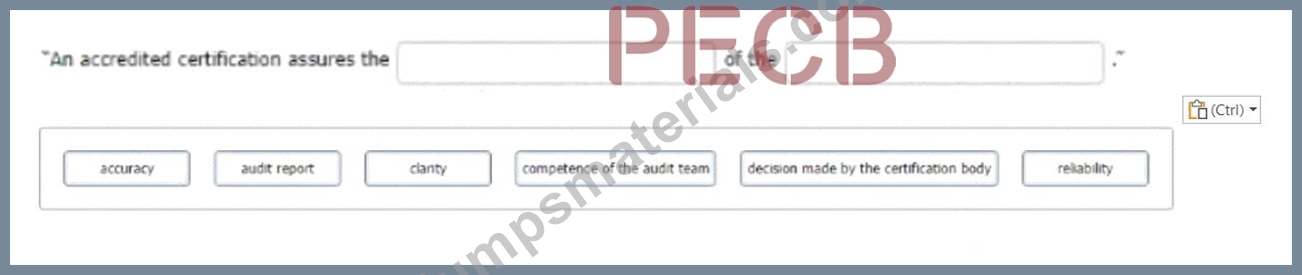
Answer:
Explanation: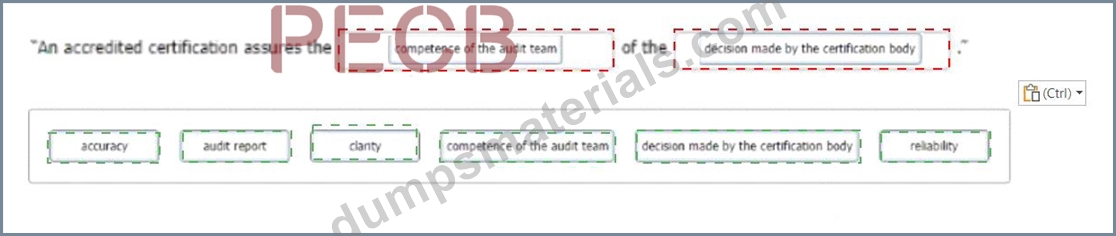
Explanation
competence of the audit team and decision made by the certification body According to ISO/IEC 17021-1, which specifies the requirements for bodies providing audit and certification of management systems, an accredited certification means that the certification body has been evaluated by an accreditation body against recognized standards to demonstrate its competence, impartiality and performance capability1. Therefore, an accredited certification assures the competence of the audit team that conducts the audit in accordance with ISO 19011 and ISO/IEC 27001:2022, and the decision made by the certification body that grants or maintains the certification based on the audit evidence and findings2. References: ISO/IEC
17021-1:2015 - Conformity assessment - Requirements for bodies providing audit and certification of management systems - Part 1: Requirements, ISO/IEC 27001:2022 Lead Auditor (Information Security Management Systems) | CQI | IRCA
NEW QUESTION # 138
Which of the following does a lack of adequate security controls represent?
- A. Threat
- B. Vulnerability
- C. Asset
- D. Impact
Answer: B
NEW QUESTION # 139
What is a repressive measure in case of a fire?
- A. Repairing damage caused by the fire
- B. Putting out a fire after it has been detected by a fire detector
- C. Taking out a fire insurance
Answer: B
Explanation:
Explanation
A repressive measure is a measure that aims to reduce or eliminate the impact of an incident after it has occurred. Putting out a fire after it has been detected by a fire detector is an example of a repressive measure, as it reduces the damage caused by the fire. Taking out a fire insurance is not a repressive measure, but a corrective measure, as it compensates for the loss after the incident. Repairing damage caused by the fire is also not a repressive measure, but a recovery measure, as it restores the normal operation after the incident. References: : CQI & IRCA ISO 27001:2022 Lead Auditor Course Handbook, page 28. : CQI & IRCA ISO 27001:2022 Lead Auditor Course Handbook, page 29. : CQI & IRCA ISO 27001:2022 Lead Auditor Course Handbook, page 30.
NEW QUESTION # 140
You are carrying out your first third-party ISMS surveillance audit as an Audit Team Leader. You are presently in the auditee's data centre with another member of your audit team.
You are currently in a large room that is subdivided into several smaller rooms, each of which has a numeric combination lock and swipe card reader on the door. You notice two external contractors using a swipe card and combination number provided by the centre's reception desk to gain access to a client's suite to carry out authorised electrical repairs.
You go to reception and ask to see the door access record for the client's suite. This indicates only one card was swiped. You ask the receptionist and they reply, "yes it's a common problem. We ask everyone to swipe their cards but with contractors especially, one tends to swipe and the rest simply 'tailgate' their way in" but we know who they are from the reception sign-in.
Based on the scenario above which one of the following actions would you now take?
- A. Raise an opportunity for improvement to have a large sign in reception reminding everyone requiring access must use their swipe card at all times
- B. Raise an opportunity for improvement that contractors must be accompanied at all times when accessing secure facilities
- C. Raise a nonconformity against control A.5.20 'addressing information security in supplier relationships' as information security requirements have not been agreed upon with the supplier
- D. Determine whether any additional effective arrangements are in place to verify individual access to secure areas e.g. CCTV
- E. Raise a nonconformity against control A.7.6 'working in secure areas' as security measures for working in secure areas have not been defined
- F. Raise a nonconformity against control A.7.2 'physical entry' as a secure area is not adequately protected
- G. Tell the organisation they must write to their contractors, reminding them of the need to use access cards appropriately
- H. Take no action. Irrespective of any recommendations, contractors will always act in this way
Answer: F
Explanation:
According to ISO/IEC 27001:2022, which specifies the requirements for establishing, implementing, maintaining and continually improving an information security management system (ISMS), control A.7.2 requires an organization to implement appropriate physical entry controls to prevent unauthorized access to secure areas1. The organization should define and document the criteria for granting and revoking access rights to secure areas, and should monitor and record the use of such access rights1. Therefore, when auditing the organization's application of control A.7.2, an ISMS auditor should verify that these aspects are met in accordance with the audit criteria.
Based on the scenario above, the auditor should raise a nonconformity against control A.7.2, as the secure area is not adequately protected from unauthorized access. The auditor should provide the following evidence and justification for the nonconformity:
Evidence: The auditor observed two external contractors using a swipe card and combination number provided by the centre's reception desk to gain access to a client's suite to carry out authorized electrical repairs. The auditor checked the door access record for the client's suite and found that only one card was swiped. The auditor asked the receptionist and was told that it was a common problem that contractors tend to swipe one card and tailgate their way in, but they were known from the reception sign-in.
Justification: This evidence indicates that the organization has not implemented appropriate physical entry controls to prevent unauthorized access to secure areas, as required by control A.7.2. The organization has not defined and documented the criteria for granting and revoking access rights to secure areas, as there is no verification or authorization process for providing swipe cards and combination numbers to external contractors. The organization has not monitored and recorded the use of access rights to secure areas, as there is no mechanism to ensure that each individual swipes their card and enters their combination number before entering a secure area. The organization has relied on the reception sign-in as a means of identification, which is not sufficient or reliable for ensuring information security.
The other options are not valid actions for auditing control A.7.2, as they are not related to the control or its requirements, or they are not appropriate or effective for addressing the nonconformity. For example:
Take no action: This option is not valid because it implies that the auditor ignores or accepts the nonconformity, which is contrary to the audit principles and objectives of ISO 19011:20182, which provides guidelines for auditing management systems.
Raise a nonconformity against control A.5.20 'addressing information security in supplier relationships' as information security requirements have not been agreed upon with the supplier: This option is not valid because it does not address the root cause of the nonconformity, which is related to physical entry controls, not supplier relationships. Control A.5.20 requires an organization to agree on information security requirements with suppliers that may access, process, store, communicate or provide IT infrastructure components for its information assets1. While this control may be relevant for ensuring information security in supplier relationships, it does not address the issue of unauthorized access to secure areas by external contractors.
Raise a nonconformity against control A.7.6 'working in secure areas' as security measures for working in secure areas have not been defined: This option is not valid because it does not address the root cause of the nonconformity, which is related to physical entry controls, not working in secure areas. Control
A.7.6 requires an organization to define and apply security measures for working in secure areas1.
While this control may be relevant for ensuring information security when working in secure areas, it does not address the issue of unauthorized access to secure areas by external contractors.
Determine whether any additional effective arrangements are in place to verify individual access to secure areas e.g. CCTV: This option is not valid because it does not address or resolve the nonconformity, but rather attempts to find alternative or compensating controls that may mitigate its impact or likelihood. While additional arrangements such as CCTV may be useful for verifying individual access to secure areas, they do not replace or substitute the requirement for appropriate physical entry controls as specified by control A.7.2.
Raise an opportunity for improvement that contractors must be accompanied at all times when accessing secure facilities: This option is not valid because it does not address or resolve the nonconformity, but rather suggests a possible improvement action that may prevent or reduce its recurrence or severity.
While accompanying contractors at all times when accessing secure facilities may be a good practice for ensuring information security, it does not replace or substitute the requirement for appropriate physical entry controls as specified by control A.7.2.
Raise an opportunity for improvement to have a large sign in reception reminding everyone requiring access must use their swipe card at all times: This option is not valid because it does not address or resolve the nonconformity, but rather suggests a possible improvement action that may increase awareness or compliance with the existing controls. While having a large sign in reception reminding everyone requiring access must use their swipe card at all times may be a helpful reminder for ensuring information security, it does not replace or substitute the requirement for appropriate physical entry controls as specified by control A.7.2.
Tell the organisation they must write to their contractors, reminding them of the need to use access cards appropriately: This option is not valid because it does not address or resolve the nonconformity, but rather instructs the organization to take a corrective action that may not be effective or sufficient for ensuring information security. While writing to contractors, reminding them of the need to use access cards appropriately may be a communication measure for ensuring information security, it does not replace or substitute the requirement for appropriate physical entry controls as specified by control
A.7.2.
References: ISO/IEC 27001:2022 - Information technology - Security techniques - Information security management systems - Requirements, ISO 19011:2018 - Guidelines for auditing management systems
NEW QUESTION # 141
An employee caught with offense of abusing the internet, such as P2P file sharing or video/audio streaming, will not receive a warning for committing such act but will directly receive an IR.
- A. False
- B. True
Answer: B
NEW QUESTION # 142
Which two of the following are examples of audit methods that 'do not' involve human interaction?
- A. Performing a review of auditees procedures in preparation for an audit
- B. Analysing data by remotely accessing the auditee's server
- C. Confirming the date and time of the audit
- D. Reviewing the auditee's response to an audit finding
- E. Conducting an interview using a teleconferencing platform
- F. Observing work performed by remote surveillance
Answer: A,B
Explanation:
Explanation
Audit methods are the techniques and procedures that auditors use to collect and evaluate audit evidence.
Audit methods can be classified into two categories: those that involve human interaction and those that do not. Human interaction methods are those that require direct or indirect communication with the auditee or other relevant parties, such as interviews, questionnaires, surveys, observations, or walkthroughs. Non-human interaction methods are those that do not require any communication with the auditee or other parties, such as document reviews, data analysis, or remote surveillance.
Some examples of audit methods that do not involve human interaction are:
* Performing a review of auditee's procedures in preparation for an audit: This method involves examining the auditee's documented information, such as policies, processes, records, or reports, to verify their adequacy and effectiveness in meeting the audit criteria. The auditor does not need to interact with the auditee or anyone else to perform this method.
* Analysing data by remotely accessing the auditee's server: This method involves accessing and processing the auditee's data, such as performance indicators, logs, metrics, or statistics, to verify their accuracy and reliability in meeting the audit criteria. The auditor does not need to interact with the auditee or anyone else to perform this method.
References:
* ISO/IEC 27001:2022 Lead Auditor (Information Security Management Systems) objectives and content from Quality.org and PECB
* ISO 19011:2018 Guidelines for auditing management systems [Section 6.2.2]
NEW QUESTION # 143
Which two activities align with the "Check'' stage of the Plan-Do-Check-Act cycle when applied to the process of managing an internal audit program as described in ISO 19011?
- A. Establish a risk-based internal audit programme
- B. Verify effectiveness of the internal audit programme
- C. Define audit criteria and scope for each internal audit
- D. Retains records of internal audits
- E. Update the internal audit programme
- F. Conduct internal audits
- G. Review trends in internal audit result
Answer: B,G
Explanation:
The Check stage of the PDCA cycle involves monitoring and measuring the performance of the process and comparing it with the planned objectives and criteria. In the context of managing an internal audit programme, this stage includes verifying the effectiveness of the internal audit programme by evaluating whether it meets its objectives, scope, and criteria, and whether it is implemented in accordance with ISO 19011 guidelines1. It also includes reviewing the trends in internal audit results by analyzing the data collected from the audits, such as audit findings, nonconformities, corrective actions, opportunities for improvement, and customer feedback1. References: ISO 19011:2018 - Guidelines for auditing management systems
NEW QUESTION # 144
You are performing an ISMS audit at a nursing home where residents always wear an electronic wristband for monitoring their location, heartbeat, and blood pressure. The wristband automatically uploads this data to a cloud server for healthcare monitoring and analysis by staff.
You now wish to verify that the information security policy and objectives have been established by top management. You are sampling the mobile device policy and identify a security objective of this policy is "to ensure the security of teleworking and use of mobile devices" The policy states the following controls will be applied in order to achieve this.
Personal mobile devices are prohibited from connecting to the nursing home network, processing, and storing residents' data.
The company's mobile devices within the ISMS scope shall be registered in the asset register.
The company's mobile devices shall implement or enable physical protection, i.e., pin-code protected screen lock/unlock, facial or fingerprint to unlock the device.
The company's mobile devices shall have a regular backup.
To verify that the mobile device policy and objectives are implemented and effective, select three options for your audit trail.
- A. Review the asset register to make sure all company's mobile devices are registered
- B. Review the internal audit report to make sure the IT department has been audited
- C. Interview top management to verify their involvement in establishing the information security policy and the information security objectives
- D. Review the asset register to make sure all personal mobile devices are registered
- E. Sampling some mobile devices from on-duty medical staff and validate the mobile device information with the asset register
- F. Review visitors' register book to make sure no visitor can have their personal mobile phone in the nursing home
- G. Interview the reception personnel to make sure all visitor and employee bags are checked before entering the nursing home
- H. Interview the supplier of the devices to make sure they are aware of the ISMS policy
Answer: A,B,E
Explanation:
Explanation
According to ISO/IEC 27001:2022, which specifies the requirements for establishing, implementing, maintaining and continually improving an information security management system (ISMS), clause 5.2 requires top management to establish an information security policy that provides the framework for setting information security objectives1. Clause 6.2 requires top management to ensure that the information security objectives are established at relevant functions and levels1. Therefore, when verifying that the information security policy and objectives have been established by top management, an ISMS auditor should review relevant documents and records that demonstrate top management's involvement and commitment.
To verify that the mobile device policy and objectives are implemented and effective, an ISMS auditor should review relevant documents and records that demonstrate how the policy and objectives are communicated, monitored, measured, analyzed, and evaluated. The auditor should also sample and verify the implementation of the controls that are stated in the policy.
Three options for the audit trail that are relevant to verifying the mobile device policy and objectives are:
Review the internal audit report to make sure the IT department has been audited: This option is relevant because it can provide evidence of how the IT department, which is responsible for managing the mobile devices and their security, has been evaluated for its conformity and effectiveness in implementing the mobile device policy and objectives. The internal audit report can also reveal any nonconformities, corrective actions, or opportunities for improvement related to the mobile device policy and objectives.
Sampling some mobile devices from on-duty medical staff and validate the mobile device information with the asset register: This option is relevant because it can provide evidence of how the mobile devices that are used by the medical staff, who are involved in processing and storing residents' data, are registered in the asset register and have physical protection enabled. This can verify the implementation and effectiveness of two of the controls that are stated in the mobile device policy.
Review the asset register to make sure all company's mobile devices are registered: This option is relevant because it can provide evidence of how the company's mobile devices that are within the ISMS scope are identified and accounted for. This can verify the implementation and effectiveness of one of the controls that are stated in the mobile device policy.
The other options for the audit trail are not relevant to verifying the mobile device policy and objectives, as they are not related to the policy or objectives or their implementation or effectiveness. For example:
Interview the reception personnel to make sure all visitor and employee bags are checked before entering the nursing home: This option is not relevant because it does not provide evidence of how the mobile device policy and objectives are implemented or effective. It may be related to another policy or objective regarding physical security or access control, but not specifically to mobile devices.
Review visitors' register book to make sure no visitor can have their personal mobile phone in the nursing home: This option is not relevant because it does not provide evidence of how the mobile device policy and objectives are implemented or effective. It may be related to another policy or objective regarding information security awareness or compliance, but not specifically to mobile devices.
Interview the supplier of the devices to make sure they are aware of the ISMS policy: This option is not relevant because it does not provide evidence of how the mobile device policy and objectives are implemented or effective. It may be related to another policy or objective regarding information security within supplier relationships, but not specifically to mobile devices.
Interview top management to verify their involvement in establishing the information security policy and the information security objectives: This option is not relevant because it does not provide evidence of how the mobile device policy and objectives are implemented or effective. It may be related to verifying that the information security policy and objectives have been established by top management, but not specifically to mobile devices.
References: ISO/IEC 27001:2022 - Information technology - Security techniques - Information security management systems - Requirements
NEW QUESTION # 145
Match the correct responsibility with each participant of a second-party audit: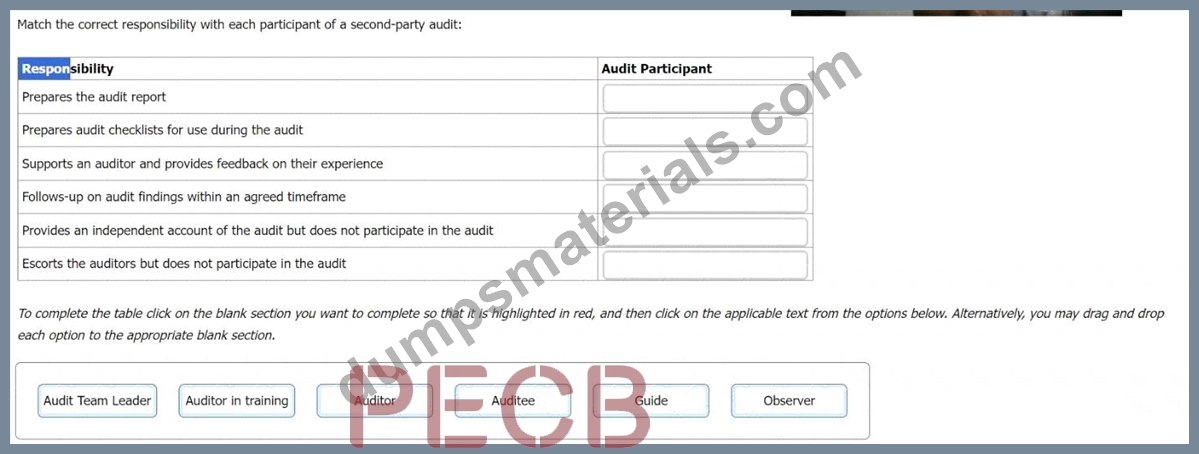
Answer:
Explanation: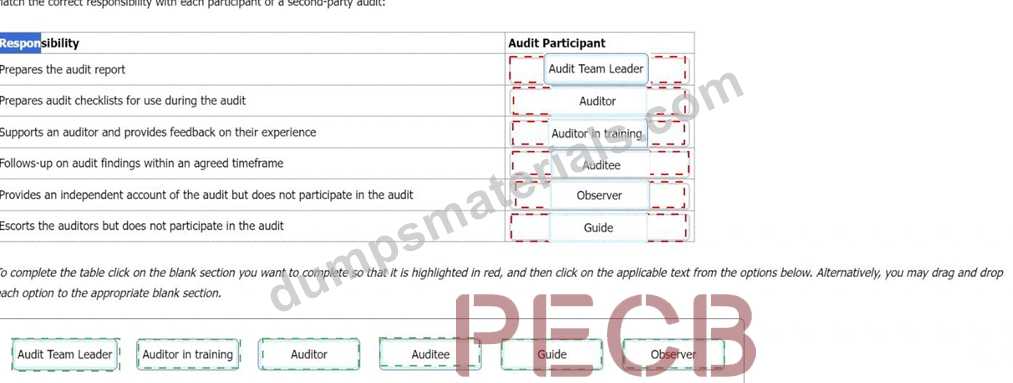
Explanation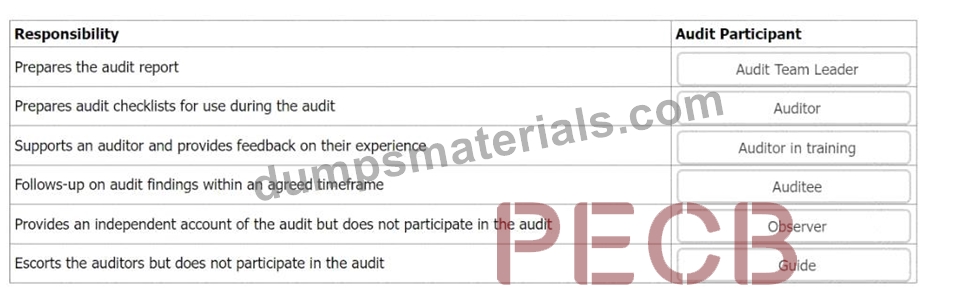
The correct responsibility with each participant of a second-party audit is:
* Prepares the audit report: Audit Team Leader. The audit team leader is responsible for coordinating the audit activities, communicating with the auditee and the customer, and preparing and delivering the audit report that summarizes the audit findings and conclusions1.
* Prepares audit checklists for use during the audit: Auditor. The auditor is responsible for collecting and verifying objective evidence during the audit, using audit checklists as a tool to guide the audit process and ensure that all relevant aspects of the audit criteria are covered1.
* Supports an auditor and provides feedback on their experience: Auditor in training. The auditor in training is a person who is learning how to perform audits under the supervision of an experienced auditor. The auditor in training supports the auditor by observing and participating in the audit activities, and provides feedback on their experience to improve their skills and competence1.
* Follows-up on audit findings within an agreed timeframe: Auditee. The auditee is the organisation that is being audited by the customer or a third party on behalf of the customer. The auditee is responsible for providing access and cooperation to the auditors, and for following up on the audit findings within an agreed timeframe, by implementing corrective actions or improvement measures as needed1.
* Provides an independent account of the audit but does not participate in the audit: Observer. The observer is a person who accompanies the audit team but does not participate in the audit activities. The observer may be a representative of the customer, a regulatory body, or another interested party. The observer provides an independent account of the audit but does not interfere with or influence the audit process or outcome1.
* Escorts the auditors but does not participate in the audit: Guide. The guide is a person who is appointed by the auditee to assist the audit team during the audit. The guide may escort the auditors to different locations, facilitate access to information and personnel, or provide clarification or explanation as requested by the auditors. The guide does not participate in the audit or influence its results1.
NEW QUESTION # 146
You are an experienced ISMS audit team leader. During the conducting of a third-party surveillance audit, you decide to test your auditee's knowledge of ISO/IEC 27001's risk management requirements.
You ask her a series of questions to which the answer is either 'that is true' or 'that is false'. Which four of the following should she answer 'that is true'?
- A. ISO/IEC 27001 provides an outline approach for the management of risk
- B. The results of risk assessments must be maintained
- C. The organisation must operate a risk treatment process to eliminate it's information security risks
- D. The organisation must produce a risk treatment plan for every business risk identified
- E. Risk assessments should be undertaken following significant changes
- F. Risks assessments should be undertaken at monthly intervals
- G. Risk identification is used to determine the severity of an information security risk
- H. The initial phase in an organisation's risk management process should be information security risk assessment
Answer: A,B,D,E
Explanation:
The following four statements are true according to ISO/IEC 27001's risk management requirements: 12
* The results of risk assessments must be maintained. This is true because clause 8.2.3 of ISO/IEC
27001:2022 requires the organisation to retain documented information of the information security risk assessment process and the results12
* ISO/IEC 27001 provides an outline approach for the management of risk. This is true because clause
6.1.2 of ISO/IEC 27001:2022 specifies the general steps for the information security risk management process, which include establishing the risk criteria, assessing the risks, treating the risks, and monitoring and reviewing the risks12
* The organisation must produce a risk treatment plan for every business risk identified. This is true because clause 6.1.3 of ISO/IEC 27001:2022 requires the organisation to produce a risk treatment plan that defines the actions to be taken to address the unacceptable risks, the responsibilities, the expected dates, and the resources required12
* Risk assessments should be undertaken following significant changes. This is true because clause 8.2.4 of ISO/IEC 27001:2022 requires the organisation to review and update the risk assessment at planned intervals or when significant changes occur12 The following four statements are false according to ISO/IEC 27001's risk management requirements:
* Risk identification is used to determine the severity of an information security risk. This is false because risk identification is used to identify the assets, threats, vulnerabilities, and existing controls that are relevant to the information security risk management process. The severity of an information security risk is determined by the risk analysis, which evaluates the likelihood and impact of the risk scenarios12
* The organisation must operate a risk treatment process to eliminate its information security risks. This is false because the organisation can choose from four options to treat its information security risks: avoid, transfer, mitigate, or accept. The organisation does not have to eliminate all its information security risks, but only those that are unacceptable according to its risk criteria12
* The initial phase in an organisation's risk management process should be information security risk assessment. This is false because the initial phase in an organisation's risk management process should be establishing the risk management framework, which includes defining the risk management policy, objectives, scope, roles, responsibilities, and criteria. The information security risk assessment is the second phase in the risk management process12
* Risks assessments should be undertaken at monthly intervals. This is false because there is no fixed frequency for conducting risk assessments in ISO/IEC 27001. The organisation should determine the appropriate intervals for reviewing and updating the risk assessment based on its risk appetite, risk profile, and operational context12 References:
1: ISO/IEC 27001:2022 Lead Auditor (Information Security Management Systems) Course by CQI and IRCA Certified Training 1 2: ISO/IEC 27001 Lead Auditor Training Course by PECB 2
NEW QUESTION # 147
Select the words that best complete the sentence:
"The purpose of maintaining regulatory compliance in a management system is to To complete the sentence with the best word(s), click on the blank section you want to complete so that it is highlighted in red, and then click on the applicable text from the options below. Alternatively, you may drag and drop the option to the appropriate blank section.
Answer:
Explanation:
Explanation:
According to ISO 27001:2013, clause 5.2, the top management of an organization must establish, implement and maintain an information security policy that is appropriate to the purpose of the organization and provides a framework for setting information security objectives. The information security policy must also include a commitment to comply with the applicable legal, regulatory and contractual requirements, as well as any other requirements that the organization subscribes to. Therefore, maintaining regulatory compliance is part of fulfilling the management system policy and ensuring its effectiveness and suitability. References:
* ISO/IEC 27001:2013, Information technology - Security techniques - Information security management systems - Requirements, clause 5.2
* PECB Candidate Handbook ISO 27001 Lead Auditor, page 10
* ISO 27001 Policy: How to write it according to ISO 27001
NEW QUESTION # 148
In regard to generating an audit finding, select the words that best complete the following sentence.
To complete the sentence with the best word(s), click on the blank section you want to complete so that it Is highlighted in red, and then click on the applicable text from the options below. Alternatively, you may drag and drop the option to the appropriate blank section.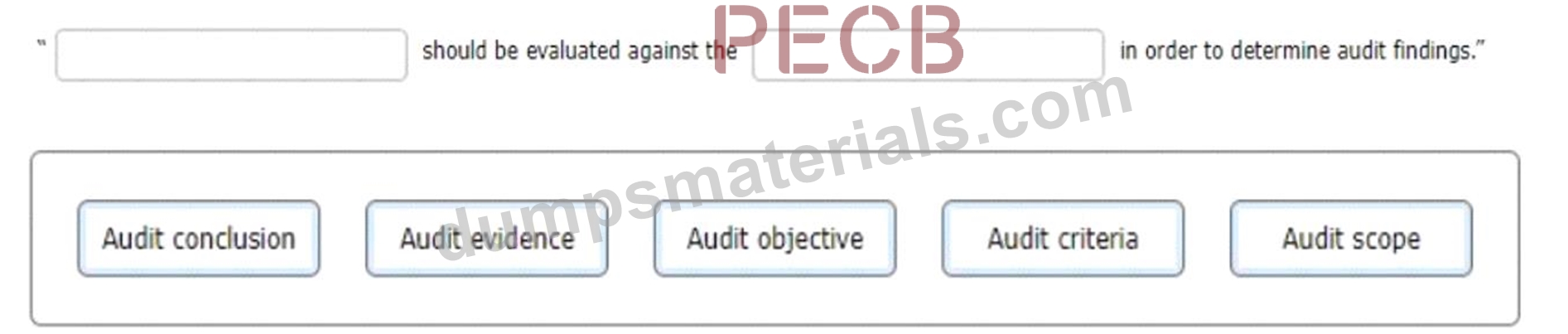
Answer:
Explanation: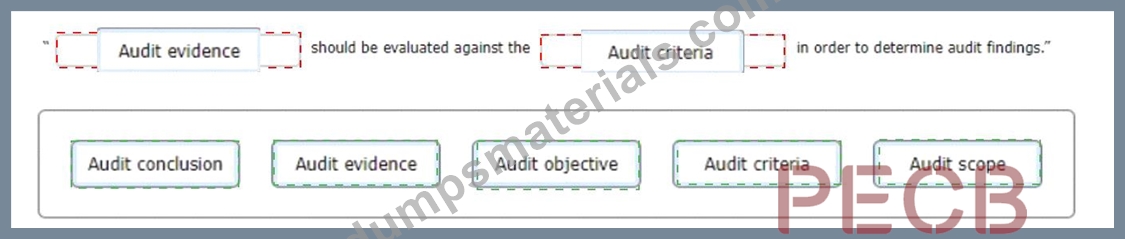
Explanation:
Audit evidence should be evaluated against the audit criteria in order to determine audit findings.
Audit evidence is the information obtained by the auditors during the audit process that is used as a basis for forming an audit opinion or conclusion12. Audit evidence could include records, documents, statements, observations, interviews, or test results12.
Audit criteria are the set of policies, procedures, standards, regulations, or requirements that are used as a reference against which audit evidence is compared12. Audit criteria could be derived from internal or external sources, such as ISO standards, industry best practices, or legal obligations12.
Audit findings are the results of a process that evaluates audit evidence and compares it against audit criteria13. Audit findings can show that audit criteria are being met (conformity) or that they are not being met (nonconformity). They can also identify best practices or improvement opportunities13.
References :=
ISO 19011:2022 Guidelines for auditing management systems
ISO/IEC 27001:2022 Information technology - Security techniques - Information security management systems - Requirements Components of Audit Findings - The Institute of Internal Auditors
NEW QUESTION # 149
During a Stage 1 audit opening meeting, the Management System Representative (MSR) asks to extend the audit scope to include a new site overseas which they have expanded into since the certification application was made.
Select two options for how the auditor should respond.
- A. Determine whether the Management System covers the processes at the new site and, if so, proceed with the audit
- B. Advise the MSR that, within the existing scope, the new work area can be included without any problem
- C. Advise the MSR that an extension of the scope may be incorporated but will have to go through established procedures
- D. Suggest that the MSR cancels the audit contract and reapplies for the new situation
- E. Advise the MSR that the audit scope has been determined based on their initial application so the audit has to proceed as planned
- F. Confirm that the auditor will advise the auditee that the audit scope will be revised to include the new work area
Answer: A,C
Explanation:
Explanation
The correct options for how the auditor should respond are:
* A. Advise the MSR that an extension of the scope may be incorporated but will have to go through established procedures
* D. Determine whether the Management System covers the processes at the new site and, if so, proceed with the audit These options are consistent with the ISO/IEC 27006:2015 standard, which states that any changes to the scope of certification should be notified by the client to the certification body, and that the certification body should evaluate and decide on these changes in accordance with its procedures1. The auditor should also verify that the ISMS is implemented and maintained at all sites included in the scope of certification1.
The other options are not appropriate for how the auditor should respond, because:
* B. Advise the MSR that the audit scope has been determined based on their initial application so the audit has to proceed as planned: This option is too rigid and does not allow for any flexibility or adaptation to the client's situation. The auditor should be open to consider any changes to the scope of
* certification that may have occurred since the initial application, as long as they are properly notified and evaluated by the certification body.
* C. Suggest that the MSR cancels the audit contract and reapplies for the new situation: This option is too drastic and unnecessary, as it would cause delays and costs for both the client and the certification body.
The auditor should not suggest that the client cancels the audit contract, but rather that they follow the established procedures for requesting and approving an extension of the scope of certification.
* E. Advise the MSR that, within the existing scope, the new work area can be included without any problem: This option is too lenient and does not ensure that the new work area meets the requirements of ISO/IEC 27001 and the ISMS. The auditor should not assume that the new work area can be included within the existing scope without any problem, but rather that they need to verify that the ISMS is implemented and maintained at the new site, and that any changes to the scope of certification are approved by the certification body.
* F. Confirm that the auditor will advise the auditee that the audit scope will be revised to include the new work area: This option is too presumptuous and does not respect the authority of the certification body.
The auditor should not confirm that they will revise the audit scope to include the new work area, but rather that they will advise the certification body of the client's request for an extension of the scope of certification, and wait for their decision.
NEW QUESTION # 150
Stages of Information
- A. creation, use, disposition, maintenance, evolution
- B. creation, evolution, maintenance, use, disposition
- C. creation, distribution, maintenance, disposition, use
- D. creation, distribution, use, maintenance, disposition
Answer: D
Explanation:
The stages of information are creation, distribution, use, maintenance, and disposition. These are the phases that information goes through during its lifecycle, from the moment it is generated to the moment it is destroyed or archived. Each stage of information has different security requirements and risks, and should be managed accordingly. Creation, evolution, maintenance, use, and disposition are not the correct stages of information, as evolution is not a distinct stage, but a process that can occur in any stage. Creation, use, disposition, maintenance, and evolution are not the correct stages of information, as they are not in the right order. Creation, distribution, maintenance, disposition, and use are not the correct stages of information, as they are not in the right order. References: : CQI & IRCA ISO 27001:2022 Lead Auditor Course Handbook, page 32. : [ISO/IEC 27001 LEAD AUDITOR - PECB], page 12.
NEW QUESTION # 151
......
PECB ISO-IEC-27001-Lead-Auditor Exam is a certification program designed for professionals who want to become certified as lead auditors for ISO/IEC 27001 Information Security Management Systems. PECB Certified ISO/IEC 27001 Lead Auditor exam certification is awarded by the Professional Evaluation and Certification Board (PECB), a leading provider of ISO certification services.
Verified ISO-IEC-27001-Lead-Auditor exam dumps Q&As with Correct 280 Questions and Answers: https://www.dumpsmaterials.com/ISO-IEC-27001-Lead-Auditor-real-torrent.html
ISO-IEC-27001-Lead-Auditor Dumps PDF and Test Engine Exam Questions: https://drive.google.com/open?id=10V7VB_9CuSgGGHY8cwgvTkrBEWWm7qKj
